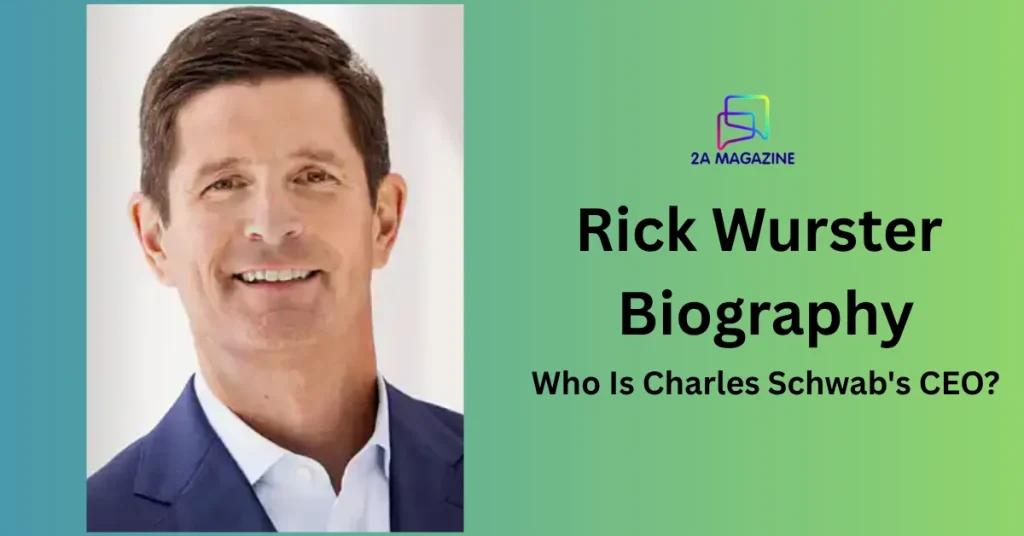
Who is Rick Wurster, and how does a kid from a four-boy household outside Boston end up running a company with more than $13 trillion in client assets? That’s the real question behind the search traffic, and the answer sits mostly in plain sight — proxy filings, an 8-K announcement, a Wall Street Journal profile Schwab later republished, and a stack of earnings-call transcripts. Almost none of it comes from tabloid digging. Wurster is not a flashy subject. He’s a numbers guy who shows up early and rarely talks about himself unless a reporter asks directly.
In brief: Richard “Rick” Wurster was born around 1972 or 1973 and grew up in Acton, Massachusetts, the second of four sons in a household where his father sold technology and his mother stayed home. He studied economics at Villanova, earned an MBA at Dartmouth’s Tuck School, and spent his early career at McKinsey and Wellington Management before joining Charles Schwab in 2016. He became President in October 2021 and was named President and CEO on January 1, 2025, succeeding longtime chief Walt Bettinger.
What He’s Said About His Own Path
Wurster doesn’t give many personal interviews, but the ones on record are consistent with each other. In the Wall Street Journal profile Schwab later republished on its own site, he described meeting his wife, Jill, during business school, calling it “the best part of business school.” That’s the closest thing to a personal, sentimental quote he’s put on record about his own life outside the office.
On the professional side, his most-quoted statement comes from the September 2024 SEC filing announcing his promotion. Reacting to being named Bettinger’s successor, Wurster said he was honored to take over and felt humbled by the confidence that Walt, Chuck, the Schwab Board of Directors, and Schwab’s employees had placed in him. It’s a boilerplate-sounding line, but it’s also the only formal statement he made at the moment his career changed for good, and it’s worth taking at face value rather than reading into it.
He’s been more expansive about the business itself. On CNBC’s Squawk Box in January 2025, days into the CEO job, he pushed back gently on the idea that Schwab only serves ordinary retail investors, noting that roughly one out of every six U.S. households with more than $20 million works with Schwab. At the Schwab Impact conference in Denver that November — his first appearance at the event as CEO — he told financial advisors the industry was behind the curve, describing what he called a “bull market for convenience” across sectors from retail to ridesharing. A month earlier, discussing the company’s slow-walked entry into crypto trading, he told analysts there was nothing on the regulatory side standing in the way, a rare moment of him addressing a delay head-on instead of deflecting it.
A short quote ledger, for anyone checking the record themselves:
- “the best part of business school” — on meeting Jill at Dartmouth — WSJ/Schwab republish, October 2024
- “one out of every six households” with $20M+ work with Schwab — CNBC, January 23, 2025
- “bull market for convenience” — Schwab Impact conference, November 2025
- “There’s nothing from a regulatory standpoint, standing in our way” — on crypto trading, RIABiz/analyst call, October 2025
None of these statements contradict each other, and none contradict what reporters independently found. That consistency is itself part of the story: Wurster comes across the same way in a boardroom filing as he does on live television.
What This Means to Him, In His Own Words
Wurster has said almost nothing about wealth, status, or the trappings of the CEO title. What he has talked about, repeatedly, is continuity and trust — Bettinger’s mentorship, Chuck Schwab’s confidence in him, and what he owes the company’s roughly 33,700 employees. He’s also brought up his competitive streak in passing, telling colleagues he treats everything from a Peloton ride to a quarterly earnings target the same way. That detail, reported by the Journal rather than stated by Wurster in a formal interview, lines up with how colleagues describe him: usually first in the office, often around 5 a.m.
The clearest window into his priorities isn’t a quote at all. According to reporting picked up by multiple outlets, Wurster once left a promising track at Wellington Management and relocated across the country so his daughter, who was born with disabilities, could get specialist care. He hasn’t turned that decision into a talking point or a leadership-book anecdote. It surfaces only because reporters covering his 2024 CEO announcement asked around and found it. That restraint says something too — a lot of executives would have worked that story into every profile since. He hasn’t.
Early Life, Family, and Education
Rick Wurster grew up in Acton, a suburb roughly 25 miles northwest of Boston. He was the second of four boys; his father worked in technology sales, and his mother managed the household. Wurster has said his parents talked often about saving for retirement — a detail that reads almost like foreshadowing given where his career ended up, though he hasn’t drawn that connection himself in anything on record. Beyond these facts, there’s little public detail about his childhood; he hasn’t given the kind of expansive, nostalgic hometown interview that some executives use to soften their public image, and no Tier 1 outlet has pushed for one.
He attended Villanova University, where he:
- Earned a bachelor’s degree in economics
- Graduated magna cum laude
- Served as captain of the golf team
That golf background wasn’t just a college activity. It later became a genuine point of connection with Schwab founder Charles “Chuck” Schwab, who is known for his own love of the sport. Colleagues have said the two bonded over rounds of golf well before Wurster was in line for the top job, and that relationship is widely credited with smoothing his path through the company’s senior ranks. Wurster now sits on the Board of Governors for First Tee, a youth golf and life-skills nonprofit, which suggests the interest has stayed with him well past his playing days rather than fading once it stopped being useful professionally.
After Villanova, he went to the Tuck School of Business at Dartmouth College for his MBA. That’s where he met Jill, who became his wife. The couple has two daughters, and by most accounts they’ve kept their family life almost entirely out of the press. There’s no confirmed public reporting on where the family currently lives beyond Wurster’s general Texas base, tied to Schwab’s headquarters move to Westlake. Secondary profile sites have speculated about the family’s day-to-day routine, but none of that speculation traces back to a named, on-record source, so it’s left out here.
Career: A Long Climb Inside a Few Firms
Wurster’s résumé is unusually linear for a Fortune 500 CEO. He didn’t jump between rival companies chasing bigger titles — he built almost his entire post-MBA career across three employers, which is part of why Schwab’s board has described his rise as a case of deliberate, organic succession rather than an outside hire brought in to shake things up.
He started at McKinsey & Company, where he became an Associate Principal and led work for asset management clients. Colleagues from that period described him as notably quiet in meetings, someone who preferred one-on-one conversations in the corner of a crowded room to speaking up in front of a group. A mentor reportedly suggested he take an acting class to build confidence; he never took to acting, but people who’ve worked with him since say he grew steadily more comfortable in front of a room over the following two decades. One secondary source, MarketScreener, lists an additional stop as Principal at Bain & Company during this period; that detail doesn’t appear in Schwab’s own biography or the Journal profile, so it’s flagged here as unconfirmed rather than repeated as fact.
From McKinsey, he moved to Wellington Management, one of the largest privately held investment firms in the world. There, he helped expand the asset-allocation team and worked on investment strategies that blended quantitative and fundamental research, building and managing products at an institutional scale rather than just advising on them from the outside. It was during this Wellington period that he made the decision to relocate for his daughter’s medical care — a choice reporters have since framed as an early, defining example of how he weighs priorities when career momentum and family need pull in different directions.
Wurster joined Charles Schwab in early 2016, initially to run two smaller asset managers the firm had just acquired: ThomasPartners and Windhaven Investment Management. From there, his path through the company looks like this:
- 2016: Joins Schwab as CEO of ThomasPartners and Windhaven Investment Management
- 2018–2021: CEO of Charles Schwab Investment Advisory (CSIA) and Charles Schwab Investment Management (CSIM); also leads Schwab Asset Management Solutions
- October 2021: Named President of The Charles Schwab Corporation, taking on client enterprises, wealth and asset management, banking, technology, and operations
- September 30, 2024: Schwab’s board announces him as Bettinger’s successor via 8-K filing
- January 1, 2025: Becomes President and CEO and joins the Board of Directors
Along the way, he picked up both the Chartered Financial Analyst (CFA) and Chartered Market Technician (CMT) designations — a dual credential that’s genuinely rare among executives at his level, since most senior leaders hold one specialty or the other, not both. It’s a detail that fits the rest of his profile: a technically grounded operator promoted from within, rather than a public-facing rainmaker brought in from outside.
What Reporters Found That Wasn’t in Any Interview
A few details about Wurster only surfaced through outside reporting rather than his own statements. Chuck Schwab himself was quoted around the CEO announcement saying Wurster is someone people trust and will follow. Walt Bettinger, in the same filing, described working alongside Wurster daily for more than eight years and credited him with a mix of intellectual honesty and personal integrity. Both statements came from people around Wurster, not from Wurster describing himself — worth noting, since self-description and colleague description aren’t the same kind of evidence, and this piece treats them differently on purpose.
Reporters have also documented that Wurster inherited a company under real pressure. Schwab’s banking arm had been losing steam for roughly two years before he took over, tied to how the Federal Reserve’s rate cycle squeezed the firm’s net interest revenue. That’s consistent with what the net worth reporting on his compensation already lays out: he was handed a fix-it job, not a victory lap, even as his pay rose alongside the promotion.
Rick Wurster’s 2026 Status
As of September 2026, Wurster remains President and CEO of Charles Schwab and sits on its board. Under his leadership so far, the company has pushed into spot Bitcoin and Ether trading, expanded its RIA custody business past $5 trillion, and reported record 2025 net revenue of $23.9 billion, up 22% year over year. He continues to make regular appearances on CNBC and at industry conferences, and his public commentary remains almost entirely tied to Schwab’s business rather than his personal life. There’s no indication in current filings or reporting that his role or family situation has changed since the CEO transition.
More on This Topic: Rick Wurster Net Worth: The Real Story Behind $18.8M CEO Pay
FAQ
Who is Rick Wurster?
He’s the President and CEO of The Charles Schwab Corporation, a role he’s held since January 1, 2025, after three years as the company’s president.
Where did Rick Wurster grow up?
In Acton, Massachusetts, a suburb of Boston, as the second of four sons.
Where did Rick Wurster go to college?
He earned a bachelor’s degree in economics from Villanova University, graduating magna cum laude, and later an MBA from the Tuck School of Business at Dartmouth.
Is Rick Wurster married?
Yes. He’s married to Jill Wurster, whom he met while studying for his MBA at Dartmouth. The couple has two daughters.
What did Rick Wurster do before Charles Schwab?
He worked at McKinsey & Company as an Associate Principal in the asset management practice, then at Wellington Management, before joining Schwab in 2016.
How did Rick Wurster become Schwab’s CEO?
Schwab’s board named him successor to longtime CEO Walt Bettinger in a September 2024 filing, and he officially took over on January 1, 2025.
Disclaimer: This biography is compiled independently from publicly available records and on-record reporting. It contains no unofficial statements from Rick Wurster, his family, or The Charles Schwab Corporation, and is neither affiliated with nor endorsed by them. Details are accurate as of September 2026; verified corrections are dated and disclosed. For informational purposes only — not investment advice.
Sources: Charles Schwab official biography (aboutschwab.com); Wall Street Journal profile, republished by Schwab, October 2024; Schwab 8-K filing, September 30, 2024; CNBC interviews, January and October 2025; RIABiz, October 2025; WealthManagement.com, November 2025; MarketScreener business leader profile.