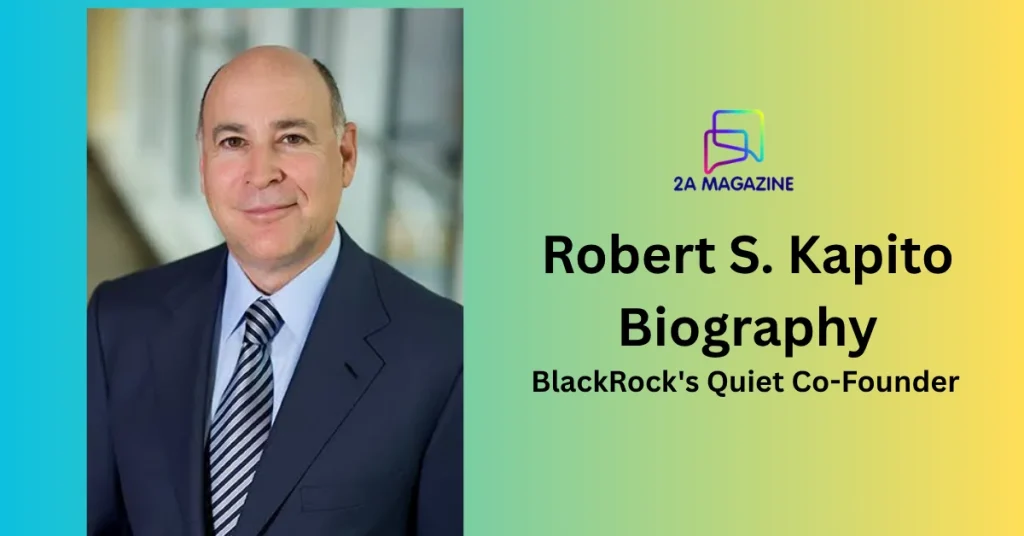
Robert S. Kapito helped build the largest money manager on earth, sits two doors down from Larry Fink, and still gets mistaken for a stranger at his own industry conferences. How does a man who co-founded a $14 trillion firm stay this unknown for nearly four decades? The answer sits in a tire shop in Monticello, New York, and in the two or three moments Robert S. Kapito has actually let reporters get close.
In brief: Robert S. Kapito was born on February 8, 1957, in Monticello, New York, to a working-class Jewish family that ran a tire and auto repair shop for fifty years. He studied at SUNY Buffalo and Wharton before earning an MBA at Harvard, joined First Boston in 1979, and co-founded BlackRock with Larry Fink and Susan Wagner in 1988. He has served as the firm’s president since 2007.
What Robert S. Kapito Has Said About His Own Life
Kapito rarely gives interviews about himself. Most of what exists on record concerns markets, inflation, or BlackRock’s business — not his childhood, his marriage, or how he spends a Saturday. The exceptions are worth more because they’re rare.
The clearest one goes back to a 2011 Institutional Investor profile, where Kapito described his father, aunt, and two brothers running the family’s Monticello tire business for half a century. Asked about it, he said plainly: “I don’t think I ever saw them with clean hands.” It’s a line he’s repeated in other settings, including a Harvard Business School commencement address, and it does more work than any polished bio paragraph could. It tells you this is a man who grew up watching labor, not capital, pay the bills.
He was thirteen when his father suffered a serious stroke. According to Kapito’s own account, his father kept working from the office anyway. His father died in 1986, not long after BlackRock’s founding was already underway; his mother died in 1997. Kapito has never elaborated much further than that in public — no memoir, no extended sit-down about grief or family. The silence itself tells you something: this isn’t a man who narrates his own hardship for effect.
The other moment that broke through wasn’t about his past at all. In March 2022, at an oil and gas industry conference in Austin, Kapito was asked about inflation and shortages. He told the room, “We have a very entitled generation that has never had to sacrifice.” Bloomberg reported the comment first; CBS News, Fortune, and The Guardian all picked it up within days. The backlash was immediate and pointed at the obvious irony — commentators noted that a BlackRock president earning tens of millions a year was lecturing younger Americans about sacrifice.
What This Means to Him, In His Own Words
Kapito has never walked the “entitled generation” comment back, and he’s never explained who exactly he meant by it. What he has been consistent about, across the handful of interviews he’s given, is a preference for talking business over biography. In a 2020 Barron’s interview about bond ETFs and retirement trends, he came across as what the reporter called a “down-to-earth executive with a logical mind” — someone who’d rather talk about the mechanics of a market than himself. Even his most quoted personal line, about never seeing his parents’ hands clean, isn’t really introspection. It’s a work ethic being stated as fact, not examined as feeling.
That pattern held into 2026. In March, speaking at a financial symposium in Melbourne, Kapito again turned a personal-adjacent moment — a room full of investors wanting his read on geopolitical risk — into pure market analysis, warning that the war in Iran could weigh on growth and push inflation higher even after fighting ends. It’s the same habit going back forty years: when the microphone is on, Kapito talks about risk, not about Robert Kapito.
What Reporters Found That Wasn’t in the Interview
A few things about Kapito only exist because journalists dug for them, not because he offered them.
- He attended SUNY Buffalo for two years before transferring to Wharton — a detail that rarely makes it into corporate bios, which tend to start the story at Penn.
- He met his wife, Ellen R. Hershey, while she was a nursing student at the University of Pennsylvania. They married in 1980 and have four children. Ellen now sits on the board of overseers at Penn’s nursing school.
- His hobbies, per a 2019 Financial Times profile, are golf, skiing, and driving restored vintage cars — a detail that sits oddly next to the tire-shop origin story, though it’s the kind of biographical footnote Kapito himself has never expanded on.
- In October 2022, Kapito was one of roughly 200 global finance executives who traveled to Hong Kong for the Global Financial Leaders’ Investment Summit. Two members of the U.S. Congress publicly questioned whether the executives should attend at all, arguing their presence legitimized the erosion of Hong Kong’s autonomy. Kapito made no public comment on the criticism.
- Fox Business and The Guardian both estimated his net worth around the time of the “entitled generation” backlash — Fox put it at “at least $485 million,” The Guardian at “about $400m.” Neither figure came from Kapito or BlackRock. He has never confirmed a personal net worth figure in public, which is consistent with a career built almost entirely around not being the story.
The Career, Start to Now
Kapito graduated Monticello High School in 1975, earned his economics degree from Wharton in 1979, and joined First Boston straight out of college in the Public Finance department. He left briefly to finish an MBA at Harvard Business School, graduating in 1983, then returned to First Boston in its Mortgage Products Group — the seat where he and a young Larry Fink helped pioneer the U.S. mortgage-backed securities market.
In 1988, Kapito, Fink, and Susan Wagner left First Boston and founded BlackRock under the Blackstone Group’s umbrella. The firm spun out independently in 1992 and grew from a fixed-income risk shop into the world’s largest asset manager. Kapito became president in 2007, a role BlackRock’s own governance filings describe as covering “day-to-day oversight” of investment strategy, client business, technology, operations, and risk analytics — including Aladdin, the platform he championed early and which now tracks tens of trillions of dollars for outside clients.
His most recent disclosed compensation, filed with the SEC in 2026 for fiscal year 2025, put his total annual pay at $31 million, up from the $21.8–25 million range reported for 2024 — the increase tied to what BlackRock’s compensation committee called a “Far Exceeds” performance rating, citing $698 billion in client net inflows during the year. None of that changes the earlier, lower 2024 figures already on record; it’s simply the next year’s number layered on top.
Family, Philanthropy, and the Parts He Keeps Private
Kapito and his wife have been married since 1980. Beyond confirming they have four children, neither has spoken publicly in any detail about family life, and no verified information exists about their children’s identities or careers. That’s a boundary Kapito appears to maintain deliberately.
His philanthropic record is easier to trace. He’s president of the board of directors for the Hope & Heroes Children’s Cancer Fund and for Periwinkle Theatre for Youth, a nonprofit arts-in-education group. He sits on the board of trustees for the New York City Police Foundation, is a former trustee of the University of Pennsylvania, and served as chairman of the UJA-Federation of New York, which awarded him its Gustave L. Levy Award in 2012 for his donations. He also holds academic ties — a Wharton School board of trustees seat, Harvard Kennedy School executive education faculty status, and a spot on Oxford’s Saïd Business School Global Leadership Council.
None of these roles get much press. They show up mostly in institutional newsletters and event write-ups, which fits the larger pattern: Kapito’s public footprint is almost entirely professional, and even that is thinner than his position would suggest.
Where Things Stand in 2026
As of September 2026, Kapito remains BlackRock’s president, a director on its board, and chairman of its Global Operating Committee. BlackRock closed 2025 with roughly $14 trillion in assets under management, and Kapito’s own compensation for that year — $31 million under the firm’s latest proxy filing — reflects the board’s view that his oversight of distribution and client relationships drove much of the firm’s growth. He continues to speak publicly on markets and macro risk, most recently on inflation and geopolitical exposure tied to the Iran conflict, but has said nothing further on record about his 2022 “entitled generation” remark or about his personal life.
More on This Topic: Robert S Kapito Net Worth: The Co-Founder Behind BlackRock’s $14 Trillion Empire — and What the SEC Filings Actually Show
Frequently Asked Questions
Is Robert S. Kapito the CEO of BlackRock?
No. Larry Fink is BlackRock’s chairman and CEO. Kapito is the firm’s president, a role he’s held since 2007, overseeing day-to-day operations across investment, client, and technology units.
Where did Robert S. Kapito grow up?
He grew up in Monticello, New York, a small town in the Catskills, where his family ran a tire and auto repair shop for fifty years.
Is Robert S. Kapito married?
Yes. He married Ellen R. Hershey in 1980, after meeting her while she was a nursing student at the University of Pennsylvania. They have four children.
What did Robert S. Kapito say that caused backlash in 2022?
At an industry conference in March 2022, he described young Americans facing inflation-driven shortages as “a very entitled generation that has never had to sacrifice,” a comment widely criticized given his own compensation.
What is Robert S. Kapito’s educational background?
He attended SUNY Buffalo for two years before transferring to the Wharton School at the University of Pennsylvania, graduating in 1979. He earned an MBA from Harvard Business School in 1983.
How did Robert S. Kapito and Larry Fink meet?
They worked together at First Boston in the early 1980s, where they helped pioneer the mortgage-backed securities market before leaving in 1988 to co-found BlackRock with Susan Wagner.
Disclaimer: These details reflect what Kapito has placed on the public record — filings, rare interviews, verified coverage — not confirmed statements from him or his family, and the gaps are intentional.
Sources: Institutional Investor (2011 profile); Bloomberg News (2022, 2026); CBS News; Fortune; The Guardian; Financial Times (2019); Barron’s (2020 interview); BlackRock corporate leadership page; BlackRock SEC proxy filings (2025–2026); Wikipedia biographical entry, cross-checked against primary sources above.