To walk through Rome is to navigate a living palimpsest, a city where the structural layers of the Republic, the Empire, the Renaissance, and the Baroque are not merely preserved but lived in. For the discerning traveler, the aesthetic beauty of the capital is inseparable from its sensory output. There is a profound, often overlooked, relationship between the architecture of Rome’s historic Rioni (districts) and the flavors that emerge from their kitchens Architecture of Taste.
In 2026, the concept of “cultural immersion” has evolved: it is no longer enough to admire a facade or taste a recipe in isolation. To truly understand the Genius Loci of Rome, one must decode how the city’s physical form—its narrow alleys, grand piazzas, and repurposed industrial spaces—has dictated its gastronomic heritage.
The Rioni Framework: A Palimpsest of Stone and Flavor
The division of Rome into Rioni is more than an administrative convenience: it is a map of distinct identities. Each district possesses a specific architectural language that has influenced how people gather, trade, and eat. From the towering travertine of the center to the humble brickwork of the periphery, the urban fabric creates a stage for culinary rituals. Exploring these layers requires a strategic eye, and many visitors find that participating in the best food tours in Rome allows them to synchronize their visual appreciation of the city with the authentic flavors that defined these neighborhoods for centuries. This synthesis of sight and taste is what transforms a simple visit into a deep cultural inquiry Architecture of Taste.
Trastevere: Where Medieval Vernacular Meets the Hearth
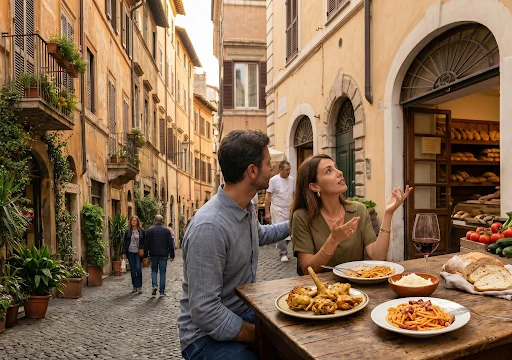
Across the Tiber, the Rione of Trastevere offers a masterclass in medieval urbanism. Its labyrinthine streets, characterized by irregular proportions and ivy-draped ochre walls, created a secluded environment where local traditions could simmer undisturbed by the grand theatricality of the Vatican or the Forums. Here, the architecture is intimate. The small, crowded squares functioned as communal dining rooms, giving rise to a culinary style that is bold, rustic, and unapologetically local.
The verticality of the buildings and the density of the streetscape encouraged a street-level economy of small bakeries (forni) and taverns. In Trastevere, the stone itself seems to hold the aroma of Pecorino Romano and guanciale. Understanding the transition from the Byzantine mosaics of Santa Maria in Trastevere to the humble trattorias nearby is essential for anyone seeking the “authentic” Rome that exists beneath the tourist veneer Architecture of Taste.
Testaccio: The Industrial Alchemy of the “Quinto Quarto”
Moving south toward Testaccio, the architectural narrative shifts from the medieval to the industrial and classical. This district, centered around Monte dei Cocci—an ancient hill made entirely of discarded Roman amphorae—represents the city’s historical logistics hub. The late 19th-century architecture of the Ex-Mattatoio (the former slaughterhouse) is a monument to functionalism, with its clean lines and expansive iron structures.
This specific industrial environment gave birth to the “Quinto Quarto” (the fifth quarter) culinary tradition. The workers were often paid in offal, leading to the creation of Rome’s most sophisticated and complex meat dishes, such as coda alla vaccinara. The juxtaposition of the rigid, grid-like street planning of Testaccio with the creative, resourceful nature of its cuisine is a testament to the Roman ability to find beauty and flavor in utility.
The Roman Ghetto: Renaissance Order and Culinary Resilience
The Jewish Ghetto is perhaps the most poignant example of how architectural restriction can lead to culinary genius. Defined by the soaring columns of the Portico d’Ottavia and the elegant Fontana delle Tartarughe, this small enclave is a dense concentration of history. The forced confinement of the community within a limited urban space led to a highly specialized culinary evolution, where local ingredients were transformed through innovative techniques like deep-frying.
The Carciofo alla Giudìa is not just a dish: it is a reflection of a resilient culture thriving within a Renaissance architectural frame. The dialogue between the ancient Roman ruins and the kosher-Roman menus creates an atmosphere that is unique in the world, proving that geography and urban limits are often the primary ingredients of innovation.
Curating the Roman Journey: The Intersection of Sight and Senses
As travel becomes increasingly personalized, the demand for experiences that bridge the gap between art history and local lifestyle continues to grow. For those who prioritize exclusivity and architectural depth, opting for private tours in Rome by Doooing offers a way to bypass the standardized tourist path. These bespoke itineraries allow for a slower, more contemplative exploration of the city’s secret courtyards, private palaces, and hidden artisanal workshops.
The modern “Grand Tour” is about recognizing these connections—seeing the link between a Baroque dome and the refinement of a seasonal tasting menu. By focusing on the Rioni as distinct architectural and culinary ecosystems, travelers can move beyond the surface of the “Eternal City.” Whether it is the brick-lined cellars of a suburban vineyard or the marble-clad dining rooms of the historic center, the architecture of Rome remains the ultimate ingredient in its timeless appeal. The city invites us to look closer, to linger longer in its piazzas, and to recognize that every stone has a story, and every story eventually finds its way to the table Architecture of Taste.
Stop scrolling. This is the one you actually need at 2A Magazine.