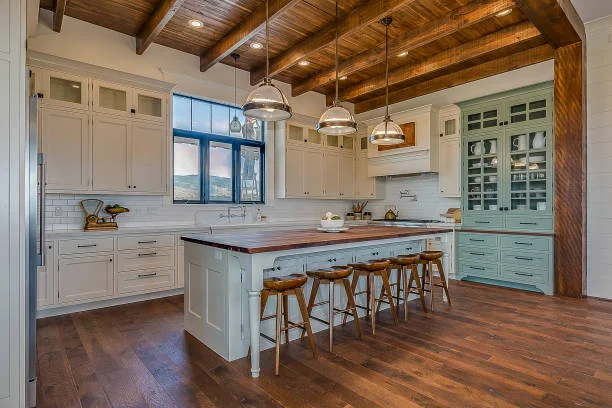
A kitchen that performs beautifully in a suburban house can start falling apart in a lakeside cottage within three or four seasons. Doors stop closing flush. Hairline gaps open along drawer fronts. Hinges bloom with rust in a building nobody would call damp. The usual assumption is a sloppy install, and that is almost never what happened. The cabinetry was specified for a house that holds a steady temperature all year, and a seasonal property does nothing of the sort. A few decisions made early determine whether a cottage kitchen still looks right a decade on.
The Real Problem Is Movement, Not Water
Wood constantly trades moisture with the air around it. As a rough rule, it changes about one percent in width for every four percent shift in relative humidity, and nearly all of that movement happens across the grain rather than along it. A cottage closed up in October sits through months of bone dry winter air, then absorbs a humid spring before anyone opens the door: a full expansion and contraction cycle every year, unsupervised. Keeping indoor air in the 30 to 50 percent range keeps timber dimensionally stable and discourages mould at the same time, which is why a small dehumidifier on a timer does more for cabinetry than most upgrades you could buy.
Box Materials Do the Quiet Work
The carcass is the part nobody sees and the part that fails first. Furniture grade plywood with balanced veneer layers handles humidity swings far better than particleboard, which swells once it takes on water and never recovers its thickness. Raw MDF is worse still at floor level, where spring melt and a stray dishwasher leak are real risks in older shoreline buildings. Whatever the material, insist that every cut edge is sealed, including the ones facing the wall.
Door Construction Beats Door Style
People agonise over shaker versus slab and skip the question that matters, which is how the door is built. A five piece door with a floating centre panel gives the panel room to expand and contract inside its frame without splitting the joints. A solid wood slab has nowhere to go and will eventually cup, while a slab on an engineered core with veneer on both faces stays flat. Cottage country changes the calculus in ways a city showroom rarely accounts for, and the kitchen cabinetry Muskoka projects call for usually starts with a stable box and a floating panel, then works outward to finish and colour. Finish all six sides of every door. An unfinished back absorbs moisture at a different rate than the front, and the door warps toward the drier side.
Hardware Takes More Abuse Than You Think
Inland lakes carry no salt load, but sustained summer humidity plus wet hands plus swimsuits draped over a chair back adds up. Stainless or coated hinges and drawer slides are worth the modest upcharge, and soft close mechanisms with a metal body outlast plastic ones in a building that goes through freeze cycles. Matte and lightly textured finishes are far more forgiving than high gloss, which shows every fingerprint, every fleck of sand, and the grey dust that settles over a closed up building all winter.
Design for the August Crowd
Cottage kitchens sit empty for nine months and then host fourteen people for a long weekend, a completely different brief from a household of two. Two separate prep zones prevent the traffic jam at the sink. Deep drawers beat lower cabinets for pot storage when several people are cooking at once. A beverage fridge outside the main work triangle keeps guests from crossing in front of the stove. One open shelf of everyday plates means visitors stop asking where things live. None of this costs more than the conventional layout. It just means designing for the busy week.
Knowing When Not to Replace
Plenty of cottage kitchens have sound boxes and tired doors, and there is real value in updating what already works instead of gutting the room. New fronts, better hardware, and a reworked drawer layout buy another fifteen years. The honest test is the carcass. Pull out a lower drawer and press the bottom corner of the box. If it flexes, sheds granules, or shows a swollen seam, the structure is done and no door upgrade will fix it.
The pattern behind all of this is the same. Seasonal buildings move, and cabinetry either accommodates that movement or fights it and loses. Specify a stable box, build doors that can breathe, seal every surface, choose hardware that tolerates dampness, and plan the layout around the weekend when the place is full. Do that and a cottage kitchen ages the way the building around it does, instead of announcing its age three summers in.