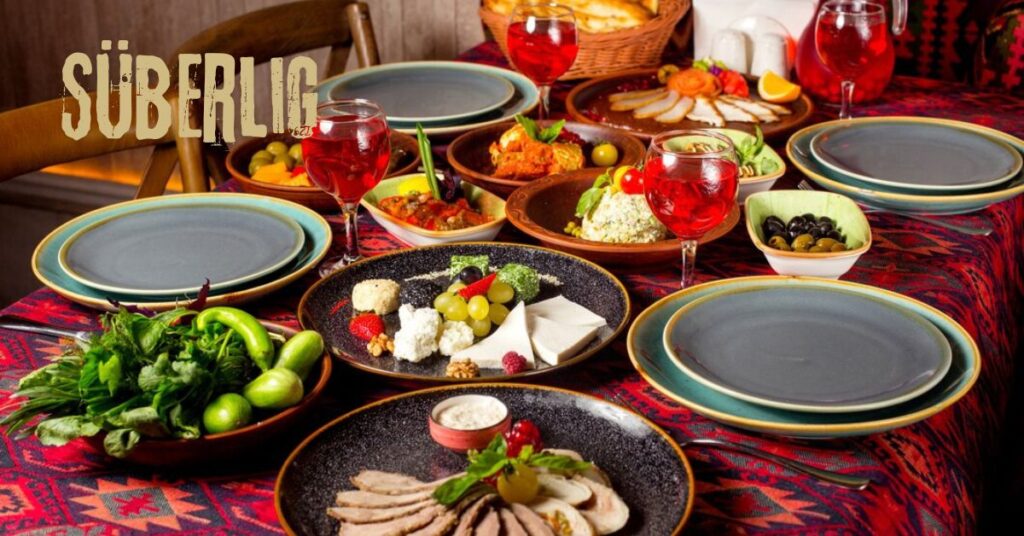
Picture this: you’re sitting at a communal table somewhere in Central Anatolia. The meal isn’t rushed. The conversation flows. And there’s an unspoken rhythm to how food, time, and people are shared — no phones, no hurry, just presence. That rhythm has a name. It’s called Süberlig.
Most people outside Turkic cultural circles have never heard of it. But in 2026, that’s starting to change — and for very good reasons.
What Exactly Is Süberlig?
At its core, Süberlig is a Turkic cultural concept describing the practice of fluid communal sharing — of meals, stories, skills, or resources — within a trusted group. The word itself comes from two Old Turkic roots: süber, meaning to flow or glide naturally, and -lig, a suffix denoting a place, state, or ongoing practice.
Think of it as the Turkic cousin of the Danish concept of hygge — but with a stronger emphasis on active giving rather than passive coziness. Where hygge is about atmosphere, Süberlig is about motion. The flowing act of passing something — bread, knowledge, care — from one person to another without expectation of return.
It’s not a ceremony. It’s not a ritual with fixed rules. It’s more of a social posture — a way of moving through shared spaces that prioritizes generosity and ease over transaction or formality.
The Cultural Roots Behind the Concept
Süberlig traces its deepest roots to the nomadic Turkic peoples of Central Asia, where survival depended on collective cooperation. Sharing resources wasn’t optional — it was structural. Over centuries, as Turkic cultures settled across Anatolia, the Caucasus, and parts of the Balkans, Süberlig evolved from a survival behavior into a cultural value.
Historians who study Turkic social anthropology have noted that many traditional Anatolian hospitality customs — like offering tea before any conversation begins, or insisting a guest eat before leaving — are surface expressions of this deeper Süberlig logic.
“Generosity in Turkic cultures was never performative,” notes cultural anthropologist Dr. Leyla Arslan in her 2024 research on shared-living traditions across the Middle East and Central Asia. “It was functional, rhythmic, and deeply embedded in how communities understood trust.”
That’s Süberlig in practice — trust made visible through flow.
How Süberlig Shows Up in Everyday Life
You don’t need to be in Turkey or Kazakhstan to recognize Süberlig once you know what you’re looking for. Here are some of the ways it naturally surfaces:
- At the dinner table: Dishes are passed before asked for. No one waits to be served — food circulates like a conversation.
- In craft communities: A skilled weaver teaches a neighbor not through formal lessons but through side-by-side working — knowledge flows without a curriculum.
- In grief or celebration: Community members show up with food, labor, or time without being invited. The act itself is the invitation.
- In marketplaces: Traditional bazaar vendors in Anatolian towns still practice a form of Süberlig — offering tea, a sample, or a story before any sale is discussed.
What unites all of these? Nothing is demanded. Nothing is formally arranged. The giving flows — and that flow is the whole point.
Why Süberlig Is Gaining Attention in 2026
There’s a reason this concept is getting renewed interest right now. Modern life has become almost aggressively transactional. Every interaction — digital or physical — is optimized, tracked, and monetized. People are exhausted by it.
Concepts like Süberlig offer an alternative framework. Not a productivity hack. Not a wellness trend with a subscription fee. Just a quiet, human-scale way of being in community that actually works.
According to a 2025 report by the OECD on social trust and wellbeing, communities with higher rates of informal mutual aid — exactly the kind Süberlig describes — consistently score higher on life satisfaction and lower on social anxiety. The data backs up what Turkic cultures have quietly practiced for centuries.
Social researchers in Europe are now drawing explicit comparisons between Süberlig and emerging concepts in communitarianism and gift economy theory. And in Turkey itself, a new wave of urban designers and neighborhood organizers are actively using the word to describe the kind of social infrastructure they want to build.
Süberlig vs. Similar Concepts: What Makes It Different?
People often compare Süberlig to other cultural wellness concepts. Here’s how it stands apart:
| Concept | Origin | Core Idea | Key Difference from Süberlig |
|---|---|---|---|
| Hygge | Danish | Cozy togetherness | Passive, atmosphere-focused |
| Ubuntu | Zulu/African | “I am because we are” | Philosophical identity concept |
| Ikigai | Japanese | Purpose and reason for being | Individual, not communal |
| Frith | Old Norse | Peace within a group | Protective, not generative |
Süberlig is distinctly kinetic. It’s not about being together — it’s about what moves between people when they are.
Who Should Care About Süberlig?
Honestly? Almost everyone working in fields that touch human connection.
Community designers and urban planners are finding Süberlig a useful design principle — building shared kitchens, libraries of things, and informal gathering spaces that encourage fluid exchange rather than structured programming.
Educators who’ve grown frustrated with transactional learning environments are exploring Süberlig-inspired pedagogy — where knowledge moves peer-to-peer, organically, without rigid hierarchy.
Mental health professionals point to the isolation epidemic, particularly among young adults, and argue that rebuilding the kind of low-key communal flow that Süberlig describes could be one of the most underrated interventions available.
And for regular people? Süberlig is simply a reminder that some of the most meaningful things in life don’t require an app, a plan, or a purchase. They just require showing up — and letting things flow.
The Future of Süberlig as a Global Idea
It’s worth noting that concepts like this rarely travel well without distortion. Hygge, for instance, got commercialized into scented candles and cashmere socks within a decade of going global. There’s a real risk Süberlig faces the same fate — becoming an aesthetic rather than a practice.
But the Turkic cultural community seems aware of this. Academics, artists, and community organizers are actively working to keep Süberlig grounded in its original meaning: not a vibe, but a verb. Not something you buy, but something you do — continuously, quietly, in the direction of others.
As of 2026, Süberlig is at an interesting crossroads. It’s gaining visibility. Whether that visibility deepens its roots or dilutes them depends largely on how the people who adopt the concept choose to live it.
Conclusion
Süberlig isn’t a trend you scroll past. It’s a centuries-old practice disguised as a simple idea — that generosity, when it flows naturally and without performance, builds something durable. In a world running low on trust and high on transactions, that’s not a small thing.
The next time something passes effortlessly between you and someone else — a meal, a skill, a moment of genuine presence — you’re already practicing it. You just now have a word for it.
FAQs
Q1: How do you pronounce Süberlig?
It’s pronounced roughly “SUE-behr-lig” — the ü sounds like the French u or German ü, a rounded front vowel. In Turkish, it flows naturally off the tongue.
Q2: Is Süberlig a formal cultural institution or an informal practice?
It’s entirely informal. There’s no organization, governing body, or certification. It’s a social disposition — a way of relating — not a structured program.
Q3: Can people outside Turkic cultures practice Süberlig?
Absolutely. The concept is culturally rooted but universally applicable. Many non-Turkic cultures have parallel practices; Süberlig just gives one very specific articulation of them a name.
Q4: Is Süberlig connected to any religion or spiritual practice?
While Anatolian Islamic hospitality traditions share some surface similarities, Süberlig itself is a cultural and social concept — not religiously defined. It predates the Islamization of many Turkic peoples and exists independently of religious identity.
Q5: How is Süberlig’s different from simple generosity?
Great question. Ordinary generosity is an act. Süberlig is a pattern of acts — continuous, mutual, and non-transactional. It’s less about giving once and more about maintaining a permanent orientation of open-handed flow within a community.