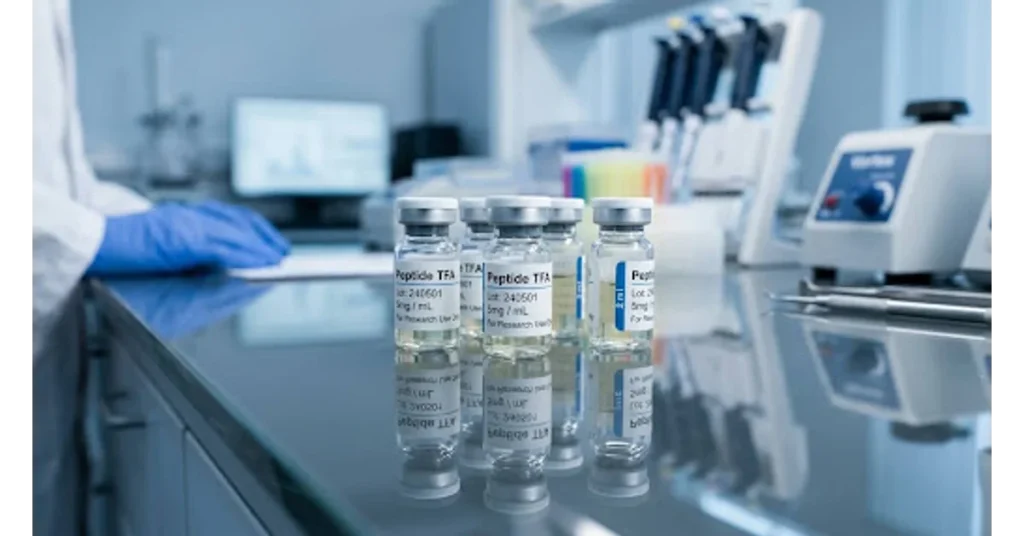
Few compounds have reshaped metabolic research conversations as quickly as GLP-1 receptor agonists, and the semaglutide research peptide sits at the center of that shift. For laboratories studying energy balance, glucose regulation, and receptor signaling, semaglutide has become a reference point: a well-characterized peptide analog with a long list of published preclinical work behind it. This overview walks through what the molecule is, the pathway it acts on, why it draws so much interest, and the practical side of working with research-grade material.
Everything here is framed for laboratory and research use. It is not medical guidance, and it contains no human dosing information.
What Semaglutide Actually Is?
Semaglutide is a synthetic analog of glucagon-like peptide-1 (GLP-1), a hormone the gut releases in response to food intake. The native hormone is a small peptide that breaks down within minutes in the body, which makes it awkward to study directly. Semaglutide was engineered to solve that problem. Its sequence is modified at a few key positions, and it carries a fatty acid chain that lets it bind albumin in circulation. Those changes slow enzymatic degradation and extend the molecule’s half-life dramatically compared to native GLP-1.
The result is a peptide that behaves as a GLP-1 receptor agonist: it binds and activates the same receptor the natural hormone targets, but it persists far longer. That stability is a big part of why it is useful as a research tool. A compound that stays intact through an experiment is easier to dose consistently and interpret than one that vanishes before measurements can be taken.
The GLP-1 Pathway in Metabolic Research
The GLP-1 receptor is expressed in the pancreas, the gut, the central nervous system, and several other tissues. When activated, it triggers a signaling cascade that researchers study from multiple angles.
In pancreatic beta cells, receptor activation is associated with glucose-dependent insulin secretion, meaning the response scales with circulating glucose rather than firing indiscriminately. This glucose-dependence is one reason the pathway attracts so much attention in models of glucose regulation. In the brain, GLP-1 receptors in regions tied to appetite and reward have been a focus of studies on food intake and energy expenditure in animal models. The pathway also intersects with gastric emptying and with signaling in cardiovascular and neural tissue, which has widened the range of research questions people bring to it.
Because a single receptor connects to so many downstream effects, semaglutide is often used as a probe: a way to switch the GLP-1 pathway on in a controlled, sustained manner and observe what happens across a system. That versatility is what has kept it in circulation across metabolic, neurological, and cell-signaling studies.
Why the Semaglutide Research Peptide Draws Interest?
Part of the appeal is simply pharmacokinetic. The extended half-life means researchers can maintain receptor engagement without constant redosing, which simplifies study design. Part of it is characterization: semaglutide has been examined extensively in preclinical settings, so new work can build on an established base rather than starting from scratch.
There is also the breadth of biology. Studies in animal models have looked at the GLP-1 axis in the context of body weight regulation, glucose handling, feeding behavior, and more recently signaling in tissues outside the classic metabolic organs. For a research program, a compound that reliably activates a pathway with this many connection points is a practical starting tool. None of this implies a human application, and in a laboratory context the value is the clean, durable receptor activation the peptide provides.
Forms Supplied for Research
Research-grade semaglutide is almost always supplied as a lyophilized powder, sealed in a vial. Lyophilization (freeze-drying) removes water and leaves a stable solid that tolerates shipping and storage far better than a solution would. Vials are typically labeled by peptide mass in milligrams, and the powder may appear as a small pellet or a thin film at the bottom of the vial. A very small quantity is normal; peptides are potent by mass, so a milligram-scale vial is expected.
The powder is not ready to use as shipped. It has to be brought into solution before it can be handled in most experimental setups, which is where reconstitution comes in.
General Research Handling
Reconstitution of a lyophilized peptide is straightforward but worth doing carefully. Bacteriostatic water, which contains a small amount of benzyl alcohol to inhibit microbial growth, is a common choice for dissolving research peptides intended for multi-day handling. The diluent is added slowly against the inside wall of the vial rather than injected directly onto the powder, and the vial is swirled gently rather than shaken. Foaming and hard agitation can stress a peptide, so patience during mixing matters.
Storage is the other half of stability. As a dry lyophilized powder, semaglutide is generally stored cold, and long-term storage in a freezer is typical for material that will not be used soon. Once reconstituted, the solution belongs in a refrigerator and is best used within a limited window, since peptides in solution are less stable than in their dry state. Repeated freeze-thaw cycles are worth avoiding because each cycle can degrade peptide integrity; aliquoting a reconstituted stock into single-use portions is a common way to sidestep that problem.
GLP-1 analogs like semaglutide are relatively stable compared to some smaller, more fragile peptides, thanks in part to the structural modifications that resist enzymatic breakdown. That said, “more stable” is not “indestructible.” Light, heat, and extended time in solution all work against a peptide, so the general principles hold: keep it cold, keep it dark, minimize time at room temperature, and limit freeze-thaw exposure.
A short handling checklist:
- Store the sealed lyophilized vial cold; freeze for long-term storage.
- Reconstitute with bacteriostatic water, adding diluent slowly down the vial wall.
- Swirl gently to dissolve; avoid shaking or foaming.
- Refrigerate the reconstituted solution and use within a limited window.
- Aliquot to avoid repeated freeze-thaw cycles.
Quality Markers for Research-Grade Material
Not all material labeled the same way is equivalent, and the quality markers are where a careful buyer separates usable stock from a question mark. The first is purity, usually reported as a percentage and typically verified by high-performance liquid chromatography (HPLC). Research work generally looks for high purity, since impurities and truncated sequences can confound results.
The second is a certificate of analysis (COA). A COA documents the batch’s identity and purity and often includes the analytical methods used, such as HPLC for purity and mass spectrometry to confirm the peptide’s molecular weight matches the expected sequence. A COA tied to the specific lot you receive is more meaningful than a generic document.
Third is independent verification. Third-party testing, where an outside lab confirms the supplier’s claims, adds a layer of confidence that the numbers on the COA reflect what is actually in the vial. Together, purity data, a lot-specific COA, and third-party confirmation form the practical checklist for evaluating research-grade semaglutide. Consistent labeling, proper vial sealing, and clear batch tracking round out the picture.
Frequently Asked Questions
Q. What is semaglutide in research terms?
It is a synthetic GLP-1 receptor agonist peptide, an engineered analog of the gut hormone GLP-1 modified for greater stability and a longer half-life. In the lab it is used to activate the GLP-1 pathway in a sustained, controlled way.
Q. How is the semaglutide research peptide supplied?
Typically as a lyophilized (freeze-dried) powder in a sealed vial, labeled by peptide mass in milligrams. It is reconstituted with a suitable diluent before use.
Q. What is used to reconstitute semaglutide for research?
Bacteriostatic water is a common diluent for research peptides handled over several days, added slowly and mixed gently to preserve peptide integrity.
Q. How should reconstituted semaglutide be stored?
Keep the solution refrigerated and use it within a limited window. Store the dry powder cold or frozen, and aliquot reconstituted material to avoid repeated freeze-thaw cycles.
A Note on Use
The information above and any semaglutide referenced are intended strictly for laboratory and research purposes only, and are not for human consumption or medical use.
Related Reading
For more on this compound class, see our overviews on Semaglutide vs Tirzepatide, the Tirzepatide research overview, and the practical guide on How to reconstitute research peptides.