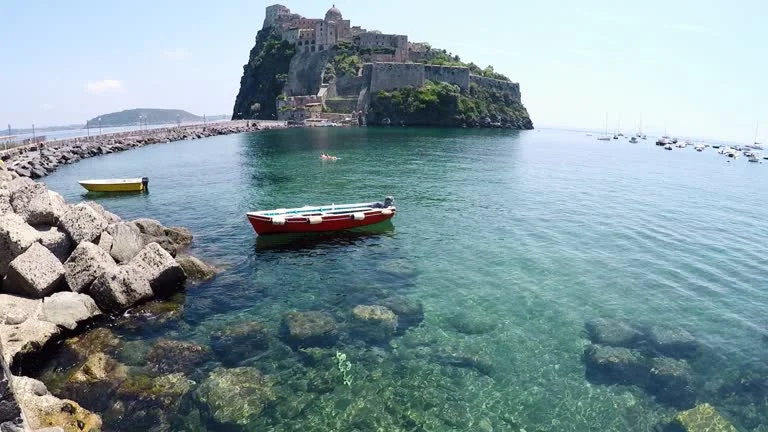
Ischia is the largest island in the Gulf of Naples and, despite its size and the quality of what it offers, probably the least internationally known of the Campanian islands. Famous primarily for its thermal springs and its distinguished history of thermal tourism, it offers something that neither Capri nor Procida can match: extraordinary coastal variety. An Ischia boat charter is the most direct way to understand what makes this island genuinely different and to access the parts of it that land-based visitors simply cannot reach.
The island that reveals itself from the sea
Someone who knows Ischia only from the land knows its thermal parks, its towns, its hilltop villages and its road system. Someone who knows it from the sea sees something else: the volcanic profile of Monte Epomeo dominating the interior, the way the different geological characters of the coastline lava rock, sandy beaches, limestone cliffs, thermal vents visible in the shallows alternate over short distances, the complete picture of the island’s topography that only a circumnavigation by boat makes legible.
The sea-level perspective on Ischia is also the perspective from which the island’s most dramatic features are most visible. The dark volcanic rock of the northern coast, the Aragonese Castle rising from its tidal islet off the eastern shore, the dramatic cliff face that falls directly into the sea on the western side of the island: these are Ischia at its most visually powerful, and they are best seen from a boat a hundred metres offshore, where the full scale of the landscape becomes apparent.
The coastal highlights of an Ischia boat charter
Spiaggia dei Maronti
The longest beach on the island, accessible from the land only by a long road or by the taxi boats that operate from Sant’Angelo. By private charter, you arrive directly, anchor in shallow water of notable clarity, and step off the vessel onto a beach that is far less crowded in the morning hours before the taxi boats begin their runs. The thermal vents that emerge through the black sand in certain sections of the beach producing warm water that mixes visibly with the cooler sea are one of Ischia’s most distinctive natural features and are most easily experienced from the water.
The Aragonese Castle
Seen from the sea, the Aragonese Castle of Ischia is one of the most dramatic images in the Gulf of Naples: a medieval fortress on a volcanic rock, connected to the main island by a narrow stone bridge, rising steeply from the water on all sides. The interior is open to visitors and worth considerable time, but the exterior the walls, the towers, the sheer rock face they emerge from is seen in its full extent only from a boat circling the islet. At dawn and at dusk, when the light is low and the shadow pattern across the walls changes rapidly, the approach by sea is genuinely memorable.
The western coast: coves and clear water
The western and south-western coast of Ischia is the least developed and most dramatically beautiful section of the island’s coastline. A series of small inlets and coves some with small beaches at their base, others closing in sheer walls of dark rock that drop directly into deep, translucent water are accessible only by sea and visited by relatively few boats even in the height of summer. These are the places that justify an early departure and a full day on the water.
Combining Ischia and Procida in a single day
Procida, separated from Ischia by a channel of less than four kilometres, offers one of the most distinctive urban landscapes in the Mediterranean: compact, colourful, built in layers above a working harbour that has changed relatively little over centuries. The fishing port of Corricella a semicircle of painted buildings reflected in the harbour water is among the most photographed scenes in southern Italy, and from the sea, arriving by private boat with the buildings directly ahead and their reflections below, the image is even more vivid than the photographs suggest.
A charter itinerary that combines Ischia and Procida uses the proximity of the two islands intelligently: a morning on Ischia’s coastline for the sea caves and the thermal beach, a midday crossing to Corricella for lunch at a harbour-side restaurant approached by dinghy, an afternoon on Procida for the clarity of the water on the island’s southern side, and an early evening return. The two islands offer such different characters that experiencing them on the same day creates a contrast that highlights what is distinctive about each.
When to go and how to plan ahead
Ischia’s waters are navigable and pleasant from May through October, with the optimal window for most guests falling in June, early July, September, and October. July and August offer the warmest water and the longest days, but also the highest concentration of vessels in the most popular anchorages and the strongest competition for mooring in the smaller ports. June and September provide conditions that are nearly as good in terms of weather and sea temperature, with meaningfully lower density of tourist traffic on the water.
Booking in advance is important for specific high-demand dates throughout the season, and becomes essential during July and August for any vessel above basic specification. The best charter experiences in this area are rarely assembled at short notice during peak season: the boats and crews that deliver consistently good results are booked weeks or months ahead by guests who have understood that the planning investment is repaid many times over in the quality of the experience itself.