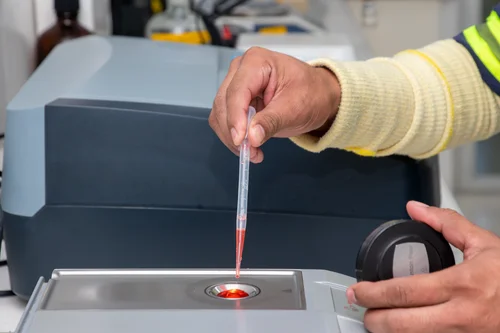
What Is Incoming Raw Material Testing?
Incoming raw material and supplier verification testing is independent lab analysis performed on a material or component before it enters production, to confirm it actually matches what the supplier’s paperwork says it is. A Certificate of Analysis from a supplier states what a batch should be. Independent testing confirms what it actually is. Those aren’t always the same thing, and the gap between them is exactly what this kind of testing exists to catch.
Why Isn’t a Supplier’s Certificate of Analysis Enough?
A Certificate of Analysis is a valuable document, but it’s still a claim made by the party selling the material, not an independent finding. A supplier can be reliable for years and still ship an off-spec lot due to a process upset, a raw material substitution further up their own supply chain, or a simple documentation error. Relying entirely on paperwork means a manufacturer only finds out about a problem after it’s already caused scrap, rework, or a customer complaint.
This is also why regulators increasingly expect independent verification rather than acceptance of supplier documentation alone, particularly for materials where identity or purity errors carry real downstream risk.
The risk grows further with suppliers overseas. International suppliers, particularly in a competitive, price-driven global market, can choose to cut corners or quietly switch to a lower-quality raw material source in hopes of protecting or raising their own margins. Distance and limited oversight make that kind of substitution easy to make and hard to catch from the buyer’s side, and the manufacturer’s product quality is what ultimately pays the price for it.
What Does This Testing Actually Check?
The specific tests depend on the material, but incoming verification testing commonly includes:
- Identity confirmation, using techniques like infrared spectroscopy (FTIR) to confirm a material is chemically what it’s labeled as
- Elemental and alloy composition analysis for metals, using methods like Optical Emission Spectroscopy (OES) or ICP-MS to confirm the specific alloy or purity
- Chemical composition and impurity testing using Gas Chromatography-Mass Spectrometry (GC-MS), for identifying and quantifying organic compounds in a material
- Nuclear Magnetic Resonance (NMR) analysis, useful for confirming a unique product’s chemical signature and catching batch-to-batch consistency issues a supplier’s paperwork wouldn’t reveal
- Contaminant and impurity screening, including heavy metals and other elemental impurities
- Microbial testing, for materials where bioburden is a risk
- Physical and mechanical property testing, depending on the application
The right combination comes down to what the material is and what’s actually at risk if it’s wrong.
Who Needs Supplier Verification Testing?
This kind of independent laboratory testing shows up across general manufacturing, metals and alloy production, electronics and semiconductor components, food and beverage ingredients, chemical and materials processing, and pharmaceutical raw materials. It tends to matter most for materials that are high-risk by nature: expensive to replace, safety-critical, subject to regulatory scrutiny, or coming from a newer or less-established supplier relationship.
How Industrial Analytical Services, Inc. Approaches It
Industrial Analytical Services, Inc., an independent third-party laboratory, performs incoming raw material and supplier verification testing using identity confirmation, elemental and alloy analysis, chemical composition testing, NMR signature analysis, contaminant screening, and more, tailored to the specific material and risk in question. Samples can be submitted directly, without a long quoting process or an account requirement, and results come from the same chemists running the analysis.
That expertise is included and available as consultation when results raise a question, whether that’s helping a client interpret an out-of-spec finding, decide whether a lot should be rejected, or think through what kind of ongoing testing makes sense for a given supplier relationship. For any company evaluating a new supplier, bringing on a higher-risk material, or simply looking to catch a bad batch before it reaches the production line, independent verification is often the cheapest insurance available against a much larger downstream cost.