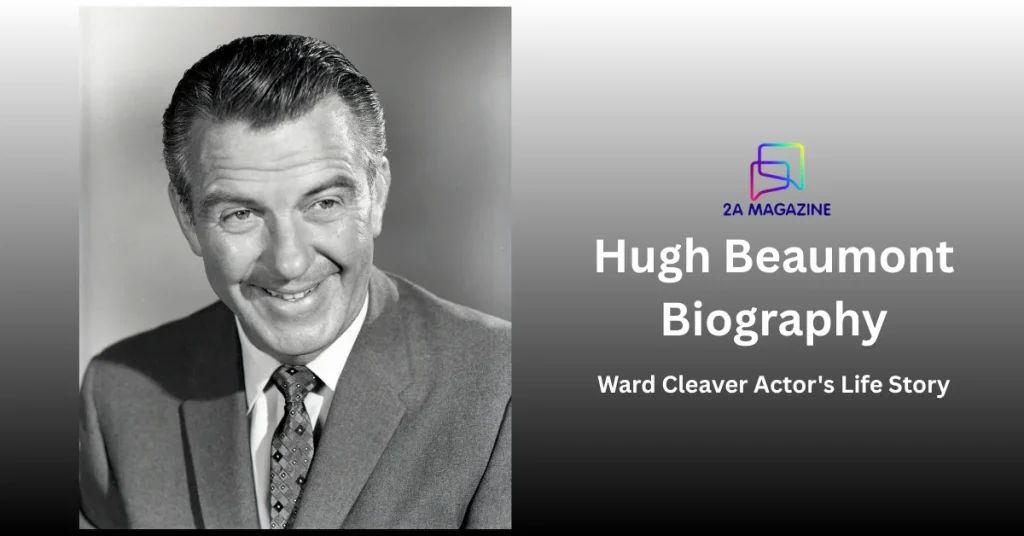
Why did Hugh Beaumont, TV’s most trusted father, turn down work that paid well? The answer starts in a church, not a studio. He played Ward Cleaver for six seasons. Yet he saw himself as a man of faith first and an actor second.
In brief: Hugh Beaumont was born Eugene Hugh Beaumont on February 16 in Kansas, in 1909 by most records. He studied theology at USC and worked as an actor from 1931. He starred as Ward Cleaver in Leave It to Beaver from 1957 to 1963. He later farmed Christmas trees in Minnesota, survived a stroke, and died in Munich on May 14, 1982. This profile follows his life step by step and marks every disputed date.
Hugh Beaumont Early Life and Family Background
Eugene Hugh Beaumont was born on February 16 in Kansas. The year is disputed. IMDb and the Kansas Historical Society say 1909, while Wikipedia says 1910.
That gap explains why his age at death appears as 72 or 73. His birthplace has two versions as well. Most records say Lawrence, but some accounts say Eudora, a town a few miles away.
No primary document we’ve seen settles either question. So this profile uses 1909 and Lawrence as the working answer. It flags both disputes wherever they matter.
His father, Edward H. Beaumont, worked as a traveling salesman. The job kept the family on the move through Hugh’s childhood. He grew up in several places before Tennessee became the base for his school years.
Hugh Beaumont Education and Ministry Training
Hugh Beaumont attended the Baylor School in Chattanooga, Tennessee. He graduated in the class of 1930. Then he played football at the University of Chattanooga.
He left the university when his place on the team changed. Next he went to the University of Southern California. There he earned a Master of Theology degree in 1946.
That degree mattered more than any film credit. Several accounts call him an ordained Methodist minister. Wikipedia describes him as a lay minister, and other profiles say he was licensed to preach.
The label varies, but the commitment doesn’t. He kept his ministry alongside his Hollywood work. It guided the jobs he accepted and the ones he refused.
Hugh Beaumont During World War II
Beaumont’s faith guided his wartime choices too. He was a conscientious objector. Yet he still served, working as an Army medic, according to Wikipedia and a 2016 tribute by his co-star Jerry Mathers.
Meanwhile, historians of mid-century film note he often inherited roles from better-known actors who left for military service. Working actors of that era took whatever parts came along. Beaumont fit that pattern in his early years.
Hugh Beaumont Career Before Leave It to Beaver
Hugh Beaumont entered show business in 1931. He worked in theaters, nightclubs and radio. He began acting in motion pictures in 1940.
Early parts were small, and many went uncredited. Over his film years he appeared in more than 30 pictures. Most were B-movies.
His biggest film run came in 1946 and 1947. He starred in five low-budget crime films as private detective Michael Shayne. He took the role over from Lloyd Nolan.
He also appeared beside Alan Ladd in the 1946 film noir The Blue Dahlia. From 1951 to 1953, he narrated the television series Racket Squad. Along the way, he also made educational and industrial films.
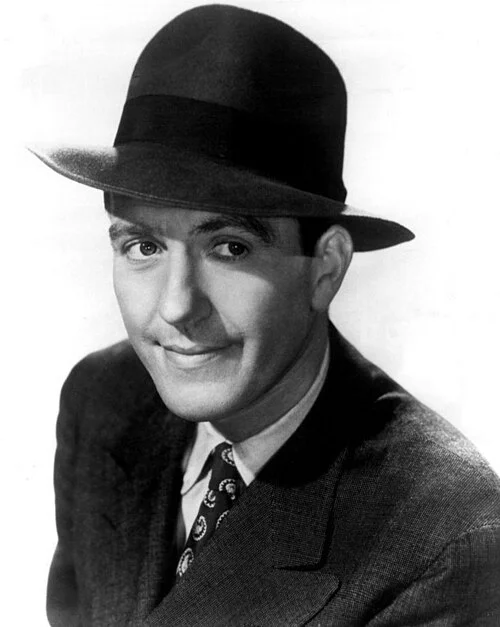
Hugh Beaumont as Ward Cleaver on Leave It to Beaver
In 1957, Hugh Beaumont was cast as Ward Cleaver. Leave It to Beaver ran from 1957 to 1963. It filled 234 episodes across six seasons.
He didn’t only act. Beaumont also wrote and directed several episodes. One was the finale, “Family Scrapbook,” in 1963.
The role made him a household name. It didn’t make him rich by Hollywood standards. Television contracts of that period were usually work-for-hire deals with little long-term upside.
After the show ended, he kept taking guest roles through the late 1960s. Then he stepped back from mainstream acting around 1969. He made occasional appearances into the early 1970s.
What Hugh Beaumont Has Said About Work and Faith
Hugh Beaumont left few interviews behind, but one statement is widely cited. IMDb records him saying that no acting income could do enough good to justify breaking his ideals. He said he wouldn’t feel justified “violating my ideals” just to earn a paycheck.
He also said he would refuse acting work that clashed with his standards as a clergyman. So the choice wasn’t a one-time gesture. It was a working rule.
Beyond that, his public record is thin. There are no long memoirs or podcast interviews we can quote. That silence is part of the story, and most of what we know about his inner life comes from people around him.
What This Means to Them, In Their Own Words
Beaumont’s daughter, Kristy, said publicly in 2020 that her father was “just like” Ward Cleaver in real life.
Jerry Mathers, who played Beaver, wrote a 2016 tribute to Beaumont. He called him a “friend and mentor.”
Those two accounts point the same way. Family and colleagues describe a steady, decent man, much like the character. Still, neither account covers his money, his contracts or his health, so we don’t stretch them further.
What Reporters Found That Wasn’t in the Interview
Reporting adds detail that his own words don’t. One figure circulates online: his gross acting income in 1967 was $1,912.50. The projection for 1968 was $1,500.
No verified primary source is attached to those numbers. They fit his path, though, because he had left Hollywood for Minnesota around then. So we treat them as unconfirmed.
Records also disagree on several basic facts:
- Birth year: 1909 in most records, 1910 on Wikipedia.
- Birthplace: Lawrence or Eudora, Kansas.
- Marriage year: 1941 in most sources, 1942 on Kansapedia.
- Stroke: 1972 in many accounts, while Wikipedia says 1970 and lists 1972 as his formal retirement.
- Ministry: ordained Methodist minister in some accounts, lay minister or licensed preacher in others.
None of these changes the outline of his life. We’ve used the most widely supported version each time.
Hugh Beaumont Personal Life and Marriage
Hugh Beaumont married actress Kathryn Adams on April 13, 1941. Wikipedia places the ceremony at Hollywood Congregational Church. Kansapedia lists the year as 1942.
Adams retired from acting after the wedding to raise their family. She returned once, to co-star with him in Blonde for a Day in 1946. They had three children: sons Hunter and Mark, and daughter Kristy.
The couple divorced in 1974, after more than 30 years of marriage. No later marriage appears in public records. Beyond that, we don’t speculate about their private life.
Their son Hunter became a psychology professor at a German university. That’s why Beaumont was in Munich when he died. No public record confirms his exact home in Minnesota.
Beaumont was also a staunch conservative Republican. IMDb trivia says he publicly supported the presidencies of Dwight D. Eisenhower, Richard Nixon and Ronald Reagan.
Hugh Beaumont Later Years, Stroke and Death
After acting slowed, Beaumont settled in Minnesota. There he ran a Christmas-tree farm. It was a big change from Hollywood, and it matched his wish for a simpler life.
Then came the stroke. Most accounts date it to 1972. Wikipedia dates it to 1970.
Doctors told him he would never walk or talk again. He proved them wrong. He recovered enough to do some directing and community theater work.
On May 14, 1982, Beaumont died of a heart attack in Munich, West Germany. He was visiting his son Hunter. He was 72 or 73, depending on which birth year holds.
Hugh Beaumont Net Worth in Brief
Money is a small part of this story, but readers ask about it often. Here are the key points:
- No Tier 1 outlet has published a verified figure.
- Our structural inference is $150,000–$500,000 at death, in 1982 dollars.
- That equals roughly $480,000–$1.6 million in 2026 dollars.
- Online claims of $3 million to $10 million have no documented source.
- The circulating 1967 income figure of $1,912.50 remains unverified.
Those numbers match the man in this profile. He was a working actor who chose principle over a bigger paycheck.
Hugh Beaumont Legacy and Cultural Place
The 1983 TV movie Still the Beaver was dedicated to his memory. TV Guide ranked his Ward Cleaver 28th on its 2004 list of the 50 Greatest TV Dads of All Time.
Ward was wise, calm and comfortable. The man who played him lived more modestly. He worked in television’s first generation, before residual deals paid stars for reruns.
Hugh Beaumont: The Life Behind Ward Cleaver
Hugh Beaumont was a theology-trained actor who served as a medic, starred in 234 episodes and later farmed Christmas trees. The record shows a steady man who placed conviction above income.
Here’s where the facts stand. His career dates, marriage and death are well documented. His birth year, birthplace and stroke date are disputed. His contracts, finances and property stay private.
More on This Topic: Hugh Beaumont Net Worth: What Ward Cleaver’s Modest Fortune Actually Looked Like
Frequently Asked Questions
When was Hugh Beaumont born?
He was born on February 16 in Kansas. Most records give 1909, while Wikipedia gives 1910. Most sources say Lawrence, and some say Eudora.
Was Hugh Beaumont a real minister?
Yes, in some form. Several accounts call him an ordained Methodist minister. Wikipedia calls him a lay minister, and other profiles say he was licensed to preach. He earned a Master of Theology from USC in 1946.
Who was Hugh Beaumont married to?
He married actress Kathryn Adams on April 13, 1941. They had three children: Hunter, Mark and Kristy. They divorced in 1974.
How did Hugh Beaumont die?
He died of a heart attack in Munich, West Germany, on May 14, 1982. He was visiting his son Hunter, a psychology professor.
What did Hugh Beaumont do after Leave It to Beaver?
He kept taking guest roles through the late 1960s. Then he moved to Minnesota and farmed Christmas trees. He also did some directing and community theater work after his stroke.
Did Hugh Beaumont serve in World War II?
He was a conscientious objector because of his religious views. Even so, he served as an Army medic, according to Wikipedia and a 2016 tribute by Jerry Mathers.
Disclaimer: Hugh Beaumont’s life off-camera was fiercely private. Where primary documents are absent or historically conflicting, we have relied on the most widely accepted public records and independent reporting to reconstruct his timeline, rather than relying on unverified family statements.
Sources: Kansas Historical Society, Kansapedia: Hugh Beaumont; Wikipedia: Hugh Beaumont; IMDb biography and trivia (quote on ideals, political support); Jerry Mathers, “My wonderful friend and mentor, Hugh Beaumont” (2016), as cited on Wikipedia; 2A Magazine, Hugh Beaumont Net Worth report (May 22, 2026).