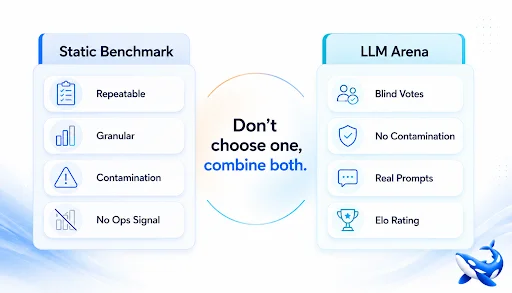
When you compare AI models, you’ll meet two very different kinds of evidence. Static benchmarks are fixed exams that produce a tidy percentage. An LLM arena is a live, crowd-voted competition where models battle head-to-head. They often disagree — so which should you trust? The short answer is both, in the right way LLM Arena vs Static Benchmarks. Platforms like OrcaRouter combine arena votes with real production data precisely because neither signal is complete on its own.
This article compares a blind LLM Arena with static benchmarks head to head, and explains why the smartest teams don’t choose between them at all.
Two philosophies of measurement
Static benchmarks are the traditional approach: a fixed test with known answers, fast, cheap, and perfectly repeatable.
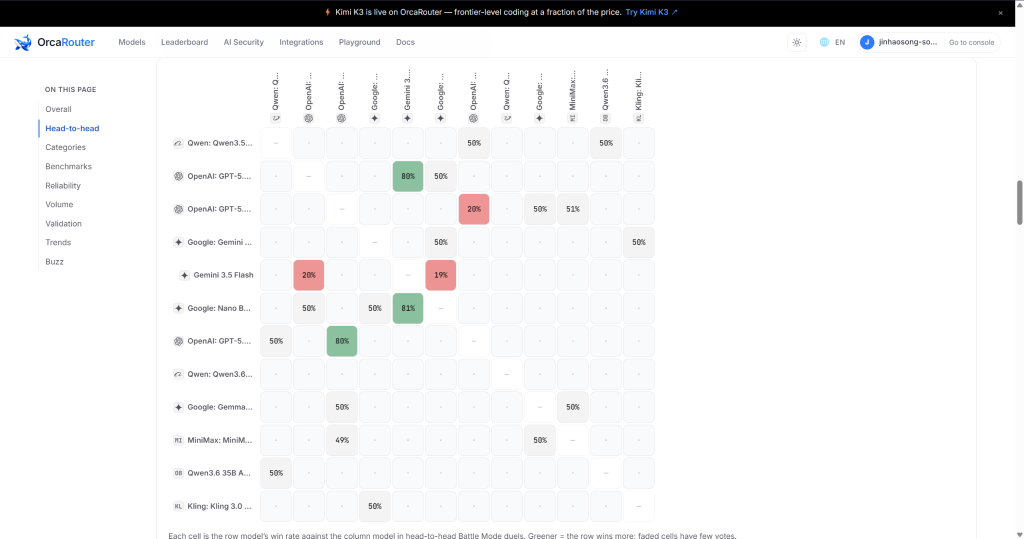
LLM arenas are the newer approach: two anonymous models answer the same real prompt, a human votes, and identities are revealed only after the vote. Aggregate millions of blind battles and you get a preference ranking driven by what people actually find useful.
One measures performance on a curated exam; the other measures preference on real, unpredictable prompts.
Where static benchmarks win
• Repeatable and objective. The same test always yields the same score — ideal for tracking progress over time.
• Cheap and fast. No human graders, no waiting for votes.
• Granular. A well-designed benchmark can isolate a specific skill.
For research and regression testing, these properties are genuinely valuable.
Where static benchmarks fail
1. Contamination. Public test questions leak into training data; models then score high by memorization.
2. The lab-vs-life gap. Benchmarks test clean problems; real users send messy, multi-turn prompts.
3. No operational signal. A benchmark says nothing about latency, cost, or reliability.
Where the LLM arena wins
• No contamination. There’s no fixed answer key to leak — prompts are whatever users type.
• Real-world relevance. You measure preference on the same open-ended prompts your users send.
• Bias resistance. Because votes are blind, brand reputation can’t sway the result. In OrcaRouter’s LLM Arena, voters only learn which model wrote which answer *after* they’ve decided — so nobody is voting for the logo.
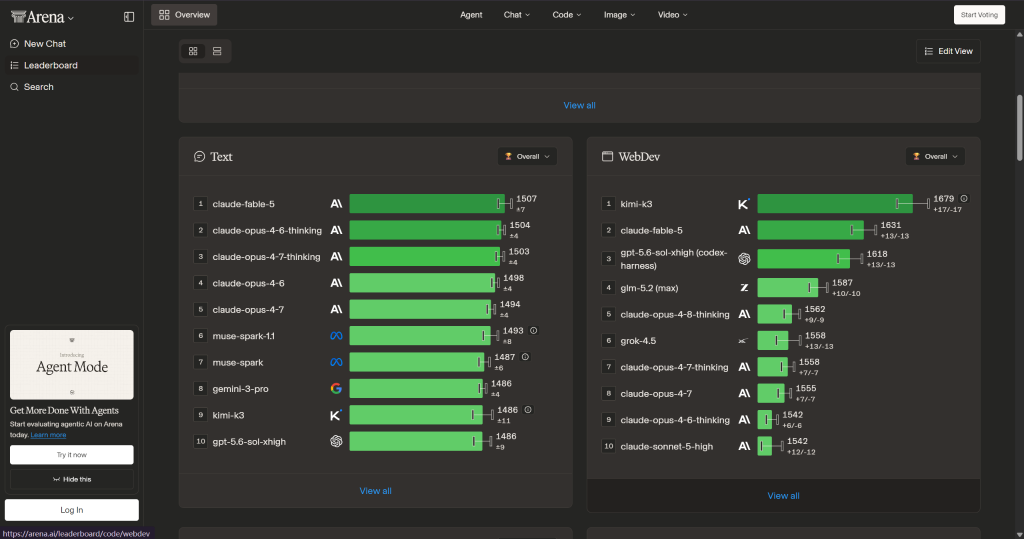
Rankings are then computed with a Bradley–Terry (Elo-style) model, complete with confidence intervals LLM Arena vs Static Benchmarks.
Where the LLM arena falls short
• Preference ≠ correctness. Voters may favor polished answers over strictly correct ones.
• Slower to build. Ratings need many votes; a brand-new model has wide error bars.
• Still no cost or latency by itself. A raw arena rating tells you nothing about price or speed.
The answer: don’t choose — combine
The debate isn’t really “arena vs benchmark” — it’s about assembling a *complete* picture from complementary signals:
• Blind arena votes for perceived quality, immune to contamination and brand bias.
• Real production-traffic data for the operational truth: success rate, p50/p99 latency, cost per million tokens, and throughput.
• External-ranking validation (via Spearman’s ρ and Kendall’s τ) to confirm the ranking agrees with independent references.
The best modern platforms fuse all three. That’s the philosophy behind OrcaRouter’s arena rankings — arena battles for quality, live traffic for reliability and cost, and correlation checks against sources like LMArena and Artificial Analysis.
A practical way to weigh them
• User-facing product? Lean on arena quality plus live latency and reliability.
• Research or tracking one skill over time? Static benchmarks give you repeatability.
• Choosing a model to run at scale? Ignore raw quality until you’ve overlaid cost — the intelligence-vs-price frontier is where the real decision lives.
The takeaway
Static benchmarks and the LLM arena aren’t rivals so much as two lenses on the same question. Benchmarks offer repeatable, granular scores but crumble under contamination and ignore real-world conditions. Arenas resist gaming and reflect genuine preference but need volume and don’t measure operations. Trust neither in isolation. Instead, use a ranking that combines a blind LLM Arena with real production data — and let the complete picture, not a single score, make your decision.