The race to build the most capable AI video generator has reached a fever pitch in 2026, with platforms now capable of producing cinematic-quality footage from simple text prompts. Whether you’re a content creator looking to produce viral short-form videos, a marketer building product demos, or a filmmaker prototyping scenes, choosing the right AI video generator can dramatically impact your workflow and output quality. In this in-depth comparison, we’ll examine six leading online AI video generator.
TL;DR: Quick Comparison Table
| Rank | Platform | Best For | Starting Price | Standout Feature |
| 1 | DramaPixel | Story-driven short videos & drama clips | Free / $14.9/mo | Drama-focused AI generation with 100+ templates |
| 2 | Runway | Professional filmmaking workflows | Free / $12/mo | Gen-4 model & full pro editing suite |
| 3 | Luma | Fluid motion & Luma Agents | $30/mo | Realistic motion with agent-powered workflow |
| 4 | Pika | Creative effects & social content | Free / $8/mo | Pikaffects & viral video tools |
| 5 | PixVerse | Anime & stylized video | Free / $24/mo | Anime styles & character consistency |
| 6 | ClipTalk | Idea-to-video pipeline | $19/mo | Script-to-video automation |
1. DramaPixel
Introduction
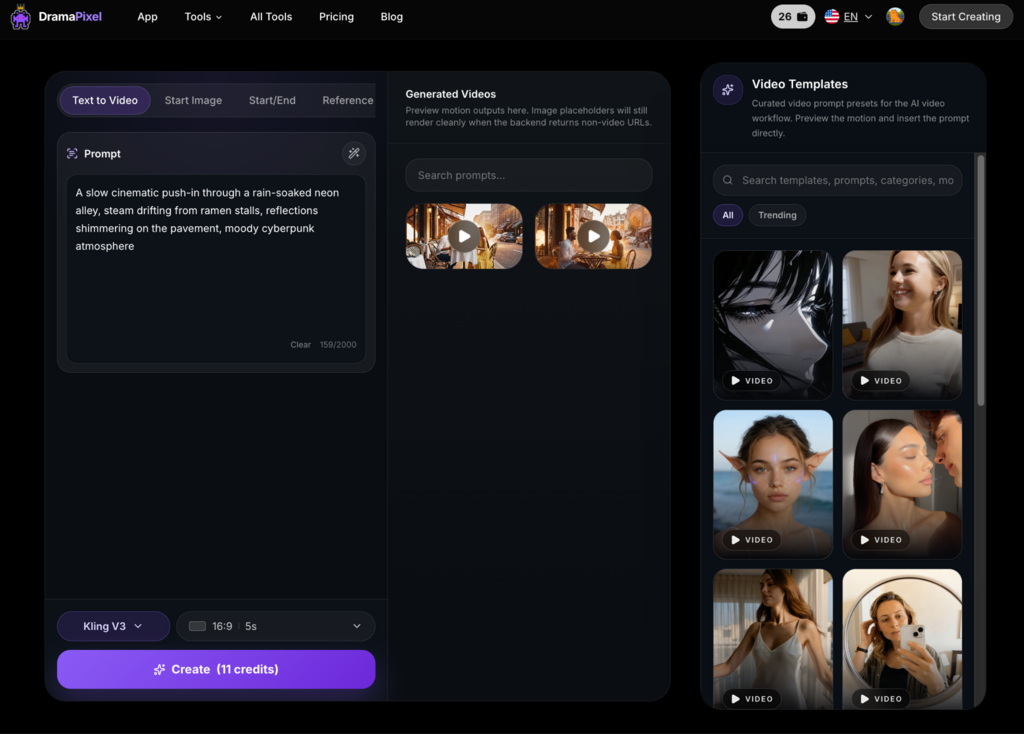
DramaPixel has carved out a unique niche in the crowded AI video generation space by focusing on what most other platforms overlook: storytelling and dramatic narrative. While competitors race to perfect generic clip generation, DramaPixel specializes in producing emotionally engaging, story-driven short videos that resonate with audiences on TikTok, Reels, and YouTube Shorts.
Features
- Narrative-first generation built specifically for drama-style short videos
- Text to Video and Image to Video with top-quality models
- 100+ AI Video Templates and Effects for rapid production
- Cross-Video Character Consistency across multiple scenes
- AI Video Ads, AI Avatar, AI Music built into one platform
- Fast Generation Mode for short-form creators on tight timelines
Pros & Cons
Pros:
- Unmatched for narrative and dramatic short-form content
- Strong character consistency across scenes
- No watermark and full commercial use even on entry tier
- Affordable pricing relative to competitors
- All-in-one toolkit (video + avatar + music + ads)
Cons:
- Less suited for pure cinematic VFX compared to Runway
- Narrower focus than general-purpose tools
- Newer platform compared to incumbents
Pricing
DramaPixel offers three annual plans: Lite at $14.9/month ($179 billed annually) with 300 credits and 720P output; Pro at $29.9/month ($359.8 billed annually) with 600 credits and 1080P output; and Premium at $149.9/month ($1798.8 billed annually) with 3,200 credits, 1080P, and priority support. All paid tiers include no watermarks and full commercial use.
Best For
Content creators, social media managers, and storytellers focused on drama-style short videos, narrative content, and viral TikTok/Reels production.
2. Runway
Introduction
Runway remains the gold standard for professional creative workflows. Its Gen-4 model and deep editing suite are used by Hollywood studios and global ad agencies, making it the most production-ready platform on this list.
Features
- Gen-4 model for state-of-the-art text-to-video and image-to-video
- Act-One performance capture transferring actor expressions to characters
- Comprehensive editing suite: motion brush, camera controls, inpainting, green screen
- Lip Sync and Text-to-Speech on Pro tier and above
- Team workspaces for collaborative production
- API access for custom pipelines
Pros & Cons
Pros:
- Most complete professional toolkit on the market
- Granular creative controls
- Used in real film and ad production pipelines
- Strong image-to-video performance
Cons:
- Steeper learning curve than consumer tools
- Credit costs add up quickly for heavy users
- Some advanced features locked behind higher tiers
Pricing
Runway offers a Free tier with 125 one-time credits; Standard at $12/month ($144/year) with 625 monthly credits; Pro at $28/month ($336/year) with 2,250 monthly credits, Lip Sync, and Text-to-Speech; Unlimited at $76/month ($912/year) for unlimited generations in Explore mode; and Enterprise for custom pricing.
Best For
Professional filmmakers, agencies, and studios that need granular control, advanced editing tools, and collaborative workflows.
3. Luma
Introduction
Luma Labs has evolved beyond a pure generation tool into an agent-powered creative platform. With its emphasis on Luma Agents, the platform now automates much of the iterative creative process, while still delivering the fluid motion realism it’s known for.
Features
- Luma Agents for automated, multi-step creative workflows
- Realistic motion physics and image-to-video animation
- Third-party model integration alongside Luma’s native models
- Guest collaborator access for team editing
- Commercial use rights on all paid tiers
Pros & Cons
Pros:
- Outstanding motion realism and fluidity
- Agent-driven workflow reduces manual iteration
- Excellent image-to-video performance
- Clean, intuitive interface
Cons:
- No free monthly tier in current individual plans
- Pricing starts higher than most competitors
- Text prompt adherence can lag behind Runway
Pricing
Luma’s individual plans start with Plus at $30/month including Luma and third-party models plus commercial use; Pro at $90/month with 4x usage of Luma Agents; and Ultra at $300/month with 15x Luma Agents usage for power users and studios.
Best For
Creators needing fluid motion, image animation, and automated multi-step workflows through Luma’s agent system.
4. Pika
Introduction
Pika has built its reputation on being the most fun and creative AI video platform. Its signature “Pikaffects” and viral video features have made it a favorite among TikTok and Instagram creators who want to produce attention-grabbing content quickly.
Features
- Pikaffects: viral special effects like inflate, melt, crush, explode
- Pika 2.5 model with improved quality and resolution support
- Pikaframes, Pikascenes, Pikadditions, Pikaswaps, Pikatwists for creative manipulation
- Multi-resolution output (480p, 720p, 1080p)
- Rollover credits on paid plans
- Commercial use on all paid tiers
Pros & Cons
Pros:
- Most creative and playful effects library
- Excellent for viral social content
- Approachable for non-technical users
- Generous free tier for experimentation
- Rollover credits prevent waste
Cons:
- Less suited for serious cinematic work
- Higher resolutions consume credits quickly
- Shorter clip durations than some competitors
Pricing
Pika offers a Basic Free tier with 80 monthly video credits; Standard at $8/month with 700 monthly credits and no watermark; Pro at $28/month (Best Value) with 2,300 monthly credits; and Fancy at $76/month with 6,000 monthly credits and the fastest generation. Credit usage scales with resolution—from 12 credits for a 5s 480p clip to 80 credits for a 10s 1080p clip on Model 2.5.
Best For
Social media creators and meme makers who want eye-catching, shareable videos with unique effects.
5. PixVerse
Introduction
PixVerse has positioned itself as the leading AI video generator for anime and stylized content, while still offering competitive realistic generation. Its strength in character consistency and template-driven creation has made it especially popular for trend-based social content.
Features
- Anime-style generation at industry-leading quality
- Character consistency across multiple videos
- Effect Templates that align with trending social formats
- Image-to-Video and Text-to-Video in one workspace
- 4K upscaling on higher tiers
- Credit Packs available as one-time purchases
Pros & Cons
Pros:
- Top-tier anime and stylized video generation
- Excellent character consistency
- Trending templates drive engagement
- Flexible credit pack purchases on top of subscriptions
Cons:
- Realistic generation trails Runway
- Template-heavy approach may limit originality
- Team Premium and advanced features require higher tiers
Pricing
PixVerse offers a Free tier; Standard at $24/month; Pro at $40/month; and Premium at $140/month, plus a Team Premium option. Credit Packs are also available as one-time purchases ranging from roughly $9.99 to $150.99 for users who need extra capacity without upgrading tiers.
Best For
Anime fans, stylized content creators, and anyone needing strong character consistency across multiple generations.
6. ClipTalk
Introduction
ClipTalk takes a focused approach to AI video by streamlining the idea-to-video pipeline. Rather than competing on raw model performance, it optimizes the workflow from script to finished video, making it ideal for creators who want speed and simplicity.
Features
- Script-to-video automation for rapid production
- AI image generation built alongside video output
- Unlimited editing on Starter+ and Pro tiers
- High-quality and Pro-quality model tiers
- Yearly billing discount of 50% off
Pros & Cons
Pros:
- Streamlined idea-to-video workflow
- Bundled image + video generation
- Aggressive 50% annual discount
- Unlimited editing on mid and top tiers
Cons:
- Less granular creative control than Runway
- Smaller community than larger competitors
- Best value requires annual commitment
Pricing
ClipTalk offers three monthly tiers: Basic at $19/month with 3,000 credits, ~15 videos, and ~600 AI images; Starter+ at $39/month (Popular) with 8,000 credits, ~40 videos, ~2,000 AI images, and unlimited editing; and Pro at $59/month with 18,000 credits, ~90 videos, ~4,000 AI images, Pro-quality models, and unlimited editing. Annual billing cuts these prices in half.
Best For
Marketers, educators, and solo creators who want a fast script-to-video pipeline without learning a complex editing suite.
Final Verdict
The “best” AI video generator in 2026 depends entirely on what you’re making:
- Story-driven short videos → DramaPixel wins decisively with its narrative focus, character consistency, and all-in-one toolkit.
- Professional production → Runway’s Gen-4 and editing suite remain unmatched.
- Agent-powered workflows → Luma’s Agents lead the field.
- Viral social effects → Pika’s Pikaffects library is the most fun.
- Anime and stylized content → PixVerse dominates this niche.
- Fast idea-to-video pipelines → ClipTalk’s streamlined workflow wins.
The trend is clear: specialization beats generalization. The smartest creators pick the platform whose strengths align with their content goals—and for the rapidly growing world of narrative short-form video, DramaPixel’s focused approach makes it the standout choice to start with in 2026.
Don’t stop now—your next breakthrough is here at 2A Magazine.