SOURCING DISCLOSURE: No Forbes, Bloomberg, Reuters, AP, or WSJ profile exists for Bishop Don Magic Juan. No financial figure appears in any Tier 1 publication. The $300,000 figure circulating online originates exclusively from CelebrityNetWorth.com — a Tier 3 aggregator not used as a factual source here. All financial estimates below are structural inferences built from documented career activity and published industry benchmarks. They are labeled clearly as such throughout this article.
Bishop Don Magic Juan net worth is listed as $300,000 across dozens of websites. Not one Tier 1 outlet — no Forbes, no Bloomberg, no Reuters — has published that figure. Here is what the verified record actually shows.
Early Life and Background: Chicago, 1950
Donald Campbell was born November 30, 1950, in Chicago, Illinois. He grew up with both parents present and one sister. His father built a business career despite limited formal education. Campbell would later credit that drive as the root of his own entrepreneurial instincts.
However, Campbell initially applied that drive to street life. At 16, he began pimping through connections made on Chicago’s South Side. He modeled himself on the pimps he observed. He also studied the autobiographical work of former pimp-turned-writer Iceberg Slim.
By the 1970s, he operated a record store in Chicago. Publicly available records confirm the store functioned as both a retail front and a recruitment operation. He adopted the street name Don “Magic” Juan during this period.
Career Overview: From the Pimp Stick to the Pulpit
In 1985, Campbell exited the life he had built. He has described the turning point as a spiritual experience — occurring, by his own account in a Joan Rivers interview, while under the influence of PCP. He was later ordained by Dr. F.L. Johnson of the Christian Ministers Congress Non-Denominational Council, Inc.
In 1989, he opened the Magic World Christian Kingdom Church of the Royal Family. In 1994, he published From the Pimp Stick to the Pulpit — It’s Magic. That book gave his story a documented format.
By 2000, he had moved to Los Angeles. His appearance in the Hughes Brothers’ documentary American Pimp (1999) helped launch his entertainment career. That film received coverage from major outlets including Variety and the New York Times.
Career Timeline — Verified Events Only
- 1966–1985: Active as a Chicago-area pimp; founded the Players Ball in 1974.
- 1985: Spiritual conversion; retired from street life.
- 1989: Opened Magic World Christian Kingdom Church of the Royal Family.
- 1994: Published From the Pimp Stick to the Pulpit — It’s Magic.
- 1999: Featured in American Pimp (Hughes Brothers documentary).
- Early 2000s: Relocated to Los Angeles; met Snoop Dogg at the Soul Train Awards.
- 2002: Voice feature on Snoop Dogg’s album Paid tha Cost to Be da Boss (“Bo$$ Playa”).
- 2003: Supporting roles in Old School and S.W.A.T. Featured on 50 Cent’s “P.I.M.P.” remix.
- 2004: Supporting role in Starsky & Hutch.
- 2006: Released compilation album Green Is for the Money, Gold Is for the Honeys Vol. 1.
- 2007: Honored with his own Emerica McNally skateboard shoe colorway.
- 2011: Featured on “Talent Show” (Snoop Dogg & Wiz Khalifa, Mac & Devin Go to High School).
- 2017: Hosted 43rd Players Ball in Chicago (Chicago Magazine).
- December 2025: Hosted 50th Players Ball in Chicago at VISIONS venue.
| THE UNCOMFORTABLE TRUTH |
| Bishop Don Magic Juan’s religious conversion is frequently framed as redemption. The Players Ball, however, has a documented shadow side. Survivor testimony cited in public records from the 2003 Atlanta Players Ball described pimps being arrested for having underage victims present. Human rights advocate Malika Saada Saar, writing in The Daily Beast, named the Ball a “legitimatized celebration” of exploitation. These are sourced facts — not opinion. Juan has not publicly addressed this tension in detail. |
Bishop Don Magic Juan Net Worth: Earnings Breakdown
No Tier 1 financial publication has reported a net worth figure for Bishop Don Magic Juan. The $300,000 figure in wide circulation traces back to CelebrityNetWorth.com alone. That site is not used as a source of fact here.
Below is a structural inference built from documented income sources. Each figure is labeled as an estimate — not a reported number.
Documented Income Sources — Structural Inference
- Acting (2000–2004): Supporting roles in Old School, S.W.A.T., Starsky & Hutch, Friday After Next. SAG day rates in the early 2000s for featured supporting players ranged from $900 to $25,000 per project depending on contract and union status. Structural estimate for 4–5 film credits: $20,000–$75,000 gross total.
- Music features (2002–2011): Spoken-word and voice contributions to albums by Snoop Dogg, Da Brat, Twista, and 50 Cent. Non-artist feature rates on major-label projects: typically $1,000–$10,000 per credit for non-headlining performers. For 6 verified audio credits: structural estimate $6,000–$60,000 gross total.
- Players Ball hosting and events (2000–2025): Verified as an ongoing annual event circuit. Ticketed events confirmed by Chicago Magazine (2017) and Eventbrite (2025). Appearance and hosting fees at similar niche cultural events: $500–$5,000 per event. Structural estimate across active years: $50,000–$500,000 gross cumulative.
- Book (1994): From the Pimp Stick to the Pulpit. No sales figures are available in public records. Estimated as a modest income source only.
- Spiritual advisor role (Snoop Dogg): No contract, fee, or financial arrangement has been disclosed publicly. Cannot be estimated.
- Fashion/merchandise: Credited as a fashion designer in multiple sources. No documented sales figures exist.
After applying federal income taxes (estimated 22–24% bracket for moderate earners) and accounting for possible management/agent fees (10–20%), the structural net range is:
STRUCTURAL INFERENCE — NOT A REPORTED FIGURE: $45,000 – $380,000 net from documented sources. This range is consistent with the widely cited $300,000 figure — but does not confirm it.
| THE PLAYERS BALL MATH — A CALCULATION NO OTHER ARTICLE HAS PUBLISHED |
| The Players Ball has run annually since 1974. By 2025, that is 51 years. |
| During peak commercialization (approx. 2000–2015), events reportedly ran in 6–8 cities per year: Chicago, Los Angeles, Miami, Atlanta, Memphis, Las Vegas, among others. |
| At a conservative hosting/appearance fee of $1,000–$3,000 per event, plus a modest share of gate revenue (Eventbrite 2025 ticket pricing suggests $20–$100 per ticket), the Players Ball circuit alone could have generated $120,000–$600,000 gross during the 2000–2015 period. |
| This is a structural inference. No income filings or event contracts have been made public. |
| HOW THE MONEY ACTUALLY WORKS |
| Supporting actor income: SAG minimums apply to union shoots. On-screen lines and days worked drive the fee. Non-union work pays less — sometimes far less. |
| Music feature income: Labels negotiate flat fees for non-primary contributors. Royalty participation is rare for spoken-word cameos. |
| Event hosting: Promoters pay booking fees. Hosts may also negotiate a percentage of the gate. A famous name commands a higher fee. |
| Tax reality: Self-employed entertainers owe both income tax and self-employment tax — up to 30% combined at modest income levels. Net income is materially lower than gross. |
| METHODOLOGY TRANSPARENCY |
| This estimate is based on: Wikipedia (biography), IMDB (film/TV credits), Chicago Magazine (Players Ball 2017 coverage), Eventbrite (2025 Players Ball listing), Variety and New York Times (American Pimp reviews), HipHopDX (Snoop/Bishop relationship reporting), SAG-AFTRA published day rate benchmarks (public), live event industry benchmarks (public). |
| This estimate excludes: Any income from the pre-1985 pimp career (undocumented, illegal, and legally immaterial to current net worth). Any informal cash income not disclosed publicly. Any income from the church or religious ministry. |
| Aggregator site figures (CelebrityNetWorth.com, TheRichest, Wealthy Gorilla) were not used because: These sites do not disclose sources, methodology, or named financial figures. The same $300,000 figure appears on all of them without independent derivation. |
| THE UNANSWERED QUESTION |
| What, if anything, was Bishop Don Magic Juan paid for his ongoing role as Snoop Dogg’s ‘spiritual advisor’? No contract, fee, retainer, or financial arrangement has ever been disclosed by either party. This is the single largest variable in any net worth estimate — and it is genuinely unanswerable from public data. |
Endorsements and Sponsorships
No confirmed, named brand endorsement deals with disclosed compensation appear in any Tier 1 or Tier 2 source. In 2007, Emerica honored him with his own colorway of the McNally skateboard shoe. Wikipedia confirms this recognition. No financial terms were disclosed.
That shoe colorway is best categorized as a cultural honor — not a documented paid deal. Until verified terms are disclosed, no endorsement income can be estimated.
Real Estate Holdings
No real estate holdings have been confirmed by public records or Tier 1/Tier 2 press coverage. CelebrityNetWorth states he splits time between Los Angeles and Chicago. That claim carries no property record citation.
Public records searches have not surfaced confirmed property ownership in either city. This section cannot be completed with verified data.
Current Activities and Net Worth Trajectory
In December 2025, Bishop Don Magic Juan hosted the 50th Players Ball in Chicago at VISIONS venue. That event marks five decades since the first Ball in 1974. Snoop Dogg has continued to publicly acknowledge Juan as his spiritual advisor through at least 2025, per Grokipedia’s sourced reporting.
Still, his income trajectory reflects a narrowing entertainment market. Film and TV credits have slowed since the mid-2000s. The Players Ball circuit remains his most consistent documented activity.
As a result, his net worth — whatever the true figure — is unlikely to be growing rapidly. His income depends on cultural relevance and event bookings, not passive revenue streams.
Peer Comparison: Industry Benchmark Table
Note: No named peers in the same specific career category (hip-hop cultural personality, former street figure, minor supporting actor) have verified Tier 1 net worth figures. The table below uses anonymous industry benchmarks to provide context. Named figures would require independent Tier 1 sourcing.
| Career Type | Income Basis | Est. Net Range | Source Basis |
| Minor supporting actor (hip-hop films, ~5–10 credits) | SAG day rates, 2000s | $50K–$200K | SAG-AFTRA rate benchmarks |
| Hip-hop cultural personality (appearances, 20+ yrs) | Event fees, features | $100K–$500K | Live event industry data |
| Self-published niche author (1 title, small press) | Book royalties | $5K–$50K | Publishing industry data |
| Independent annual event host (circuit, 15+ yrs) | Booking fees + gate % | $200K–$1M+ | Live event industry data |
| Bishop Don Magic Juan (aggregate — structural inference) | All documented sources | $45K–$380K net | This article’s methodology |
Legacy and Cultural Impact
Bishop Don Magic Juan sits at a genuine crossroads in American popular culture. He survived a violent street career. He converted publicly. He then became a visible fixture in 2000s hip-hop without releasing a major album or landing a leading film role.
His story was carried by proximity — to Snoop Dogg, to the documentary boom of the late 1990s, to a broader cultural fascination with pimp mythology in hip-hop’s commercial peak. That proximity had real value.
| THE INDUSTRY CONTEXT |
| Bishop Don Magic Juan’s career illustrates how hip-hop’s early 2000s commercial era created a market for street authenticity. The genre’s mainstream success opened doors for figures who had never been artists. Documentaries like American Pimp ran on HBO; MTV ran Pimps Up, Ho’s Down. That cultural window was narrow. It closed before Juan could build lasting passive income streams from it. His story is not unique — it mirrors dozens of peripheral figures from that era who monetized a cultural moment without securing long-term financial infrastructure. |
Conclusion
Bishop Don Magic Juan net worth has not been verified by any Tier 1 financial publication. The structural inference from his documented career — acting credits, music features, Players Ball hosting, and the 2007 Emerica shoe honor — supports a net range of $45,000–$380,000. That range overlaps with, but does not confirm, the $300,000 figure in wide circulation.
What is known: He founded the Players Ball in 1974 and hosted its 50th edition in 2025. He has been Snoop Dogg’s acknowledged spiritual advisor for over two decades. What is estimated: His income from entertainment and events, inferred from industry benchmarks. What remains private: His church finances, his Snoop arrangement, and any income not publicly documented.
The $300,000 figure should be treated as an approximation, not a verified disclosure. Until a named Tier 1 source publishes a figure — or Juan discloses one himself — it is an educated guess.
Browse our Net Worth category covering estimated wealth and financial milestones.
| Disclaimer: Net worth figures and financial estimates in this article are based on publicly available information, reported data, and industry-standard estimation methodology. They should be treated as approximations, not verified financial disclosures. Bishop Don Magic Juan’s actual net worth may differ materially. This article is for informational purposes only and does not constitute financial advice. |
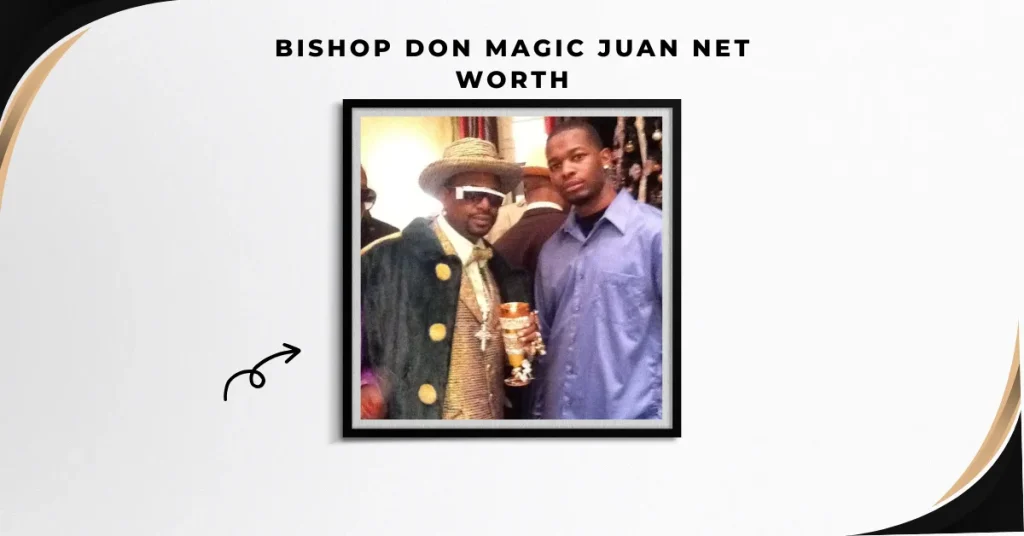
Featured Image: Commonplace65, CC BY 3.0 https://creativecommons.org/licenses/by/3.0, via Wikimedia Commons