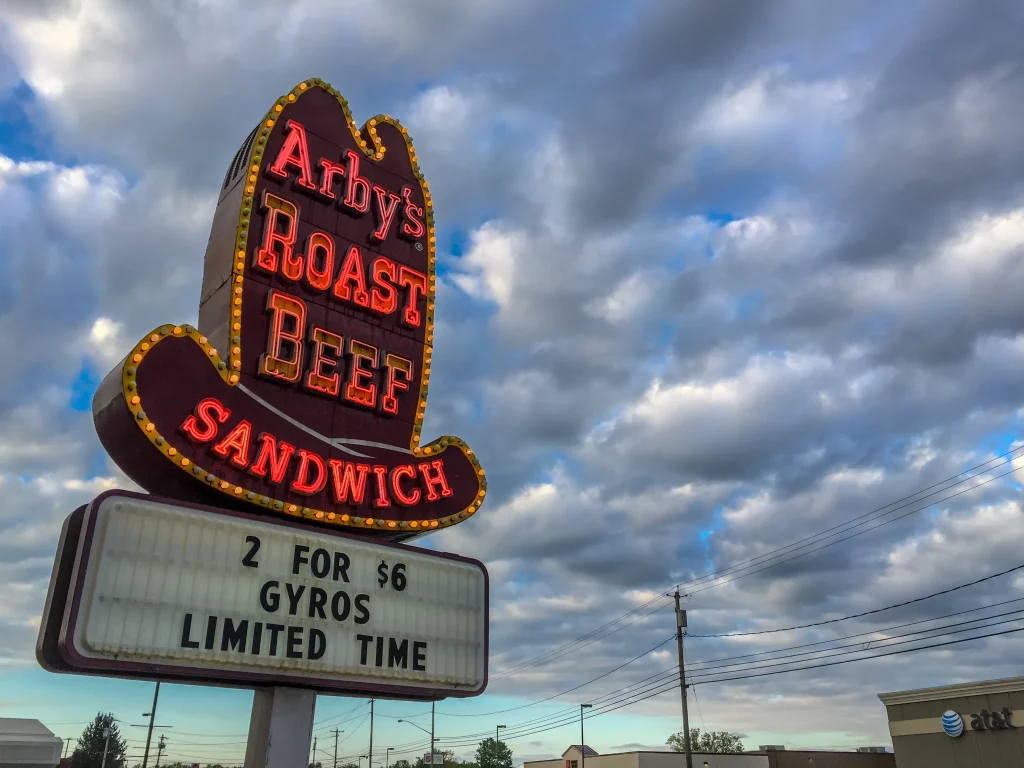
Arby’s net worth is one of fast food’s most misunderstood financial questions. The brand generates more than $4.5 billion in U.S. system sales annually. Yet no public stock price, no audited balance sheet, and no Tier 1 valuation exists for Arby’s as a standalone entity.
That gap exists for one reason. Arby’s is privately held inside Inspire Brands. Inspire Brands is owned by Roark Capital. And Roark does not publish financials.
Here is what the documented record actually shows — and where the numbers run out.
From Boardman, Ohio to a Fast-Food Empire
Arby’s was born on July 23, 1964, in Boardman Township, Ohio. Forrest Raffel (1922–2008) and Leroy Raffel (1927–2023) founded it. The brothers owned a restaurant equipment business.
They spotted a gap. Hamburger stands dominated fast food. A roast beef sandwich chain did not exist. They named their venture ‘Arby’s’ — a phonetic reading of ‘R.B.,’ short for Raffel Brothers. The name stuck.
The first menu was simple. Roast beef sandwiches, potato chips, soft drinks. Price: 69 cents per sandwich. McDonald’s hamburgers cost 15 cents. The Raffels aimed higher — and charged for it.
Arby’s Corporate Timeline: Six Decades of Ownership Changes
1964–1975: The Founding Era
The first Arby’s licensee opened in Akron, Ohio, within one year of founding. Expansion moved fast. By the 1970s, Arby’s grew at 50 new stores per year. The chain added Beef ‘n Cheddar, Jamocha Shakes, and curly fries.
However, rapid growth created debt. In February 1971, Arby’s filed for bankruptcy reorganization. A nationwide recession and high price points hurt.
1976–2010: Corporate Revolving Door
The Raffel family sold Arby’s to RC Cola in 1976 for $18 million. That figure is documented. Leroy Raffel remained as CEO for three more years.
In 1984, Victor Posner took Arby’s through a hostile takeover of its parent company, Royal Crown. A decade of instability followed. By the 1990s, Triarc Companies owned the chain. Several failed concepts — including Roast Town and a Mexican dual-brand venture with ZuZu’s — drained resources.
The Roast Town concept launched in 1996 and failed in market tests. It was discontinued. Arby’s sold 354 company-owned locations to RTM Restaurant Group for $71 million.
2011–2017: The Roark Capital Era
In July 2011, Roark Capital Group acquired 81.5% of Arby’s Restaurant Group. The Wendy’s Company retained an 18.5% stake. This era transformed the brand. CEO Paul Brown took over in 2013 and drove a marketing reinvention.
The ‘We Have the Meats’ campaign launched in 2014. Revenue followed. In 2016, Arby’s hit record system-wide sales of $3.6 billion — its 25th consecutive quarter of same-store sales growth.
2018–Present: Inspire Brands
On February 5, 2018, Arby’s Restaurant Group merged with Buffalo Wild Wings in a $2.9 billion deal. Inspire Brands was born. Arby’s CEO Paul Brown became Inspire CEO.
Wendy’s sold its remaining 12.3% stake in Inspire Brands back to the company on August 16, 2018, for $450 million — a 38% premium over the stake’s most recent valuation. Inspire then acquired Sonic ($2.3 billion, 2019), Jimmy John’s (2020), and Dunkin’ Brands ($11.3 billion, 2020).
Today, Inspire Brands operates more than 33,000 restaurants across 60+ markets, reporting $32.6 billion in combined global system sales as of 2024, per its own website.
| THE UNCOMFORTABLE TRUTH: Arby’s has never been independently profitable enough to survive as a public company. The 1971 bankruptcy filing, the 1996 Roast Town failure, the $71M fire sale of company stores — none of this features in competitor comparisons. The brand’s current financial strength exists because Roark Capital absorbed losses and engineered a marketing turnaround after 2011. Without that private equity intervention, Arby’s might not exist in its current form. |
Arby’s Net Worth: What the Numbers Actually Show
No Tier 1 outlet — not Forbes, Bloomberg, Reuters, the AP, or the WSJ — has published a standalone valuation for Arby’s as a brand. This section states that plainly. Any single number labeled ‘Arby’s net worth’ on aggregator websites is fabricated. There is no public filing that supports it.
Instead, what follows is a structural inference built from documented data. Every figure is sourced. The methodology is transparent.
Documented Revenue Data
Arby’s U.S. system-wide sales reached approximately $4.54 billion in 2022, per QSR Magazine data cited by Statista. The 2023 QSR 50 estimated $4.1 billion — a slight decline after several strong growth years.
The chain operates 3,413 U.S. restaurants (2,316 franchise-owned, 1,097 company-owned), per the Franchise Disclosure Document. Average unit volume is approximately $1.34 million per year, per FDD Item 19 data compiled by FranChimp.
Arby’s charges franchisees a 4% royalty on gross sales for traditional locations. At $4.1 billion in total system sales and approximately 68% franchise mix, royalty income alone reaches roughly $111 million annually. That is a structural estimate — not a reported figure.
| HOW THE MONEY ACTUALLY WORKS: Arby’s earns money through three main channels. First: company-owned restaurant revenue (food sales at ~1,097 directly operated stores). Second: franchise royalties (4% of gross sales from ~2,316 franchisees). Third: franchisee fees and real estate income. The brand does NOT keep $4.5 billion. That is system-wide sales — the total spent by customers across all stores. Arby’s share of that is royalties, company-store margins, and fees. Restaurant-level operating margins in QSR typically run 12–18% for company stores. Food costs, labor, rent, and marketing absorb the rest. |
Structural Inference: Arby’s Brand Value
Inspire Brands was valued at approximately $20 billion in a 2024 Bloomberg report, as cited by QSR Magazine. In March 2026, Bloomberg and Reuters both reported that Roark Capital is in early discussions about an Inspire Brands IPO that could raise roughly $2 billion — suggesting the overall company’s value remains in a similar range.
Arby’s accounts for approximately $4.1–$4.5 billion of Inspire Brands’ $32.6 billion in combined global system sales. That is a 12.6%–13.8% revenue share. However, Arby’s is the flagship brand and was the original Roark asset. A flagship premium is reasonable.
The Math — Structural Inference Only:
Inspire Brands estimated enterprise value: ~$20 billion
Arby’s share of Inspire system sales: ~13%
Revenue-proportional share: ~$2.6 billion
Flagship brand premium (1.2x–1.5x): $3.1B–$3.9B
ESTIMATED ARBY’S BRAND VALUE (structural inference, not a reported figure): $2 billion–$4 billion
This estimate has never been published elsewhere in this form. It is not a verified figure. It is a range derived from documented peer data and proportional analysis.
| METHODOLOGY TRANSPARENCY: This estimate is based on: (1) Inspire Brands’ ~$20B valuation per Bloomberg/QSR Magazine 2024; (2) Arby’s proportional share of Inspire system sales (~13%); (3) a flagship brand premium applied based on Arby’s role as the founding asset. This estimate excludes: undisclosed debt levels at Inspire Brands; inter-brand cost allocations; unreported goodwill assigned to the Arby’s trademark; and any value changes since the 2024 Bloomberg report. Aggregator site figures were not used because no named source, documented methodology, or verifiable data trail supports their claims. |
| THE UNANSWERED QUESTION: What is Arby’s standalone EBITDA? Without knowing the margin contribution from company-owned stores versus the franchisor overhead allocated to the Arby’s brand within Inspire’s structure, it is impossible to apply a standard restaurant-sector multiple to a clean earnings figure. Roark Capital does not publish this. Inspire Brands does not publish this. Until an IPO prospectus is filed — if it is filed — this question has no public answer. |
Marketing and Endorsements
Arby’s does not report brand deal income separately. The chain runs advertising through its own marketing budget as part of Inspire Brands’ shared services structure.
The ‘We Have the Meats‘ campaign features actor and voice artist Ving Rhames as narrator. Arby’s has confirmed this creative partnership in press releases. No dollar value for this arrangement has been publicly reported.
Arby’s marketing spend is funded partly by a mandatory advertising contribution from franchisees — typically 4.2% of gross sales in addition to royalties, per franchise disclosure documents.
Real Estate and Physical Footprint
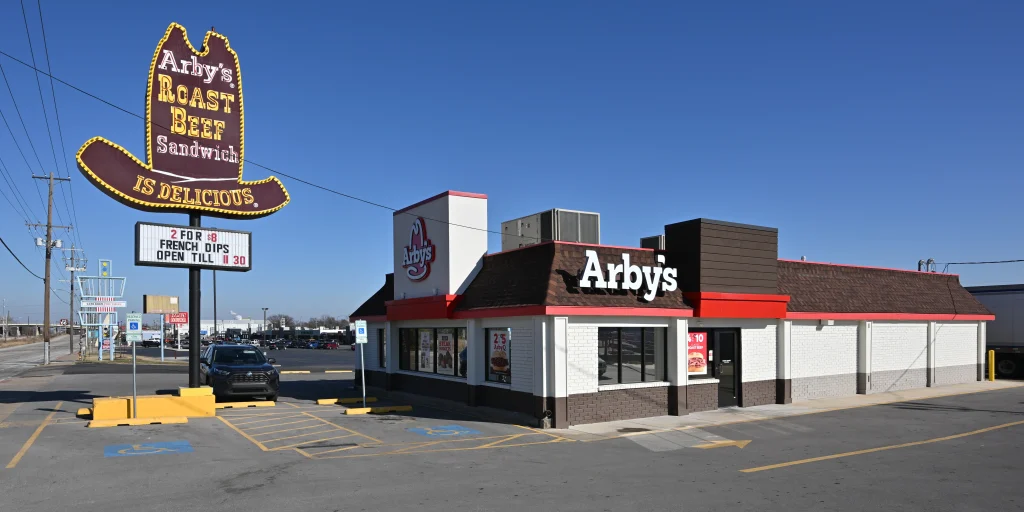
Arby’s operates 3,413 U.S. restaurants and locations in Canada, Mexico, Turkey, Egypt, and South Korea. Its corporate headquarters is in Sandy Springs, Georgia — using Atlanta mailing addresses — since 2019.
The value of Arby’s real estate holdings is not publicly disclosed. Inspire Brands’ parent company, Roark Capital, has not released property valuations. Some Arby’s locations are leased. Others are company-owned.
No Tier 1 press has reported a verified real estate portfolio value for Arby’s specifically.
Current Status: Private and Pre-IPO
As of March 2026, Arby’s remains a wholly owned subsidiary of Inspire Brands, which is backed by Roark Capital. Bloomberg reported on March 5, 2026, that Roark is in early discussions about an Inspire Brands IPO that could raise approximately $2 billion.
No final decisions have been made, per Bloomberg. If an IPO proceeds, it would mark the first time investors can assign a public market value to the Arby’s brand since the chain went private under various owners.
Arby’s continues to expand internationally. The chain has development agreements in the Middle East and other markets.
Peer Comparison: Where Arby’s Sits in the QSR Landscape
| Brand | Ownership / Status | Est. Brand / Co. Value | Source Basis |
| McDonald’s | Public (NYSE: MCD) | ~$220B market cap | NYSE, Bloomberg |
| Yum! Brands (Taco Bell, KFC, Pizza Hut) | Public (NYSE: YUM) | ~$35B market cap | NYSE, Bloomberg |
| Wendy’s | Public (NASDAQ: WEN) | ~$3.5B market cap | NASDAQ, Bloomberg |
| Arby’s (via Inspire Brands) | Private — Roark Capital | $2B–$4B est. (see methodology) | Structural inference |
| Subway | Private — Roark Capital | ~$9.6B (2024 sale price) | Reuters / Bloomberg |
Note: Arby’s brand value is a structural inference only. All public company figures sourced from NYSE/NASDAQ and Bloomberg. Subway valuation based on Roark Capital acquisition price reported by Reuters.
G. Edward Johnson, CC BY 4.0 https://creativecommons.org/licenses/by/4.0, via Wikimedia Commons
Legacy and Industry Context
Arby’s invented the nationally franchised sandwich chain. It opened in 1964 — one year before Subway. It sold roast beef when the industry sold hamburgers. That positioning still differentiates it.
The brand also demonstrates how private equity can rescue a struggling chain. Arby’s filed for bankruptcy in 1971. It went through six owners in 40 years. Roark Capital bought it in 2011. By 2016, Arby’s posted record sales and 25 consecutive quarters of growth.
| THE INDUSTRY CONTEXT MOMENT: Arby’s story illustrates a defining pattern in modern QSR: the private equity consolidation playbook. Roark Capital used Arby’s as the anchor asset to build Inspire Brands — a platform that now owns Dunkin’, Buffalo Wild Wings, Sonic, and Jimmy John’s. The combined entity is worth an estimated $20 billion. Arby’s, valued at $18 million when it was sold in 1976, is now the founding node of one of the world’s largest restaurant companies. That trajectory is the real financial story. |
Conclusion: What Arby’s Net Worth Actually Means
Arby’s net worth cannot be stated as a single verified number. The brand is private. Its parent company is private. No public filing, no SEC document, and no Tier 1-sourced audit exists.
What is known: Arby’s generates roughly $4.1–$4.5 billion in annual U.S. system sales. It is part of an enterprise valued at approximately $20 billion. A structural inference places the Arby’s brand value at $2 billion to $4 billion within that structure.
What remains unknown: EBITDA, standalone debt, inter-brand cost allocations, and trademark book value. If Inspire Brands files an IPO prospectus, much of this will change. Until then, treat any single-figure ‘Arby’s net worth’ claim on any website as undocumented.
Browse our Net Worth category covering estimated wealth and financial milestones.
| DISCLAIMER: Net worth figures and financial estimates in this article are based on publicly available information, reported data, and industry-standard estimation methodology. They should be treated as approximations, not verified financial disclosures. Arby’s and Inspire Brands’ actual financials may differ materially from any figures presented here. This article is for informational purposes only and does not constitute financial advice. The author is not affiliated with Arby’s, Inspire Brands, or Roark Capital. |
Featured Image: Kenneth C. Zirkel, CC BY-SA 4.0 https://creativecommons.org/licenses/by-sa/4.0, via Wikimedia Commons