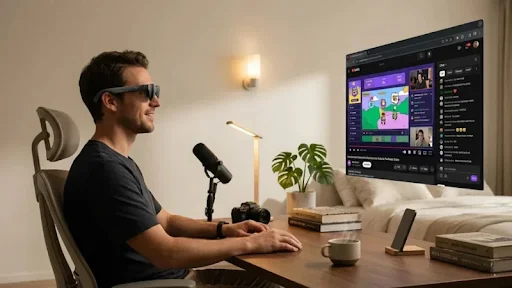
Display-class smart glasses are becoming viable portable movie screens in 2026. The RayNeo Air 4 Pro AR glasses stand out because RayNeo markets them as the world’s first AR glasses with HDR10 display support — a rare spec that shifts what a wearable screen can deliver.
This guide breaks down the optics, audio, and processing behind that claim, then compares the RayNeo Air 4 Pro AR glasses against leading display-class smart glasses in mid-2026 to help you decide if a wearable screen can replace a tablet for movies and travel viewing.
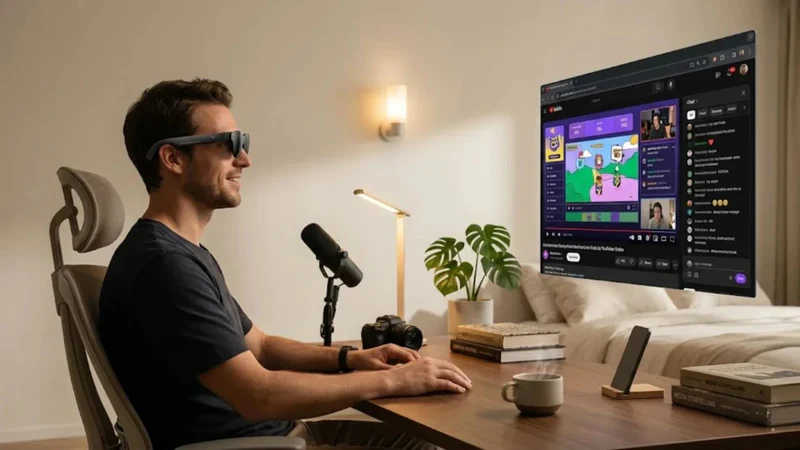
Why Portable Screens Still Disappoint Movie Lovers
Laptop and tablet displays compete with ambient light. Even premium OLED panels lose contrast on planes and in bright rooms. Watching a dark thriller means squinting at washed-out shadows while the passenger beside you glances over.
VR headsets solve the privacy problem but introduce new trade-offs. Many are heavier, warmer, and more isolating than glasses-style displays. For a full-length movie, that combination of bulk and full enclosure tends to discourage repeat viewing.
AR display glasses sit between these extremes. They project a virtual screen while keeping you aware of your surroundings. The question is whether any current pair delivers image quality good enough to serve as a proper portable cinema.
What HDR10 Changes for Movies on AR Glasses
Most AR display smart glasses output SDR video with limited color depth and contrast. The RayNeo Air 4 Pro AR glasses break that ceiling with HDR10 display support — a format that shifts color, contrast, and brightness in measurable ways.
10-Bit Color and the DCI-P3 Gamut
HDR10 uses a 10-bit color pipeline, producing smoother gradients and finer tonal transitions than standard 8-bit SDR. The Air 4 Pro covers 98% of the DCI-P3 gamut with color accuracy rated at ΔE < 2, a threshold used in professional grading.
Real-Time SDR-to-HDR Upscaling
The custom Vision 4000 chip, co-developed with Pixelworks, converts SDR content into HDR in real time. YouTube clips, older Netflix titles, and standard broadcast feeds all gain expanded dynamic range and richer color without any manual adjustment.
Contrast Ratio at 200,000:1
The Micro-OLED panels in these RayNeo Air 4 Pro AR glasses deliver a 200,000:1 contrast ratio. Shadow detail in dark scenes stays visible while bright highlights retain texture — the same principle that separates premium cinema projection from ordinary screens.
Why Dynamic Range Matters More Than Screen Size
A 500-inch virtual screen with flat SDR color still looks flat. HDR10 on a 201-inch screen improves contrast in dark scenes and preserves highlight detail that SDR loses. For movie watching, dynamic range can matter more than headline screen size alone.
The Dolby Analogy — and Its Limits
The Air 4 Pro borrows part of the cinema conversation — HDR contrast, wider color, stronger dark-scene visibility — without matching Dolby Cinema, Dolby Vision, or Dolby Atmos. HDR10 is a separate open standard. The analogy is perceptual, not certification.
The Full Cinema Stack: Display, Sound, and 3D
RayNeo Air 4 Pro AR glasses pair the HDR10 panel with spatial audio and native 3D playback. Together, these three layers move the experience closer to a personal cinema setup — beyond just a floating screen, toward a more complete portable viewing system.
A 201-Inch Micro-OLED Virtual Screen
The SeeYa 0.6-inch Micro-OLED panels project a 201-inch equivalent display at 1920 × 1080 per eye. Peak brightness hits 1,200 nits — enough to hold contrast in moderately lit rooms. The 120 Hz refresh rate keeps motion crisp during fast action sequences.
Spatial Audio Co-Tuned by Bang & Olufsen
Four speakers deliver 360-degree spatial sound, tuned in collaboration with Bang & Olufsen. A whisper mode activates phase-cancelling acoustics to cut leakage in shared spaces. The optional Sound Tube accessory ($15) channels audio directly into the ear canal for louder, more private listening.
3D Movies Without a Theater
These smart glasses play native 3D content at 3840 × 1080 resolution. A proprietary AI algorithm also converts 2D video into 3D with depth enhancement — though this conversion currently requires an iPhone 15 or newer. Android support has not been confirmed.
How the Top Smart Glasses Compare for Movies
Not every pair of smart glasses prioritizes the same display specs. The comparison table below isolates the key features that matter most for dedicated movie watching across five leading display-class AR models available in mid-2026.
| Feature | RayNeo Air 4 Pro | Viture Beast | XREAL One Pro | XREAL 1S | Viture Pro XR |
|---|---|---|---|---|---|
| Price | $299 | $549 | $599 | $449 | $459 |
| HDR Support | HDR10 | Not listed | Not listed | Not listed | Not listed |
| Peak Brightness | 1,200 nits | 1,250 nits | 700 nits | 700 nits | ~1,000 nits |
| FOV | 47° | 58° | 57° | 52° | 46° |
| Virtual Screen | 201″ | 174″ | ~171″ | 500″ | 135″ |
| Weight | 76 g | 88 g | ~87 g | 82 g | 77 g |
| Audio | B&O spatial (4 speakers) | HARMAN AudioEFX | Bose spatial | Bose | Harman |
Where Competitors Have an Edge
The Viture Beast leads on field of view at 58 degrees and slightly exceeds the Air 4 Pro on peak brightness. The XREAL One Pro ships with a dedicated X1 spatial chip for 3DoF screen anchoring. Both offer wider viewing angles that some users prefer for immersion.
Where the Air 4 Pro Wins on Movies
No competing pair of Smart Glasses lists HDR10 display support. That gap matters for film content, where shadow detail and highlight precision define visual quality. The Vision 4000 chip also adds real-time SDR-to-HDR upscaling — a processing feature competitors have not matched.
The Price Factor
RayNeo Air 4 Pro AR glasses retail at $299 — roughly half the cost of the Viture Beast and $300 less than the XREAL One Pro. For movie-focused buyers, that price gap gives the Air 4 Pro one of the strongest value positions among current display-class smart glasses.
Built for Long Viewing Sessions
Movie watching demands sustained comfort that holds up well beyond the first twenty minutes of a session. The RayNeo Air 4 Pro AR glasses address this through deliberate design choices that separate them from heavier smart glasses:
- A 76-gram frame with a 46.7:53.3 front-to-back weight ratio that distributes pressure evenly across the nose bridge and ears
- TÜV SÜD certification for low blue light and flicker-free viewing at 3,840 Hz PWM dimming frequency
- A magnetic prescription lens frame supporting up to −10.00 D myopia, +8.00 D hyperopia, and −2.00 D astigmatism
Nine-level flexible temple adjustment accommodates different head sizes and viewing postures without creating pressure hotspots during extended sessions. Among smart glasses priced under $500, few offer this particular combination of corrective lens support and ergonomic design.
What to Know Before You Buy
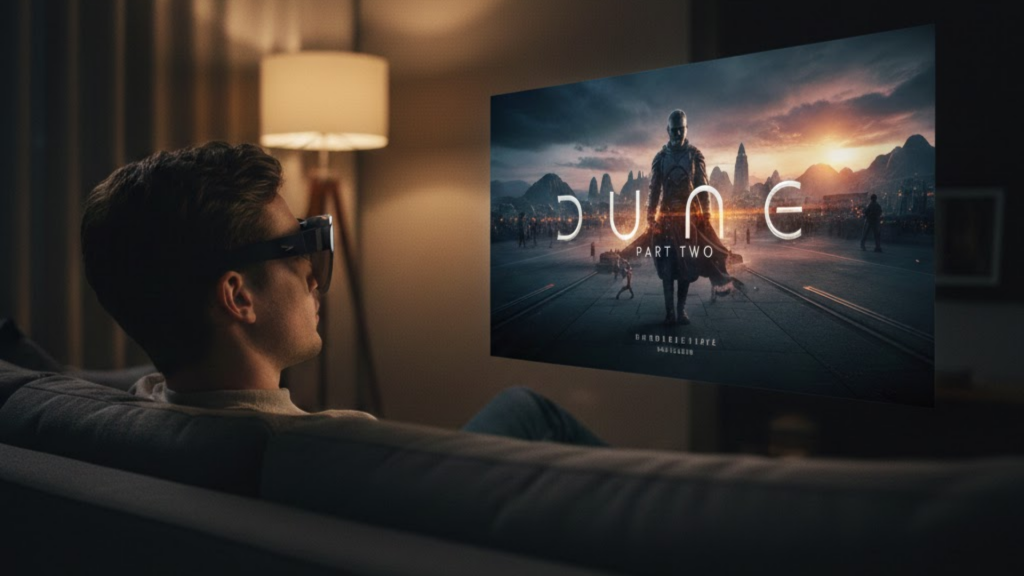
The Air 4 Pro requires a host device for both power and video signal via USB-C with DisplayPort Alt Mode. There is no internal battery or standalone media player built in. Consider these practical trade-offs before purchasing:
- The Pocket TV accessory ($129) adds standalone streaming, but that raises total investment to $428
- The 47-degree field of view is narrower than the Viture Beast (58°) and XREAL One Pro (57°)
- The AI 2D-to-3D conversion remains exclusive to iPhone 15, 16, and 17 as of May 2026
Buyers who prioritize wide-angle peripheral immersion over color depth and contrast may find other smart glasses more suitable for their needs. For movie-first viewers, the HDR10 display on the RayNeo Air 4 Pro AR glasses likely outweighs that field-of-view gap.
Final Take
For movie-first buyers, the RayNeo Air 4 Pro AR glasses pair HDR10 display support, B&O-tuned spatial audio, and a 201-inch virtual screen in a 76-gram frame at $299. Wider-FOV rivals cost significantly more and do not list HDR10 — giving the Air 4 Pro a clear value edge for portable film viewing.