Every pre-roll brand starts the same way: someone rolling joints by hand, figuring out the process, validating the product. It works — until it doesn’t. The moment demand outpaces what hands can produce, every operational weakness in manual production becomes visible at once: inconsistent weights, variable burn quality, rising labor costs, and a compliance exposure that tightens with every batch.
This guide breaks down exactly what separates manual from automated pre-roll production — technically, economically, and operationally — so you can make the right decision for where your brand is now and where it’s going.
How to Roll a Pre-Roll by Hand: The Baseline
Before comparing methods, it’s worth understanding what manual production actually involves — because “hand-rolling” covers a wider range of approaches than most people realize.
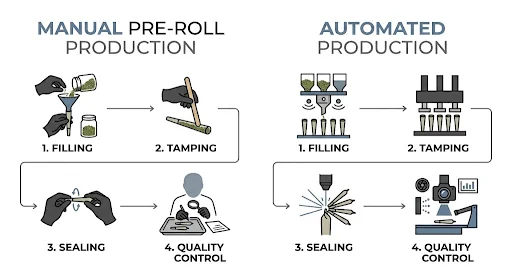
True hand-rolling means a person takes a pre-formed cone or rolling paper, fills it with ground flower using a small scoop or funnel, packs the fill with a tamping tool, and twists the tip closed. A skilled roller produces 60–100 units per hour. Quality depends entirely on the individual: their technique, their consistency across a shift, and their attention to fill weight on unit 400 versus unit 40.
Manual filling boards (also called cone-filling trays) improve on pure hand-rolling by allowing an operator to fill 50–150 cones simultaneously. Ground flower is spread across the board, vibrated into the cones, and tamped in a single action. Output rises to 300–600 units per hour per operator, and fill weight variance improves somewhat — though it remains dependent on flower consistency and operator technique.
Both methods share the same ceiling: human variability. No matter how skilled the roller, fatigue, distraction, and material inconsistency introduce unit-to-unit differences that compound across a production run.
The Real Cost of Manual Production
Manual production looks cheap until you account for everything it actually costs.
Direct labor is the obvious line item — a roller at $18–$22/hour producing 400 units per shift at 8 hours costs roughly $0.36–$0.44 per unit in labor alone, before benefits, training, and management overhead. Scale that to 5,000 units per week across a small team and the labor burden becomes the dominant cost in your P&L.
The hidden costs are where manual production really damages unit economics. Fill weight variance of ±15–20% means some units are consistently over-filled — a direct giveaway of product and margin. Inconsistent packing density means variable burn quality, which drives consumer complaints and return-to-dispensary conversations that erode brand reputation. And in regulated markets, a batch with fill weights outside declared tolerances isn’t just an operational problem — it’s a compliance failure.
Where Manual Production Still Makes Sense
Manual and semi-manual production isn’t always the wrong answer. There are contexts where it remains appropriate:
Brand validation stage. If you’re producing under 500 units per week to prove retail demand and refine your product, manual production is the right tool. The capital preserved by not purchasing automated equipment is better deployed in licensing, lab testing, and initial dispensary relationships.
Craft and boutique positioning. A small number of premium brands have successfully built “hand-crafted” as a core brand attribute, commanding price premiums that absorb the higher per-unit production cost. This works at volumes under roughly 1,500 units per week, with strong storytelling and tight distribution.
Infused specialty formats. Some ultra-premium infused formats — particularly hash holes and multi-layer concentrate applications — still involve significant manual finishing steps even in otherwise automated operations. The hand-applied elements are part of the product differentiation, not a production inefficiency.
Outside these specific contexts, manual production is a temporary solution that scales into a structural problem.
How Automated Pre-Roll Production Works
A fully automated pre-roll machine transforms the production process from a labor-intensive manual operation into a controlled, repeatable manufacturing workflow.
The automated sequence moves through four core stages: cone loading (empty cones are fed into the machine from a hopper or tray), metered filling (a precise dose of ground flower is delivered into each cone by weight or volume), mechanical tamping (a tamping mechanism compresses the fill to the target density with consistent force), and tip closure (the cone tip is twisted or sealed automatically). Advanced systems integrate inline weight verification, rejecting out-of-spec units before they reach packaging.
The critical difference from manual production isn’t just speed — it’s the elimination of human variability from the fill and tamp cycle. Every unit receives the same dose, the same compaction force, and the same tip treatment. Fill weight variance drops from ±15–20% in hand production to ±1–3% in automated systems. That consistency is what makes label claims defensible, burn quality predictable, and consumer experience repeatable.
Output on commercial automated systems ranges from 500 to 2,000+ units per hour depending on configuration — compared to 60–600 per hour for manual methods. One machine running a single shift can replace a rolling team of four to six people while producing a more consistent product.
For brands crossing the 2,000–3,000 units per week threshold, the transition to a fully automated pre roll machine like the Hefestus AuraX represents the operational inflection point that unlocks real scalability – delivering commercial throughput, tight fill tolerances, and the production reliability that dispensary buyers and regulators both require.
Suggested infographic: A side-by-side process flow diagram — “Manual Rolling” vs. “Automated Production” — showing each stage (fill, tamp, seal, QC), with output per hour, fill weight variance, and labor requirement annotations at each step.
The Numbers That Drive the Decision
The automation investment decision comes down to one calculation: at what weekly volume does automated production cost less per unit than manual production?
| Metric | Manual (team of 4) | Automated (1 machine) |
| Output per 8hr shift | 1,200 – 2,000 units | 4,000 – 16,000 units |
| Fill weight variance | ±15–20% | ±1–3% |
| Labor cost per unit | $0.35 – $0.50 | $0.05 – $0.12 |
| Product waste from overfill | 8–12% of flower used | 1–2% of flower used |
| Compliance risk | Moderate–High | Low |
| Scalability ceiling | ~3,000 units/week | Near-unlimited |
The crossover point — where automated production becomes cheaper per unit than manual, accounting for machine amortization — typically falls between 2,500 and 4,000 units per week for most operations. Brands above that threshold operating manual production lines are paying a hidden tax on every unit they produce.
Conclusion
Knowing how to roll a pre-roll by hand is where every brand starts — and manual production is the right tool for that stage. But the brands that build durable businesses in cannabis don’t stay there. They treat manual production as a validation phase, invest in automation at the right volume threshold, and compete on the consistency and scale that only systematic production enables.
The question isn’t whether to automate — it’s when. And for most operations, the answer is earlier than they expect.
Found this breakdown useful? Share it with your team or save it for your next production planning conversation.
Discover the hidden patterns most competitors are missing right now at 2A Magazine.