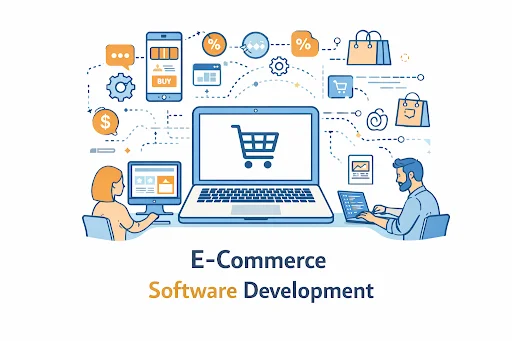
The systems and features that help a retail brand sell, manage, and scale online are all part of e-commerce software development. A contemporary business setup consists of a storefront, product data management, checkout, payment, inventory, order, customer accounts, and reporting. In the case of retail brands, the objective is to facilitate sales, operations and customer experience using fewer process gaps.
Many brands begin exploring custom or semi-custom solutions when packaged tools stop fitting the way the business actually works. Some evaluate external partners through https://brainence.com/e-commerce-software-development-company/ while comparing what should be built, integrated, or replaced. Practical decisions matter here because commerce software affects daily trading activity rather than isolated back-office tasks.
What E-Commerce Development Usually Includes
E-commerce development becomes more important when product volume grows, operational workflows become more complex, or different systems need to exchange data reliably.
Storefront and Customer Experience
The storefront is the most visible part of an e-commerce system, but it is only one layer of the overall software environment. Product pages, search, filtering, cart behavior, account access, and mobile responsiveness all influence how smoothly customers move from browsing to purchase.
Retail brands usually need these features to perform consistently across devices and campaigns. Weak storefront logic can reduce conversion even when traffic quality is strong.
Back-End Operations and Order Flow
A working online shop depends on what happens after the customer clicks buy. Order routing, stock updates, shipping logic, returns handling, and customer notifications all need to work with minimal friction. Operational reliability matters because retail teams often process many orders under time pressure. A weak back end can create customer-facing problems very quickly.
Integrations With Other Systems
E-commerce software often needs to connect with ERP platforms, payment tools, warehouse systems, CRMs, tax services, and marketing tools. Growth usually increases the importance of these connections because more teams depend on the same data.
The integration needs below often influence software design decisions early:
- Real-time stock synchronization
- Order data transfer into ERP or accounting tools
- Payment and refund status updates
- Customer data flow into marketing systems.
Why Retail Brands Move Beyond Basic Solutions

Packaged e-commerce tools can support many businesses well, but growth often exposes operational limits. A retail brand may still process sales successfully while losing time through workarounds, manual corrections, or reporting gaps.
More Complex Product and Pricing Logic
Retail brands often outgrow simple catalog structures. Product bundles, regional pricing, promotions, subscription models, and channel-specific offers can all create complexity that standard setups handle poorly.
Custom development becomes more relevant when pricing and product logic are tied closely to how the business competes. Flexibility matters more once growth depends on more than basic online selling.
Multi-Channel and Multi-Team Coordination
Many retail businesses sell through more than one channel. Ecommerce sites, marketplaces, physical stores, wholesale operations, and social platforms often need to work from a shared operational model.
Cross-channel coordination usually becomes harder when systems are disconnected. A stronger software foundation helps retail teams reduce duplicate work and improve visibility across channels.
The business pressures below often push brands toward more tailored development:
- Higher order volume across several channels
- More frequent stock and catalog updates
- Greater reporting demand from finance and operations
- More customer service pressure during peak periods
- Stronger need for workflow automation.
Better Control Over Growth
Retail growth often creates software questions about scalability, speed, and internal control. A system that worked well at one stage may become restrictive once the brand adds more traffic, regions, warehouses, or product lines. More control usually means deciding where standard tools are enough and where custom development will reduce long-term friction.
What Brands Should Review Before Starting
A useful development decision starts with operational clarity. Retail brands should know where current software creates delays, where manual work is increasing, and which processes are becoming harder to scale. Without that review, development planning often turns into a list of disconnected feature requests instead of a response to real commercial and operational pressure.
A stronger starting point usually comes from mapping the full path from product data and storefront behavior to payment, fulfillment, returns, and reporting. Clearer visibility into those pressure points makes it much easier to define whether the business needs custom development, deeper integration work, or a more selective system upgrade.
A Practical Way to Assess E-Commerce Development
Retail brands benefit most when e-commerce development is treated as an operational investment rather than a website redesign project. Storefront quality matters, but order flow, integrations, pricing logic, and reporting usually have just as much influence on business performance.
A practical review starts with real workflow pressure points. When a brand identifies where software is slowing sales, creating manual effort, or limiting visibility, it becomes easier to decide what kind of development will actually support growth.
Connect the dots—see how this applies to your bottom line at 2A Magazine.