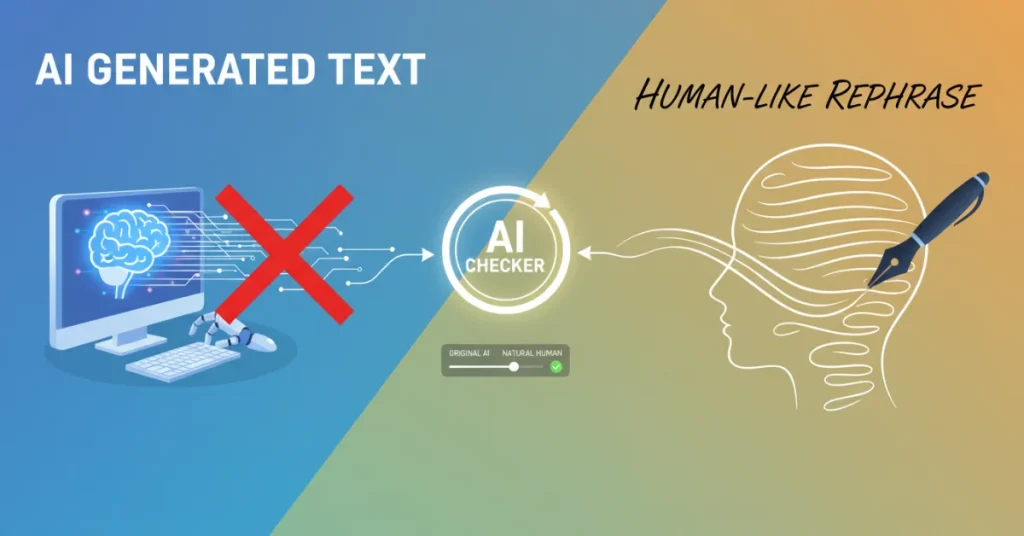
AI tools have changed how fast we write, but they have also changed how often we hesitate. Many writers finish a draft and pause, unsure whether the content sounds convincing or simply automated. That uncertainty slows teams to Dechecker AI Checker, frustrates students, and complicates professional review. Dechecker was built for this moment, helping writers move from doubt to decision with clarity and control.
The New Reality of AI-Assisted Writing
Speed without assurance creates friction
AI makes drafting effortless, yet confidence rarely keeps pace. Writers now spend more time questioning finished work than producing it. This is usually where an AI Checker enters the workflow, not as a correction tool, but as a way to confirm whether hesitation is justified.
Human judgment alone no longer scales
Editors once relied on experience to spot artificial phrasing. As AI output becomes smoother, that instinct weakens. Even seasoned reviewers struggle to explain why something feels off, only that it does.
Risk has shifted from grammar to perception
Most AI text is technically correct. The real risk lies in how readers interpret tone, intent, and originality. Dechecker addresses that gap by focusing on signals people subconsciously notice.
Dechecker as a Process Tool, Not a Shortcut
From reaction to structured evaluation
Instead of reacting emotionally to suspicion, Dechecker introduces a repeatable review step. Writers can assess text, decide what matters, and move forward without endless rewrites.
Making revision intentional
Not every flagged sentence deserves attention. AI Checker or Dechecker AI Checker highlights patterns, allowing writers to focus effort where it actually changes perception.
Supporting consistent standards
In teams, disagreements about “AI-ness” can stall projects. Dechecker creates a shared reference point that aligns decisions across roles.
Where AI Checker Changes Outcomes
Draft review before heavy editing
Running checks early prevents wasted effort. Writers learn which sections already work and which deserve refinement.
Detecting structural predictability
AI Checker or Dechecker AI Checker surfaces subtle repetition in sentence length, transitions, and phrasing that humans often miss during close reading.
Knowing when a draft is finished
Sometimes the most valuable result is confirmation. Dechecker helps writers stop editing when changes no longer improve authenticity.
Understanding Why Readers Sense AI
Uniform confidence feels unnatural
Human writing shifts tone as ideas develop. AI often maintains even confidence, which can feel rehearsed rather than thoughtful.
Rhythm influences trust
Readers respond to pacing instinctively. Overly balanced sentences reduce engagement, even if meaning remains clear.
Learning through repeated feedback
Using AI Checker or Dechecker AI Checker regularly sharpens awareness. Writers begin adjusting drafts instinctively, reducing reliance on tools over time.
Humanizing Without Erasing Intent
Deciding when rewriting matters
Detection alone does not solve perception issues. When multiple signals cluster, rewriting becomes a strategic choice rather than a reflex.
Using AI Humanizer with restraint
In those moments, the AI Humanizer helps vary rhythm and emphasis without changing meaning. It works best as a targeted adjustment, not a full rewrite.
Reviewing changes critically
Writers retain authority by comparing versions. The goal is improved flow, not hiding AI use at all costs.
Academic Writing Under Closer Scrutiny
Students navigating blurred boundaries
Many students use AI to explore ideas responsibly, yet worry about how submissions will be judged. Dechecker gives them visibility before consequences appear.
Educators balancing fairness and workload
Manual detection is inconsistent and exhausting. AI Checker provides a standardized reference that supports objective evaluation.
Teaching responsible AI use
Seeing how small edits affect results helps students understand writing mechanics rather than simply avoiding detection.
Marketing and Content Operations at Scale
Volume amplifies patterns
High output increases the chance of repetitive AI structures. Dechecker identifies these trends before audiences disengage.
Protecting brand tone
Marketing copy depends on nuance. AI Checker reveals where generic phrasing undermines differentiation.
Maintaining speed without sacrificing trust
Dechecker allows teams to publish quickly while preserving credibility, avoiding last-minute rewrites driven by doubt.
Professional Documents and Decision Risk
Pre-delivery verification
Reports, proposals, and policies carry reputational weight. Dechecker adds a final checkpoint that reduces exposure.
Aligning stakeholders
When reviewers disagree on tone, AI Checker results ground discussion in observable patterns rather than opinion.
Demonstrating responsible AI governance
Organizations increasingly need to show how AI is managed. Dechecker supports transparent, controlled use rather than unchecked automation.
Developing Stronger Writing Systems
From dependence to intuition
Over time, writers move from relying on AI outputs to anticipating AI Checker feedback instinctively. They begin spotting sentences that might appear mechanical and adjust them proactively, improving draft quality even before any formal review. This shift transforms writing into a more thoughtful, deliberate process, where intuition guides refinements and reduces reactive editing.
Improving prompts upstream
Learning how AI Checker evaluates text helps writers design better prompts and structure instructions more effectively. By guiding AI output intentionally, they produce initial drafts that are coherent, natural, and stylistically consistent. This proactive approach decreases the need for extensive revisions later and strengthens control over the creative process.
Confidence replaces second-guessing
As writers become familiar with feedback patterns, uncertainty gives way to assurance. They spend less energy worrying about detection flags or mechanical phrasing and more on crafting clear, purposeful content. Confidence grows alongside skill, allowing the focus to shift from fear of mistakes to delivering meaningful, human-centered writing.
Writing Forward With Structure and Trust
AI is now embedded in writing workflows. The challenge is not avoiding it, but managing it responsibly. Dechecker supports that management quietly, without interrupting momentum.
By integrating AI Checker or Dechecker AI Checker insights with selective humanization, writers and teams create work that reads naturally and holds up under review. The result is faster decisions, clearer accountability, and writing that earns trust in an AI-saturated environment.
Dive deeper into ideas that matter to you at 2A Magazine.