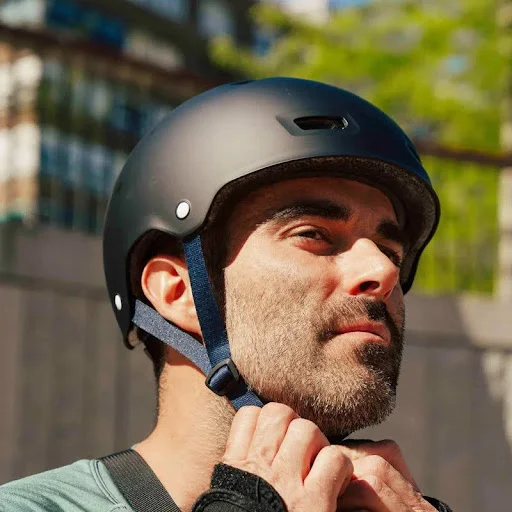
Here’s an uncomfortable truth about bike commuting: a huge number of people who diligently wear a helmet every day are wearing it in a way that quietly undermines its protection. Tilted back, straps dangling loose, perched on top of the head like a hat. The helmet is there — it’s just not positioned to do its job.
The good news is that getting it right takes about two minutes and zero extra money. Here’s how to actually wear, fit, and look after a helmet so it protects you the way it’s designed to.
Why fit matters more than the helmet itself
A modest helmet that fits perfectly will protect you better than an expensive one that’s loose or crooked. That’s because a helmet only works if it stays put and stays in the right position during a fall. A helmet that shifts, slides, or rocks around has already lost half its value before anything happens.
So before you think about features or price, the single highest-value thing you can do is get the fit dialed in. Everything else is secondary to that.

The two-minute fit check
Run through this whenever you put on a helmet, and especially with a new one:
- Level, not tilted. The helmet should sit level on your head, with the front edge about two finger-widths above your eyebrows. Pushed back off the forehead is the single most common mistake — it leaves your forehead exposed exactly where you’d hit it.
- Snug, not loose. It shouldn’t rock side to side or front to back when you shake your head. Use the rear adjustment dial (most helmets have one) to tighten the cradle until it’s secure but not painful.
- Straps form a “V” under each ear. The side straps should meet just below and slightly forward of your earlobe.
- Chin strap check. You should be able to fit no more than one or two fingers between the strap and your chin. Open your mouth wide — the helmet should press down slightly. If it doesn’t, tighten up.
If it passes all four, you’re wearing it correctly. If not, two minutes of adjustment fixes it.
How far helmets have come
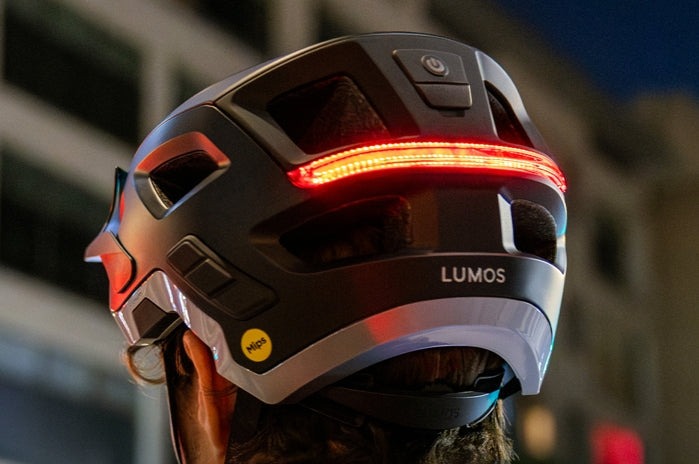
If it’s been a few years since you bought a helmet, it’s worth knowing how much the technology has moved on — because a lot of people are protecting their commute with gear from a decade ago. Modern helmets are lighter, far better ventilated, and many now build in rotational-impact protection systems and integrated lighting that older models never had. Some helmet brands like Lumos have pushed the category furthest, building lights and turn signals directly into the shell so the helmet does double duty as a visibility tool.
The point isn’t that you must rush out and replace a helmet that fits and works. It’s that “a helmet is a helmet” hasn’t been true for years, and it’s worth knowing what’s changed before your next one.
Habits that keep a helmet protecting you
A correctly fitted helmet still needs a little care to stay that way:
- Don’t hang it by the straps or toss it in the bottom of a bag. Knocks and compression degrade the protective foam over time.
- Keep it out of hot cars. Repeated extreme heat breaks down the foam faster than normal use.
- Clean it gently. Mild soap and water on the pads; harsh chemicals can weaken the materials.
- Re-check the fit periodically. Pads compress, dials loosen, and a helmet that fit perfectly last year may have drifted. Thirty seconds every few months keeps it honest.

Know when it’s genuinely time to replace
Fit and care extend a helmet’s life, but not forever. Replace it without hesitation if it’s taken any real impact — the protective foam crushes on impact and can’t do its job twice, even if the shell looks fine. Beyond crashes, most manufacturers suggest replacing a helmet every few years as the materials age.
When that day comes, treat it as an upgrade rather than a like-for-like swap. Browsing a current bike helmet range will show you how much better fit systems, ventilation, and built-in visibility have become — so your replacement does more for you than the one it’s retiring, not just the same job in a newer shell.
Two minutes now, every ride from now on
None of this is complicated. Get the helmet level, snug, and strapped properly; treat it with a bit of care; re-check the fit now and then; and replace it when it’s genuinely due. That’s the whole list.
The best helmet in the world does nothing sitting crooked on the back of your head. The cheapest one, worn correctly, is quietly doing exactly what it should every single time you ride. Spend the two minutes — your future self will be glad you did.
Ride safe out there.
The one guide our clients are obsessing over today at 2A Magazine.