Ever wondered why many small or medium-sized enterprises (SMEs) struggle with their financial reporting and cash flow as they expand?
The reason is that financial complexity increases more rapidly than the operational capacity. Plus, managing finances internally can be expensive and inefficient.
As costs and margins tighten, 77% of SMEs report that budgetary pressure increases, with staff and regulatory compliance cited as significant burdens.
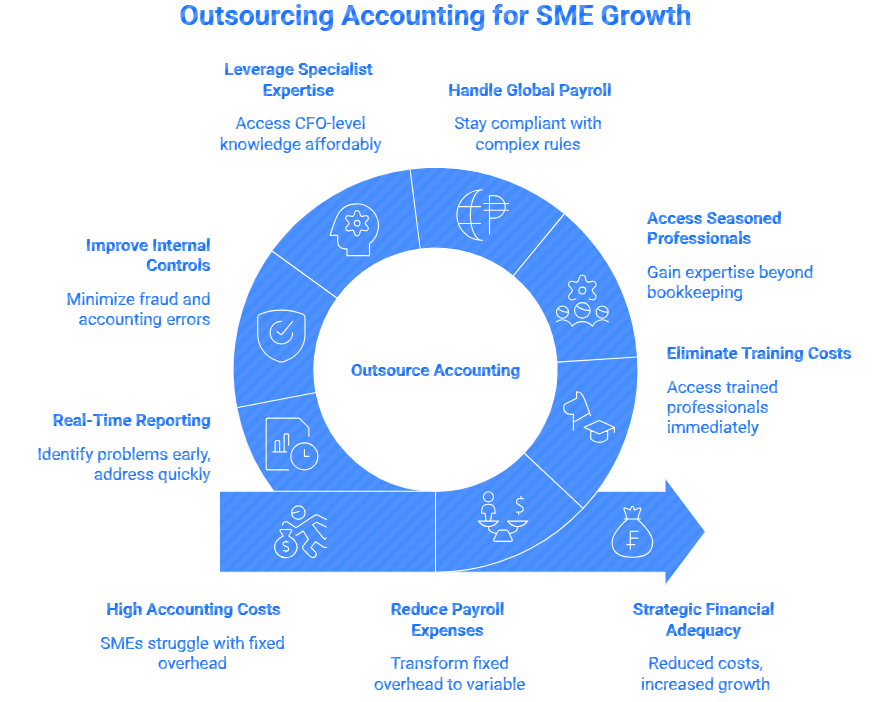
Conventional in-house accounting usually entails significant payments for salaries, benefits, training, and software licenses. Conversely, through third-party accounting, one can access highly qualified accountants and other financial professionals at a very low cost and save up to 75% of the total cost of employing full-time employees.
In light of that, small businesses that are outsourcing accounting and bookkeeping services in usa are not only saving money but also enjoying better compliance and accuracy. Research indicates that they have fewer financial errors and improved reporting quality.
Third-party accounting is not only a cost-saving measure but also provides SMEs with a competitive advantage by ensuring they remain compliant and can grow without necessarily creating an in-house accounting department, which would require time and cost.
Access to Experts and Cost Efficiency
Reduce Payroll and Hiring Expenses:
The high cost of having an in-house accounting team is one of the biggest headaches for SMEs. Salaries, benefits, payroll taxes, recruitment fees, and training costs can mount up very rapidly, in fact, 20%-60% of a business’s finance budget. Outsourcing eliminates this fixed overhead and transforms it into a variable, pay-as-you-use cost structure.
Instead of paying a single accountant full salary, outsourced accounting allows you to access a pool of specialists at a small fraction of the cost – SMEs can save 40%-60% of the cost of having an accountant on staff.
Training Expenses Eliminated:
Salary is not the only expense when hiring a new employee. Onboarding, certifications, continuing education, and system training require time and money, too.
The outsourced providers already have trained professionals who are familiar with the current regulations, reporting standards, and best practices in finance.
Immediate Access to a Seasoned Professional:
By creating an internal finance team, SMEs usually gain the experience of one person.
In contrast, outsourced accounting gives SMEs immediate access to a deep bench of accounting talent who bring broader expertise from working across multiple clients in similar industries.
Additionally, third-party accounting service providers often have U.S.-based management actively involved in onboarding, training, and continuous guidance of their teams, ensuring consistent quality and alignment with client expectations.
Examples in the Industry: Better Outcomes and Real Savings:
Consider the case of a new product line introduced by an SME or at the end of a high season. It can take weeks to recruit and train employees to work for the company.
In contrast, outsourcing is plug-and-play. An outsourced team can scale up immediately to handle increased transaction volumes, without long lead times. This flexibility helps businesses avoid both over-hiring during peaks and under-staffing when demand surges.
Cloud accounting and automation enable outsourced teams to generate real-time cash flow reports and process invoices much faster, and to assist businesses in changing plans on the fly, which is difficult for smaller teams that have to do so manually.
Proficiency That SMEs Can Hardly Afford In-house:
Rather than recruiting a single generalist accountant, SMEs can take advantage of specialists in areas such as:
- Inventory management
- Cash flow management
- Financial planning and analysis
- Financial reporting
This depth of expertise is available from outsourced providers, as they serve many customers and spread the burden of specialization across them. This implies that small businesses will receive CFO-level knowledge without CFO-level salaries.
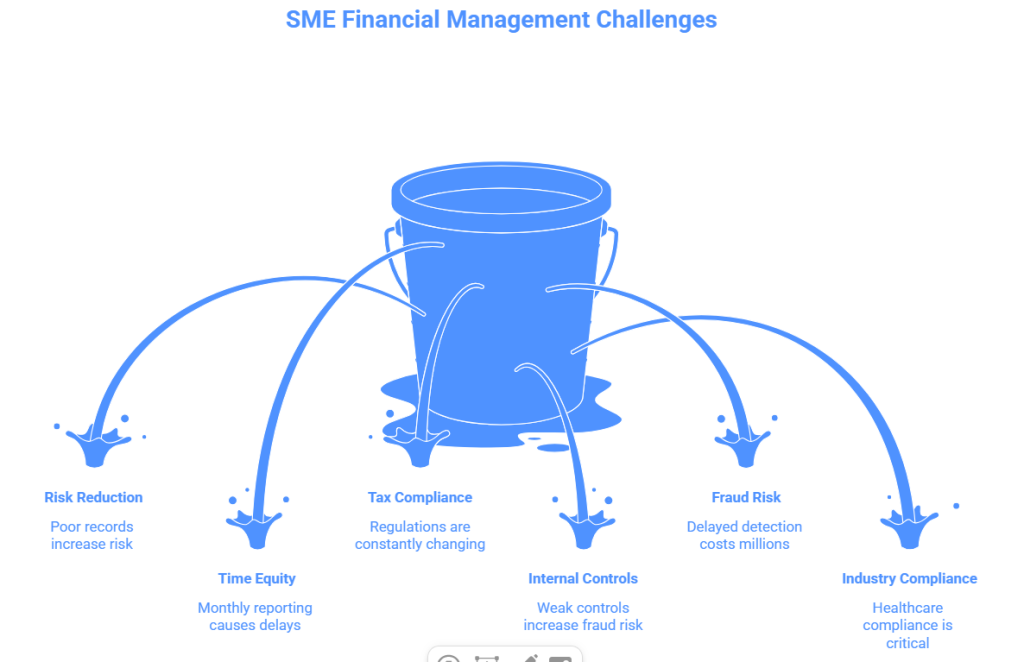
Time Equity in Reporting: End-of-Month to Real-Time:
The majority of small businesses maintain monthly reporting. However, modern finance requires real-time visibility. According to a Deloitte study, companies that rely on professional accounting services have easy access to performance-related information and can thus address problems early, before they escalate.
In practice, this implies that SMEs will be able to identify cash-flow shortages, sluggish receivable collections, or sudden cost increases weeks or months earlier than with conventional in-house accounting.
Tax Compliance- Evading Financial Fines:
The tax regulations of the U.S. federal, state, and local governments are in constant flux. The IRS updates its guidelines and interpretations hundreds of times annually on its own. As a core service, a third-party provider keeps them up to date.
According to a study published in the Journal of Accounting and Taxation, outsourced firms with taxation and compliance functions are much less likely to incur fees or penalties for late filing than those with internal generalists.
A case in point: a regional retailer that outsourced tax planning and compliance saved almost $50,000 in late-payment and misclassification fines after two years by changing its reporting and withholding procedures to meet changing regulations.
Effective Internal Controls- Inherent Controls:
Internal controls, checks, and balances in the way financial information is recorded and accessed are also poor in SMEs, due to owners’ assumption that it is merely bookkeeping. However, weak controls are among the known risk factors for fraud, errors, and misstatements in financial data.
The COSO Framework (used as a universally accepted best practice) highlights segregation of responsibilities, reconciliation procedures, and audit trails – all fundamental components of professional third-party accounting services.
When automated and supervised by skilled teams, these controls provide SMEs with inherent shields that minimize the risk of unrecognized fraud and accounting errors.
Fraud Risk- Early Warning and Detection:
The ACFE’s Report to the Nations claimed that fraud cases identified through tip or early-detection programs save organizations millions of dollars compared to the cost of delayed detection. Outsourced providers regularly monitor financial trends and suspicious variances, providing SMEs with early warning signs that an internal team might miss due to workload or limited experience.
Industry Case Study- Healthcare Compliance:
In the healthcare industry, compliance is never a choice; it is life and death – and money as well. An intermediate-sized clinic has engaged external accounting and compliance services. The results? Reduction of 24% in coding errors and billing discrepancies that caused stricter reimbursements and a decrease in audit complaints.
According to a recent Health Affairs study, outsourced compliance expertise significantly reduces regulatory reporting errors among healthcare SMEs.
Strategic Focus and Scalability:
Grow Without Growing Costs
Scalability is one of the greatest untold advantages of outsourced accounting. Studies conducted by McKinsey indicate that a company with administrative functions can outsource them to expand operations without the resulting increases in employee numbers, expenses, and management overhead.
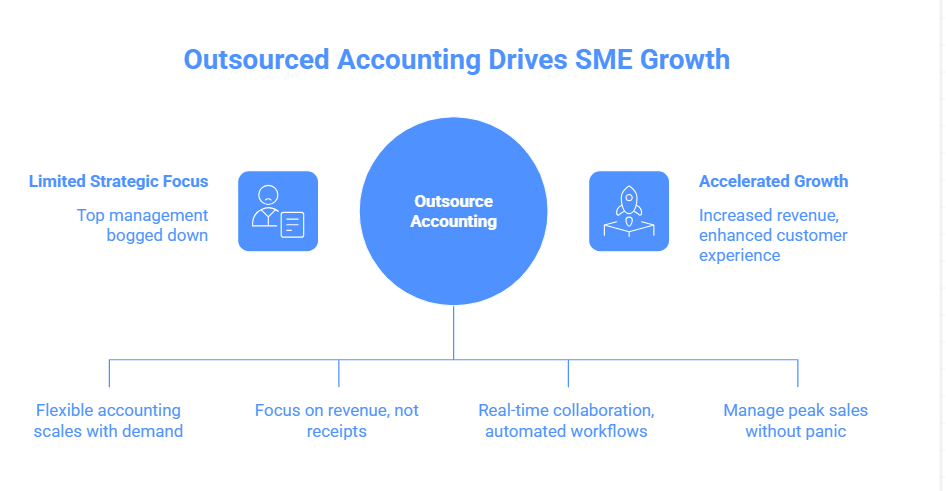
In the case of SMEs, this means flexible accounting services that scale up and down with demand – be it opening new facilities, new products, or broadcasting of sales channels.
The Bookkeeping Business To Business Insight
Outsourced accounting frees top management from day-to-day bookkeeping so they can concentrate on strategy. The Harvard Business Review article on the dynamics of SME growth suggests that owners who shift away from operational work and focus on strategic leadership increase revenue more rapidly and respond better to market changes.
Rather than looking at invoices, the owners can assess pricing strategy, strategize expansion, or negotiate financing, all high-value items that will bring about growth as opposed to mere maintenance of the lights.
Cloud Tools and Scalability
Contemporary outsourced accounting services are based on cloud-based ERP and financial management systems, such as NetSuite, QuickBooks Online, and Xero.
SMEs do not need to spend much on servers or software. The cloud automatically scales as transactions increase – your outsourced team will take care of configuring and securing the cloud.
Seasonal Versatility- Peak Without Panic:
Businesses that rely on retailers, restaurants, and holiday volume tend to experience extreme up-and-down variations. Outsourced accounting also gives SMEs the flexibility to manage peak sales without hiring temporary staff or paying overtime.
A survey by Forbes Insights suggested that companies that had outsourced finance teams reported less operational stress during peak seasons and a shorter financial close cycle than those with only internal teams.
Strategic Focus:
As the administration is outsourced, internal leadership acquires cognitive capacity to think about revenue. The CEOs will be able to dedicate more of their time to customer experience, product development, and business growth – rather than receiving receipts.
A Deloitte study of SME growth trends found that companies outsourcing accounting operations were more strategic in their emphasis on core differentiators (including marketing, customer acquisition, and innovation), leading to greater profitability and rapid market response.
Scaling Technology Startup:
A US technical start-up that employed an outsourced accounting partner reduced financial close time by half and redirected its leadership focus to its sales strategy. Revenue increased by 70% over 18 months, mainly due to accelerated decision-making and price optimization, which relied on reliable financial information.
Growth Enabling Scalability:
Accounting Services Outsourcing grows with your company. It is not only about saving time, but also about freeing administration leadership from needing to manage staff responsibilities. So they can focus on strategic initiatives that drive revenue, enhance the customer experience, and build competitive advantage.
Conclusion:
Accounting is not a back-office job; it is a growth enabler:
Third-party accounting and bookkeeping services have not only been used to save on bookkeeping costs. It has become a significant ingredient in the expansion of financial capability, an element that numerous SMEs would not develop internally. The rising regulatory pressure, falling profit margins, and the rapid pace of business development make traditional accounting models ineffective, dangerous, and limited.
Outsourcing provides SMEs with real-time visibility, accurate financial reporting, enhanced compliance, and stronger controls and risk management. It also makes senior experts accessible to them, enabling managers to make better decisions.
The trend is the same across industries: healthcare, retail, tech startups, multi-location restaurants, etc.: the companies that view accounting as a strategic operation are more successful than those that view it as mere paperwork.
Expertise Accelerated professional accounting services strengthens business, particularly when errors are costly and time is of the essence. It allows SMEs to evolve without stutter, remain within the confines of compliance without fear, and make considered decisions.