
When you operate an LLC, you may eventually be asked to prove that your business is active, properly registered, and compliant with state requirements. This request often comes up when opening a business bank account, applying for financing, registering to do business in another state, signing a major contract, or renewing certain licenses.
The document used to prove this status is commonly called a Certificate of Good Standing. However, in many states, it goes by another name: a Certificate of Status.
So, what is a Certificate of Status for an LLC? In simple terms, it is an official state-issued document confirming that your limited liability company legally exists and is authorized to conduct business in the state where it is registered. It shows that your LLC has met the basic compliance requirements maintained by the Secretary of State or similar state agency.
Although the document is usually short, it can play an important role in business transactions. Banks, lenders, investors, vendors, government agencies, and other states may request it before they agree to work with your company.
This guide explains what a Certificate of Status is, when an LLC may need one, how it differs from other business documents, and how to request one.
What Does a Certificate of Status Mean?
A Certificate of Status is an official certificate issued by a state business filing agency. It confirms that an LLC is currently recognized by the state and has not been administratively dissolved, revoked, or otherwise marked inactive in the state’s records.
For an LLC, the certificate typically confirms that:
• The LLC is legally registered with the state.
• The LLC currently exists in the state’s business records.
• The LLC has met key state filing requirements.
• The LLC has paid required state fees, when applicable.
• The LLC is authorized to conduct business in that state.
The exact language depends on the state. Some states use the phrase “active,” while others use “in existence,” “in good standing,” or “authorized.” The basic purpose is the same: the certificate gives third parties official confirmation that your LLC is valid and compliant according to the issuing state.
Is a Certificate of Status the Same as a Certificate of Good Standing?
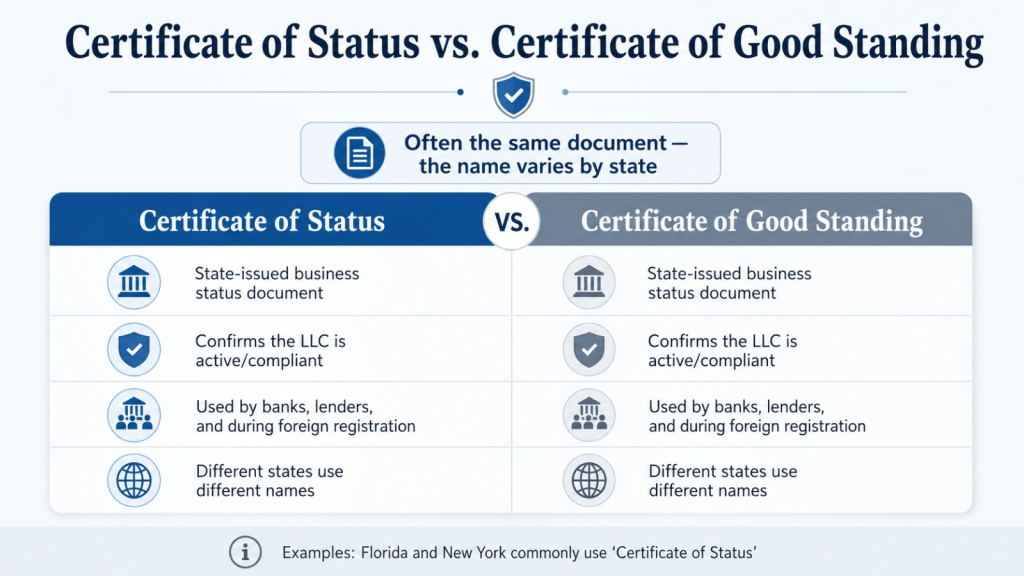
In many cases, yes. A Certificate of Status and a Certificate of Good Standing often serve the same practical purpose. Both documents are used to verify that a business entity exists and is compliant with the state’s requirements.
The difference is mostly terminology.
Some states call the document a Certificate of Good Standing. Others call it a Certificate of Status, Certificate of Existence, Certificate of Fact, Certificate of Compliance, or Certificate Under Seal.
For example, Florida commonly uses the term Certificate of Status. New York also uses Certificate of Status for business entities. Other states may use Certificate of Good Standing or a different official name.
Because the name varies by state, business owners often search for the same document using different terms. If someone asks for your LLC’s Certificate of Good Standing, but your state issues a Certificate of Status, you are usually looking for the same type of proof.
What Information Is Included in a Certificate of Status?
A Certificate of Status is usually a concise document, often one page. It does not include every detail about your LLC, but it does include enough information to verify the company’s legal standing.
A typical Certificate of Status may include:
• The LLC’s legal name.
• The state filing or document number.
• The date the LLC was formed or authorized.
• A statement that the LLC is active, valid, or in existence.
• A statement that the LLC has satisfied applicable state filing requirements.
• The date the certificate was issued.
• The signature or authentication of the issuing state office.
• The state seal or electronic verification details.
Some states also include a tracking number, document number, or validation code that allows the certificate to be verified online.
Why Would an LLC Need a Certificate of Status?
Most LLCs do not need to keep a Certificate of Status on hand every day. It is usually requested for a specific transaction or compliance purpose.
Here are the most common reasons an LLC may need one.
Opening a Business Bank Account
Some banks request a Certificate of Status when opening a business checking account, especially if the LLC is newly formed, registered in another state, or has limited business history.
The bank may also request your Articles of Organization, EIN confirmation letter, operating agreement, and identification for the owners or authorized signers. The Certificate of Status helps the bank verify that the LLC exists and is active with the state.
Applying for a Loan or Line of Credit
Lenders often want to confirm that a business is legally active before approving financing. A Certificate of Status may be requested during the underwriting process for a loan, line of credit, equipment financing, SBA-related financing, or other business funding.
For lenders, the certificate reduces uncertainty. It shows that the LLC has not been dissolved or suspended and that the company is recognized by the state.
Registering as a Foreign LLC in Another State
If your LLC was formed in one state but wants to do business in another, you may need to register as a foreign LLC in the new state. During that process, the new state may ask for a recent certificate from your home state.
For example, if your LLC was formed in Florida and you want to register it in another state, that state may ask for a Florida Certificate of Status. If your LLC was formed in New York, the new state may ask for a New York Certificate of Status.
This requirement helps the second state confirm that your LLC is valid in its original jurisdiction before granting authority to operate there.
Signing Contracts or Vendor Agreements
Larger companies, government agencies, and institutional clients may request a Certificate of Status before signing a contract. This is especially common when the contract is high value, long term, regulated, or involves sensitive services.
The requesting party wants to know that the LLC is legally active and able to enter into the agreement.
Applying for Licenses or Permits
Some professional licenses, local permits, and industry-specific registrations may require proof that the business is in good standing with the state. A Certificate of Status can satisfy this requirement when the agency wants official verification rather than a screenshot from a state database.
Selling a Business or Bringing in Investors
If an LLC is being sold, merged, financed, or restructured, the buyer, investor, attorney, or due diligence team may request a Certificate of Status. It is a simple way to confirm that the LLC is still legally recognized before the transaction moves forward.
Applying for Business Credit Cards
Credit card companies may also request verification documents for an LLC, especially for larger credit lines or newer businesses. A Certificate of Status can help confirm the company’s legal existence and current status.
Does Every LLC Automatically Have a Certificate of Status?
No. A Certificate of Status is usually not automatically issued when you form an LLC unless you specifically request it or select it as an optional add-on during formation.
When you form an LLC, the state typically provides approved Articles of Organization or a filing confirmation. That proves the LLC was formed. However, a Certificate of Status is a separate document that verifies the company’s current status at the time the certificate is issued.
This distinction matters. Your formation documents show that your LLC was created. A Certificate of Status shows that your LLC is currently active and compliant according to state records.
How Long Is a Certificate of Status Valid?
A Certificate of Status usually does not have a fixed expiration date printed on it. However, many banks, lenders, agencies, and other requesting parties require a recent certificate.
In practice, a certificate may need to be dated within the last 30, 60, or 90 days, depending on the institution requesting it.
This is because a company’s status can change. An LLC that was active six months ago may later miss an annual report, fail to pay a required fee, lose authority, or become inactive. For that reason, third parties often ask for a recently issued certificate.
If someone requests a Certificate of Status from your LLC, ask whether they have a recency requirement. This can help you avoid ordering the document too early.
What Can Prevent an LLC from Getting a Certificate of Status?
An LLC usually must be active and compliant before the state will issue a Certificate of Status. If your LLC has unresolved compliance issues, the state may reject the request or show a status that does not satisfy the requesting party.
Common issues include:
• Missed annual reports.
• Unpaid state fees.
• Late franchise taxes or state taxes, where applicable.
• Failure to maintain a registered agent.
• Administrative dissolution.
• Revocation of authority for a foreign LLC.
• Suspension for failure to meet state-specific requirements.
In some states, compliance with certain tax agencies may also affect good standing. In others, the Secretary of State focuses mainly on business filings and state records.
If your LLC is not eligible for a Certificate of Status, you will usually need to correct the issue first. That may mean filing a missing report, paying a fee, reinstating the LLC, updating registered agent information, or resolving another state compliance matter.
Certificate of Status vs. Articles of Organization
A Certificate of Status is often confused with Articles of Organization, but the two documents are not the same.
Articles of Organization are the formation documents filed to create an LLC. They usually include the LLC’s name, registered agent, principal office, organizer, and other required information depending on the state.
A Certificate of Status is issued after formation and confirms the LLC’s current status.
In other words:
• Articles of Organization prove that the LLC was formed.
• A Certificate of Status proves that the LLC is currently active or in good standing.
Many banks and agencies may ask for both. The Articles of Organization show the legal creation of the company. The Certificate of Status shows that the company remains valid today.
Certificate of Status vs. Certified Copy
A certified copy is also different from a Certificate of Status.
A certified copy is an official copy of a filed document, such as Articles of Organization, Articles of Amendment, or a merger filing. It verifies that the copy is a true and correct copy of the document on file with the state.
A Certificate of Status does not usually attach or reproduce your formation document. Instead, it certifies the company’s current standing.
You may need a certified copy when someone wants to review a specific filing. You may need a Certificate of Status when someone wants to verify that the LLC itself is active and compliant.
Certificate of Status vs. Business License
A Certificate of Status is not a business license.
A business license gives a company permission to operate in a particular city, county, profession, or regulated industry. It may be issued by a local government, state licensing board, or other regulatory agency.
A Certificate of Status simply confirms the LLC’s status with the state business filing office.
For example, a restaurant may need a business license, food service permit, sales tax registration, and other approvals. Its Certificate of Status does not replace those licenses. It only shows that the LLC itself is active in state records.
How to Get a Certificate of Status for an LLC
The process varies by state, but the general steps are similar.
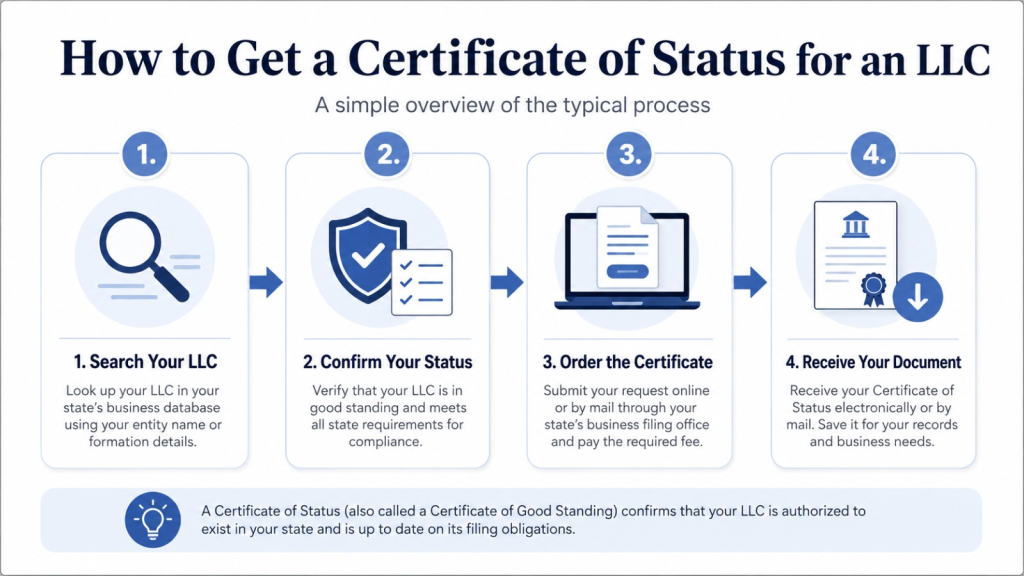
To get a Certificate of Status for an LLC:
• Identify the state where your LLC is registered.
• Search for your business in the state’s business entity database.
• Confirm that the LLC name, filing number, and status are correct.
• Check whether your LLC is eligible for a certificate.
• Resolve any compliance issues if the company is inactive or delinquent.
• Place the certificate order with the state or through a document retrieval service.
• Download or receive the certificate once issued.
If your LLC was formed in Florida, request the certificate from Florida. If your LLC was formed in New York, request it from New York. If your LLC is registered as a foreign LLC in another state, you may need a certificate from the state where the requesting party wants proof.
Getting a Certificate of Status in Florida
Florida is one of the states where this document is commonly called a Certificate of Status. It is issued by the Florida Department of State, Division of Corporations.
A Florida Certificate of Status confirms that the LLC exists in Florida’s records and has satisfied the applicable filing and fee requirements maintained by the Division of Corporations.
Business owners often need this document when opening accounts, applying for financing, registering in another state, or proving that a Florida LLC is active. If you need help obtaining a certificate of status Florida, you can order it online through a document retrieval service that handles the request process for you.
Florida also allows online validation for certain certificates, which can be helpful when a bank, lender, or third party wants to confirm that the document is authentic.
Getting a Certificate of Status in New York
New York also uses the term Certificate of Status for business entities. It is issued by the New York Department of State, Division of Corporations.
A New York Certificate of Status confirms that a corporation, LLC, or other business entity exists in the state’s records. It may also be referred to as a Certificate of Good Standing or Certificate of Existence in general business conversations.
New York LLCs may need this certificate for financing, contracts, foreign qualification, legal transactions, or institutional due diligence. If your company needs a certificate of status New York, you can request assistance online and avoid navigating the process on your own.
New York also has state-specific LLC compliance rules that business owners should keep in mind, including publication requirements for many newly formed LLCs. If your LLC has unresolved compliance issues, you may need to address them before a certificate can be issued or accepted by the requesting party.
Can a New LLC Get a Certificate of Status Right Away?
In many cases, yes. A newly formed LLC can often request a Certificate of Status once the state has approved the formation filing and updated its business records.
However, timing depends on the state. Some states update records quickly and can issue certificates almost immediately. Others may require additional processing time before the LLC appears as active or eligible in the database.
If you just formed an LLC and need a certificate for a bank account or financing, make sure your Articles of Organization have been approved and your LLC appears in the state’s business search system.
Do Single-Member LLCs Need a Certificate of Status?
A single-member LLC may need a Certificate of Status for the same reasons as any other LLC. The number of owners does not usually determine whether the certificate is required.
A single-member LLC may be asked for a certificate when opening a bank account, applying for a business credit card, registering in another state, entering a major contract, or applying for certain licenses.
Even if your LLC has only one owner, it is still a legal entity registered with the state. A Certificate of Status confirms that the entity remains active.
Do Foreign LLCs Need a Certificate of Status?
A foreign LLC is an LLC that was formed in one state but is registered to do business in another. Foreign LLCs often need certificates during registration and compliance processes.
For example, if an LLC formed in Florida wants to register as a foreign LLC in New York, New York may require proof that the Florida LLC exists and is in good standing in Florida. That proof typically comes from a recent certificate issued by the home state.
Foreign LLCs may also need certificates from the states where they are authorized to do business, depending on the transaction.
How Much Does a Certificate of Status Cost?
The cost depends on the state, entity type, delivery method, and whether expedited processing is available. Some states charge only a small fee. Others charge more, especially for expedited or paper certificates.
There may also be additional fees if you use a document retrieval service, need rush handling, or need multiple certified documents.
Before ordering, confirm:
• The correct state.
• The official document name.
• The state filing fee.
• The delivery format.
• The expected processing time.
• Whether expedited service is available.
• Whether the requesting party needs a certificate dated within a specific timeframe.
Should You Order a Certificate of Status Yourself or Use a Service?
Many business owners can order a Certificate of Status directly from the state. This may be the best option if you are familiar with the process, know exactly which document you need, and have time to handle the request.
However, a document retrieval service can be helpful when:
• You are not sure which certificate your state issues.
• You need the document quickly.
• You are ordering for a state you are unfamiliar with.
• You want help avoiding mistakes.
• You need certificates for multiple states.
• You are handling a time-sensitive transaction.
• You prefer a guided online process.
A service does not replace the state agency. The certificate is still issued by the appropriate government office. The service simply helps submit, track, and retrieve the document for you.
Practical Tips Before Ordering
Before you request a Certificate of Status for your LLC, take a few minutes to confirm the details.
Make sure the LLC’s legal name is spelled correctly. Even small differences can delay processing or cause confusion.
Check the LLC’s state status in the official business database. If the company is inactive or delinquent, fix that first.
Ask the requesting party how recent the certificate must be. If they require a certificate issued within 60 days, an older document may not be accepted.
Confirm whether they need a digital or paper copy. Some institutions accept electronic certificates, while others may want an original or certified paper version.
Know which state the certificate must come from. If your LLC is formed in one state and registered in another, the requesting party may specify which jurisdiction’s certificate is required.
Final Thoughts
A Certificate of Status for an LLC is a simple but important business document. It confirms that your company exists in state records and is authorized to conduct business. While it may not be needed for everyday operations, it often becomes essential during banking, financing, licensing, expansion, and major business transactions.
The most important thing to remember is that terminology varies by state. A Certificate of Status, Certificate of Good Standing, Certificate of Existence, or similar document may serve the same general purpose depending on where your LLC is registered.
If someone asks for proof that your LLC is active and compliant, do not assume your formation documents are enough. In many cases, they are asking for a current state-issued certificate.
Ordering the right document at the right time can help your LLC avoid delays, satisfy third-party requirements, and move forward confidently with important business opportunities.