
Ubisoft recently experienced a business decline despite its stabilization efforts during 2025, which included a major investment from Tencent Structural Problems. Tencent brought in significant funding and operational support, but it failed to avert the company’s financial and operational crisis. A crisis that worsened with time.
In March 2025, Ubisoft announced the establishment of a new subsidiary to operate its three most valuable franchises when Tencent purchased a €1.16 billion minority stake (~25 %) in that subsidiary.
Ubisoft described the strategy as a method to “crystallize the value of its world-class IPs,” which would help it improve its financial situation, as the studio is currently in a very difficult position on the heatmap.
The amount injected was a major part of the company’s capital, totalling approximately €1.16 billion. Funds that the company used to reduce its debt and support the growth of some important franchises, like adding DLCs in Assassin’s Creed Shadows, or a 3rd player mode on Avatar: Frontiers of Pandora.
The studio is not generating enough revenue despite owning iconic franchises such as Far Cry, Watch Dogs, Prince of Persia, and Assassin’s Creed. According to official documents, the funds from Tencent were intended to enable Ubisoft to develop its AAA game ecosystems and improve its multi-platform experiences, thereby generating more revenue.
The current economic situation is unfavorable. Ubisoft just revealed a complete restructuring plan that includes six game cancellations, seven game delays, studio closures, layoffs, and a forecasted operating loss of around 1 billion euros for 2026. In addition, the company, like some other giants from the S&P 500, requested all employees to return to the offices five days a week, which led to another wave of discontent among employees.
Ubisoft’s stock price dropped between 33% and 39% on the 22nd of January 2026, marking the most significant daily decline ever in the history of the company.
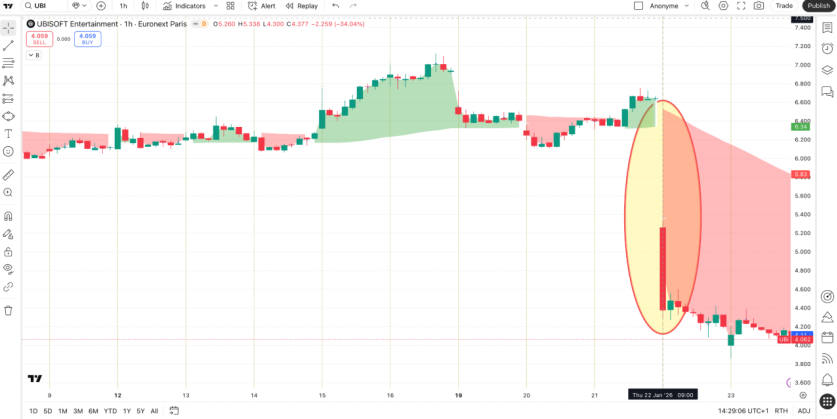
This resulted in the company losing most of its market value, which fell to approximately 590 million euros after previously reaching a value above 10 billion euros.
The investigation indicates that Tencent’s investment failed to compensate for the existing structural financial issues. Ubisoft currently fails Structural Problems to deliver successful games, its projects experience expensive delays, and investors have been losing trust in the company for multiple years.
Another challenge is that Vantage Studios (a Tencent-backed entity) remains under Ubisoft’s control, with Tencent holding a minority stake. This means that the capital can boost liquidity but doesn’t give Tencent any control over Ubisoft’s broader strategy or current operations. And they keep grappling with losses and restructuring pressures without Tencent being in a position to clearly change the course of things.
Analysts explain that Ubisoft reduced its net bookings guidance due to its existing debt covenant restrictions, which forced it to use Tencent funding to repay loans rather than pursue new growth projects.
Tencent’s investment brought immediate financial support and demonstrated some trust in Ubisoft’s most valuable franchises Structural Problems, but it couldn’t solve the financial performance challenges, pipeline instability, or investor confidence.
Explore deeper ideas that build on what you’ve learned at 2A Magazine.