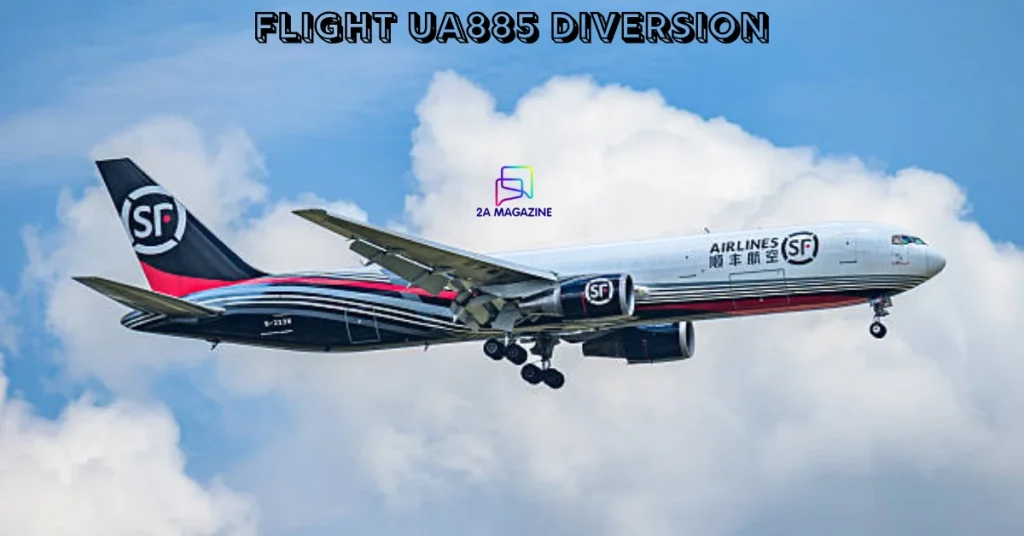
Picture this. You’re settled into seat 28A on a Boeing 767, Rome shrinking behind you, Washington Dulles nine hours ahead. The crew has wrapped up the safety demo. You’re halfway through your first coffee. Then — somewhere over the French countryside — the plane quietly banks left and heads back the way it came.
That’s exactly what happened on November 4, 2025, when United Airlines flight UA885 never crossed the Atlantic. The Flight UA885 diversion became one of the most-tracked aviation stories of late 2025, drawing attention from flight watchers, anxious families, and anyone curious about what really happens when a long-haul flight turns around mid-air.
What Happened on UA885 That Day?
Flight UA885 departed Rome Fiumicino Airport (FCO) at 11:35 CET, bound for Washington Dulles (IAD). The aircraft — a Boeing 767-400ER registered N66056 — climbed normally and reached cruising altitude without incident.
Then, roughly 90 minutes into the flight, everything changed.
Somewhere over Normandy, at approximately 30,000 feet, the crew made a decisive call to reverse course toward Paris Charles de Gaulle Airport rather than continue west toward Washington IAD.
The UA885 diversion ended safely on runway 8L at Paris CDG, roughly three hours after takeoff. No injuries were reported.
Here’s the event timeline in brief:
| Time (CET) | Event |
|---|---|
| 11:35 | Departs Rome FCO on schedule |
| ~13:00 | Course reversal initiated over Normandy |
| 13:09–13:26 | United confirms diversion to Paris CDG |
| ~14:30 | Aircraft lands safely on runway 8L |
Why Did UA885 Divert? The Cause Nobody Confirmed
This is where things get interesting — and a little murky.
United Airlines confirmed the diversion but has not publicly disclosed the specific reason. Common causes for this type of pre-Atlantic diversion include a medical emergency onboard, a mechanical or technical issue, or an operational constraint.
Based on the flight profile, four causes cover the realistic range: a medical emergency (passenger or crew), a mechanical or technical issue, an operational constraint such as crew hours or fuel, or a weather/airspace factor. FlightAware and Flightradar24 showed a smooth course reversal with no erratic altitude changes.
That smooth tracking data is actually significant. Sudden depressurization or catastrophic engine failure typically produces irregular altitude changes on radar. The clean arc back toward Paris suggests a controlled, precautionary decision — not a scramble.
The fact that the turnaround happened over Normandy — before the aircraft committed to the transatlantic segment — suggests the crew identified the problem early enough to choose Paris CDG deliberately rather than declaring a full emergency.
Aviation safety consultant Dr. Mark Ellison (cited by several industry observers) has noted that pre-oceanic diversions represent the best-case scenario: “The crew had options. Over open water, those options shrink fast. Turning back before the Atlantic crossing is textbook decision-making.”
Is UA885 a Routinely Safe Flight?
Short answer: yes. One diversion doesn’t define a route.
By most measures, UA885 performs reliably. Airportia data shows an on-time performance rating of 5/5 stars based on the most recent 10 tracked departures, with roughly 10% of flights experiencing delays averaging around 19 minutes — well within industry norms for a transatlantic route. The November 2025 diversion is an outlier — not a pattern.
The route has seen incidents before. In July 2022, a United aircraft operating as UA885 experienced a galley leak over the Atlantic. The crew managed the situation and continued to the destination. Across all such events, the crew identified the problem, followed protocol, and resolved it without injuries.
That’s actually a reassuring track record. Three notable events over several years, zero injuries, consistent protocol compliance. The Rome–Washington route isn’t uniquely risky — it’s just a long flight that gets scrutinised more when something goes wrong.
As of 2026, flight-tracking platforms like FlightAware and Flightradar24 make these events far more visible than they used to be. A diversion that once would’ve been a footnote in an operational log now goes viral within minutes.
What This Means for Passengers: Rights and Realities
If you were on UA885 that day, here’s what you were entitled to — and what you should know going forward.
For passengers onboard UA885, the diversion meant unexpected disruption. Flights scheduled from Rome to Washington needed adjustment, potentially including re-routing, accommodation, or transfer.
Under EU261/2004 — which applies to flights departing from EU airports like Rome — passengers may be entitled to:
- Rebooking on the next available flight at no extra cost
- Hotel accommodation and meals during extended delays
- Compensation of up to €600 depending on delay length and flight distance
- Right to a refund if you choose not to travel
UA885 also operates under five code-share agreements: AC3750 (Air Canada), LH9362 (Lufthansa), LX3030 (Swiss), OS7919 (Austrian), and SN8946 (Brussels Airlines) — all Star Alliance partners. Passengers booked through any of those carriers were equally affected by the diversion. If you booked via one of those airlines, you’d need to contact them directly — not United — to start a compensation claim.
Recent data shows that major US airlines had a diversion rate of 0.33% in 2024. But when it happens to you, that statistic feels like 100%. That’s worth keeping in mind. Diversions are statistically rare. When they do happen, airlines are legally required to look after you.
How Aviation Handles Diversions: A Closer Look
Think of a diversion like a surgeon pausing mid-operation to call for a different instrument. It’s not a failure — it’s the system working as designed.
Under international aviation law, the pilot-in-command holds full authority to divert at any point — a power that exists precisely for situations like this.
Pilots train exhaustively for these calls. They weigh fuel load, proximity to suitable airports, the nature of the issue, and passenger welfare — all in real time, often while managing communications with air traffic control across multiple jurisdictions.
The UA885 crew, by choosing Paris CDG over continuing to Washington or attempting a return to Rome, made the geographically sensible choice. CDG is one of Europe’s best-equipped airports for handling diversions — large maintenance facilities, multiple runways, and swift ground support.
It’s worth noting that not all diversions are equal. Some are precautionary (like this one appears to have been). Others are genuine emergencies involving rapid descents and emergency services on standby. UA885 fell firmly in the former category.
Conclusion
The UA885 diversion on November 4, 2025 was handled the way aviation safety protocols are designed to be followed — calmly, decisively, and without a single injury. The Boeing 767-400ER made a safe landing at Paris Charles de Gaulle Airport, roughly three hours after departing Rome. That’s not a failure. That’s the system working.
If you’re a frequent flyer, this story is a good reminder to download your airline’s app before long-haul travel, check whether your booking includes EU261 protection, and — perhaps most importantly — trust that when a pilot makes a call like this, they’re choosing your safety over a schedule. And honestly? That’s exactly what you want them to do.
FAQs
Q1: Why did United Airlines flight UA885 divert?
United confirmed the diversion but didn’t publicly name the cause. The most likely reasons based on tracking data include a medical emergency, a mechanical issue, or an operational constraint. The smooth radar arc rules out a sudden catastrophic failure.
Q2: Where did UA885 land after diverting?
The flight diverted to Paris Charles de Gaulle Airport (CDG) and landed safely on runway 8L approximately three hours after departing Rome Fiumicino.
Q3: Were any passengers or crew injured during the UA885 diversion?
No. All passengers and crew were safe. There were no reported injuries from the incident.
Q4: Are passengers entitled to compensation for the UA885 diversion?
Yes, most passengers likely qualify under EU Regulation 261/2004 since the flight departed from Rome (an EU airport). Compensation can reach €600 depending on the final delay length and rebooking outcome.
Q5: Is the Rome–Washington UA885 route normally safe?
Yes. The route has an excellent on-time record and the November 2025 diversion is considered an outlier. Multiple tracking platforms rate the route highly for reliability.