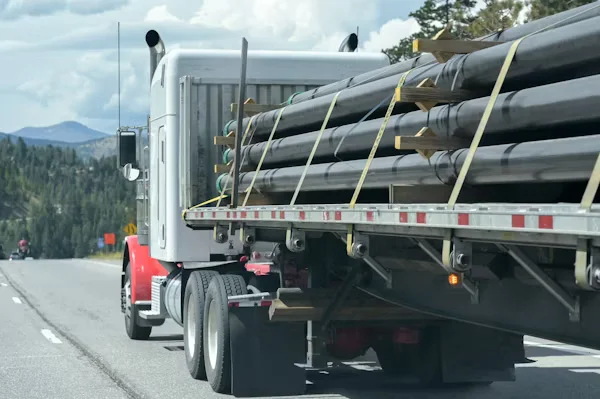
Federal and state regulations establish maximum weight thresholds for commercial vehicles because engineers design those vehicles to operate within specific mechanical limits. Every system on a commercial truck functions within a defined load range. When carriers and shippers push beyond those limits, the consequences extend far beyond the truck itself, creating danger for every driver, passenger, and pedestrian on the road or Overloaded Commercial Trucks.
Why Overloading Happens and How Carriers Avoid Detection
The financial structure of commercial trucking creates persistent pressure to maximize each load. Carriers and shippers operate in a competitive environment where tight profit margins make every trip a fixed operational cost. Hauling more freight per trip reduces the number of trips a carrier needs to move a given volume of goods, producing direct cost savings. When that calculation overrides safety and legal compliance, overloaded vehicles end up on public roads.
Federal regulations set the maximum gross vehicle weight for most commercial trucks at 80,000 pounds. Individual axle weight limits add another layer of restriction, capping the load any single axle can bear to protect both vehicle integrity and road infrastructure. States may impose their own limits, and carriers transporting oversized or overweight loads must obtain special permits, plan designated routes, and in some cases travel only during specified hours or Overloaded Commercial Trucks.
Despite this regulatory framework, overloading occurs with regularity. Weigh stations along major freight corridors exist to catch vehicles that exceed legal weight thresholds, but not every truck passes through one on every trip. Weigh-in-motion technology on highways has improved enforcement in recent years, but gaps in coverage remain. Some carriers knowingly load trucks beyond legal limits and treat the risk of a fine as an acceptable cost of doing business on routes where enforcement is thin. Others distribute weight across axles in ways that keep total gross weight within legal bounds while placing dangerous stress concentrations on specific vehicle components.
Shippers who load cargo onto a carrier’s truck beyond safe limits without the carrier’s knowledge add another dimension to the problem. In those situations, a driver may have no awareness that the vehicle operates beyond safe weight parameters until mechanical systems begin to show signs of strain.
What Overloading Does to a Commercial Truck
Braking systems bear the most immediate and severe impact. Engineers calibrate a truck’s braking capacity to its rated maximum weight. When a carrier exceeds that weight, stopping distances increase in ways that outpace the weight increase itself. A truck carrying 20 percent more than its rated capacity requires far more distance to stop than its driver anticipates. At highway speeds, that gap leaves almost no margin for error when traffic conditions change ahead for Overloaded Commercial Trucks.
Tires absorb the stress of excess weight across every mile of a trip. Overloaded tires run hotter than tires within rated parameters, and heat drives tire failure. Sidewall integrity degrades, tread separates, and the risk of a blowout climbs with every additional mile under excess load. A tire failure on a heavily-loaded commercial truck at highway speed can sweep across multiple lanes of traffic.
Steering and suspension components designed for specific load parameters develop accelerated wear under overloaded conditions. A driver operating an overloaded truck may notice changes in handling characteristics, reduced responsiveness to steering inputs, and greater difficulty maintaining lane position on curves or uneven road surfaces. These effects worsen as mechanical wear accumulates over the course of a journey.
How Overloaded Trucks Cause Crashes
Rear-end collisions are a direct consequence of extended braking distances. A driver who cannot stop a truck within the available distance during a traffic slowdown will strike the vehicle ahead regardless of reaction time or driving skill. When that vehicle is a passenger car, the size and weight disparity between the two produces severe injury outcomes for the occupants of the smaller vehicle.
Rollover crashes occur when excess weight raises a truck’s center of gravity beyond the threshold that the vehicle’s suspension and tire contact can stabilize. Curves, ramps, evasive maneuvers, and sudden lane changes all generate lateral forces that an overloaded truck cannot manage as well as one operating within its rated parameters. Rollovers involving loaded commercial trucks often result int multi-vehicle crashes, road blockages, and cargo spills that extend the zone of danger well beyond the initial impact.
Tire blowout crashes develop with little warning and leave drivers with limited options. A blowout on a rear trailer axle can initiate trailer sway that escalates into a jackknife if the driver’s corrective response comes too late. A blowout on a front axle affects steering and can produce near-immediate loss of directional control.
Overloaded trucks also cause accelerated deterioration of road surfaces and bridge structures. When an overloaded vehicle stresses infrastructure beyond its design limits, the resulting crash can pull in every vehicle in the surrounding area.
Legal Liability and the Path to Compensation
Identifying liability requires investigation that goes beyond the accident scene. Loading records, weigh station data, electronic logging device information, bill of lading documentation, and communications between dispatch and the driver all contribute to establishing what the truck carried, how a carrier or shipper loaded it, and who made the decisions that put an overweight vehicle on the road. When a shipper bears responsibility for the overload or Overloaded Commercial Trucks, that party enters the liability picture alongside the carrier.
Regulatory violations strengthen the legal foundation of a claim. A truck that exceeded federal weight limits at the time of a crash operated outside the law, and that violation bears direct relevance to questions of negligence and fault. Carriers with a pattern of weight violations in their inspection records or prior citations face a more difficult legal position than those whose violation appears isolated.
A truck accident lawyer like the attorneys at Dozier Law Group with experience in commercial vehicle cases understands how to obtain and analyze this evidence, identify every liable party, and build a claim that accounts for the full scope of harm. Medical expenses, future treatment costs, lost income, diminished earning capacity, and the broader impact of serious injury on a person’s daily life all factor into the compensation an injured party can pursue.
We love dropping massive value for you. Check out 2A Magazine updates.