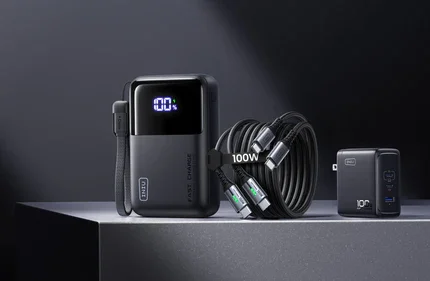
5G offers revolutionary speeds that promise to change how we work and play, but this digital leap comes with a significant “battery tax.” The transition to 5G has been one of the most significant shifts in mobile history, offering gigabit speeds that rival home fiber optics. However, for the average user, this performance boost has a noticeable downside: the smartphone battery drains significantly faster than it did on 4G LTE. As 5G modems work overtime to process massive data streams and hunt for high-frequency signals, the power bank has evolved from a “just in case” accessory into a high-performance necessity. We are no longer just carrying spare juice; we are carrying sophisticated energy hubs designed to keep pace with the most demanding network in history.
The Rising Standard for Mobile Energy
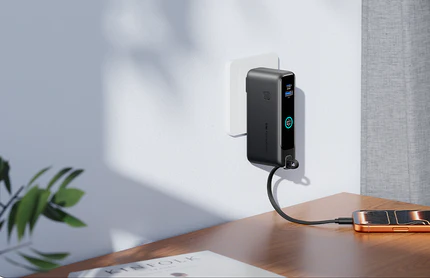
As 5G becomes the global standard, the hardware supporting our connectivity has had to undergo a radical transformation. For millions of users, finding a high-performance power bank for iPhone or other flagship smartphones has become a priority to ensure they can stay connected throughout a full workday. This necessity is driven by the technical architecture of 5G itself.
Unlike previous generations, 5G requires multiple antennas—often referred to as MIMO (Multiple Input, Multiple Output)—and specialized high-frequency signal processing units. These components generate more heat and consume more milliwatts every second the screen is on. When you are downloading a large file at 1Gbps, the CPU, the modem, and the storage drive are all working at peak capacity simultaneously, creating an immense load on the internal battery.
Why 5G is a Power Hungry Beast: The Technical Reality
To understand the evolution of charging, we must first understand why 5G devices are so thirsty for energy. The move from 4G to 5G isn’t just a software update; it is a fundamental hardware overhaul. In areas where 5G coverage is still being optimized, phones often engage in a “ping-pong” effect. This occurs when the device constantly switches between 4G and 5G bands as it searches for the most stable connection. This “network hunting” is one of the most aggressive ways to deplete a battery, as the modem increases its power output to maintain a handshake with distant cell towers.
Higher speeds also encourage behavior that drains power. With 5G, users are more likely to stream 4K HDR video, engage in low-latency cloud gaming on platforms like Xbox Cloud Gaming, or use augmented reality (AR) apps that require heavy graphical rendering. To combat this, the modern USB charger and its portable counterparts have had to move beyond basic 5W or 10W power delivery. This is why a specialized power bank for iPhone today often features Power Delivery (PD) outputs of 20W, 27W, or even higher, ensuring the device can actually gain a charge while being used heavily for data-intensive tasks.
Evolution 1: The Shift to High Wattage and GaN Technology
As 5G drains batteries in minutes, the industry has responded with materials that can refill them just as fast. The bottleneck has long been the limitations of silicon, which loses efficiency and generates excessive heat when pushed to handle high currents.
The most significant technological leap has been the adoption of Gallium Nitride (GaN). Traditional silicon-based chargers were too bulky and ran too hot to provide the high wattage (ranging from 30W to 140W) needed to quickly “top off” a 5G device. GaN is a semi-conductor material that can handle higher voltages and conduct electrons more efficiently than silicon. This allows internal components to be placed closer together, resulting in chargers that remain pocket-sized while handling massive energy throughput without overheating.
When paired with Power Delivery protocols, these units can negotiate the exact voltage a device needs. This evolution has led to a surge in specialized hardware designed to support the specific fast-charging curves of modern flagships. This means a user can plug in for just 15 to 30 minutes and get enough power to last through hours of high-speed browsing.
Evolution 2: Wireless Integration for an “Always-On” World
In the 5G era, the most efficient cable is the one you don’t have to plug in at all. For the 5G power user, convenience is king. The integration of wireless charging into the portable ecosystem—specifically through magnetic standards like MagSafe and Qi2—has changed how we use our phones.
Instead of being tethered to a wall by a cord, users now “snap” a magnetic battery pack onto the back of their device. This creates a continuous stream of energy that offsets the high consumption of 5G modems, essentially acting as an external fuel tank. This “snap-and-go” philosophy ensures that even during intensive video conferencing or gaming sessions, the phone remains at 100%, effectively extending the battery life of a device by two or three times its original capacity without the clutter of wires.
Evolution 3: Intelligent Thermal Management
Fast charging a 5G-active device creates a “heat-on-heat” scenario that requires smart cooling. Charging a battery generates heat, and running a 5G modem—especially on Millimeter Wave (mmWave) bands—generates even more.
To prevent thermal throttling or battery damage, modern portable chargers now feature NTC (Negative Temperature Coefficient) sensors. These “smart chips” monitor the temperature of both the battery and the phone in real-time. If the heat exceeds a certain threshold, the device will intelligently dial back the wattage to protect the hardware. This ensure that 5G speeds don’t come at the cost of long-term battery health, preserving the chemical lifespan of the device’s internal power cell.
Evolution 4: Sustained Sustainability and Capacity
As our reliance on portable power grows, the industry is also looking at the materials used in these “energy hubs.” We are seeing a move toward higher energy density cells, such as 21700 lithium-ion cells, which provide more capacity in a smaller footprint. The goal is to reach a balance: providing enough capacity to charge a 5G phone multiple times while keeping the weight low enough for daily carry.
Furthermore, as we consume more power, manufacturers are increasingly focusing on the environmental impact, using recycled plastics and sustainable manufacturing processes. The modern charger is becoming not just more powerful, but more responsible.
Conclusion
Ultimately, 5G didn’t just make the internet faster; it made our charging technology smarter and more resilient. The relationship between 5G and power technology is symbiotic. Without the advancements in high-wattage GaN components and the seamlessness of magnetic charging, 5G would be too impractical for heavy mobile use.
As we look toward the future, the race continues: as processors and networks demand more energy, our charging solutions will continue to evolve, transforming into pocket-sized power grids that ensure our high-speed world never has to slow down.