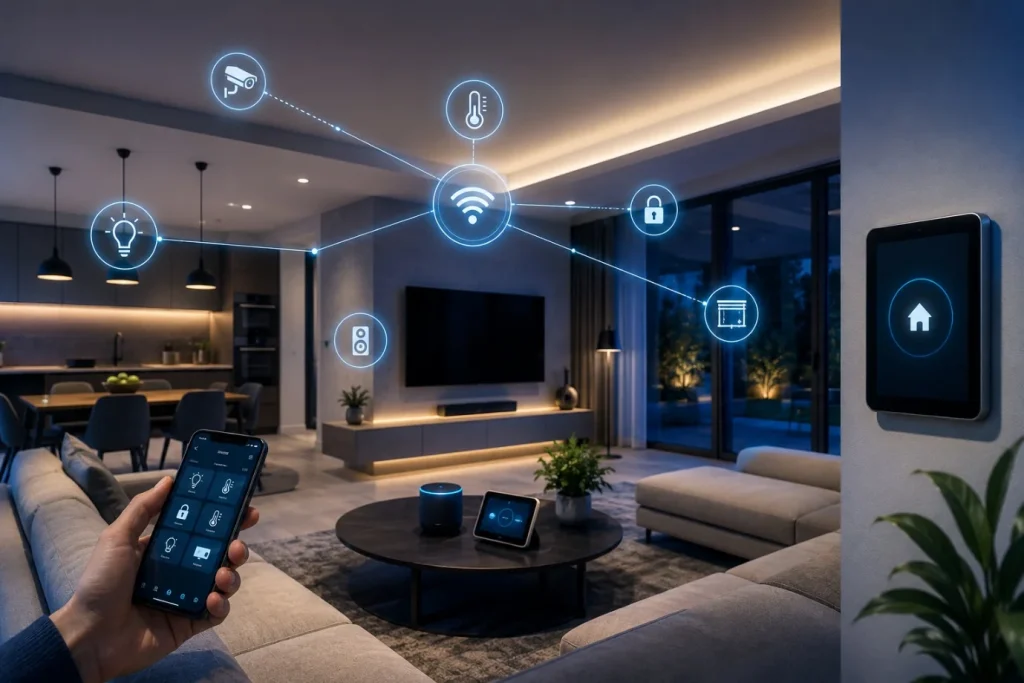
Smart home automation technology is an increasingly determining factor in today’s homes, transforming the way homes will be managed via contact devices, artificial intelligence, and interconnected “internet of things” devices. Automation technologies are progressing past convenience into providing greater efficiency, security, and sustainability through the use of intelligent lighting, energy-efficient thermostats, and advanced security systems.
Industry experts predict that the smart home automation economy will see ongoing growth throughout the next ten years, driven by increased consumer adoption, decreasing prices for smart home technologies, and increasing demand for energy efficient and more secure homes.
As stated by Data Intelo, smart home automation global sales are expected to reach $68.5 billion in 2025 and $145.2 billion in 2034, representing a compound annual growth rate (CAGR) of 9.2% for the next ten years.
The continued expansion of the housing market with greater numbers of Smart Homes, improved wireless technology, increased acceptance of cloud computing and AI will support market expansion. Market growth will also be driven by the growing demand for energy-saving solutions and enhanced home security solutions.
Continued Growth in Internet-Connected Devices
The continued growth of IoT connected devices is largely what continues to fuel the market for smart home automation. By 2025, over 19 billion connected IoT devices should be connected worldwide, with residentially-based IoT devices making up a large portion of that number. Commonly, we are seeing the following types of IoT devices in the typical household: smart speakers, security cameras, lighting controls, and connected appliances.
In addition to the growing number of Internet-connected devices, more and more consumers are building IoT to create a complete ecosystem of smart home products that can be managed from a single smartphone app or through a voice-controlled assistant.
This connected ecosystem creates more convenience for consumers, plus allows the devices to communicate with each other to automatically create routines for light, temperature control, entertainment, and security. With faster Wi-Fi speeds and the availability of expanded fiber optic Internet service, consumers will experience even better performance from their Internet-connected devices.
The Growth of Energy Efficiency in The Marketplace
The increased focus on energy savings as a result of home building and home development has motivated a number of families to invest in automation technologies, including energy management systems, to automate energy savings in their houses. Homeowners are typically more conscious of how much they spend on electricity; therefore, they are looking to invest in systems that allow them to lower their total energy costs while maintaining the same level of home comfort.
Studies have found that just by using a smart thermostat, homeowners can save between 10% – 15% annually on their heating and cooling costs, and when combined with occupancy sensors and automated scheduling, they could save as much as 35% on energy spent on lighting.
In addition, smart appliances and smart plugs provide consumers with real time tracking of how much energy each individual device is consuming, making it possible for the consumer to find methods to eliminate or reduce their energy consumption.
| Smart Home Segment | Estimated Impact |
| Smart Thermostats | 10–15% reduction in HVAC energy use |
| Smart Lighting | Up to 35% lower lighting electricity consumption |
| Smart Security Systems | 24/7 remote monitoring capabilities |
| Smart Appliances | Improved operational efficiency and scheduling |
| Home Energy Management Systems | Better tracking of overall electricity usage |
The increasing emphasis on sustainable practices has led some governments and utility companies in a number of countries to promote energy efficiency via rebates, incentives, and education programs. These initiatives will help to encourage the use of these technologies in both new residential constructions and existing homes.
Increased Intelligence within Home Security Solutions
Throughout the smart home automation industry, security is the growing segment for the fastest rate of growth. With the ability to use mobile applications as a means of remotely monitoring their property, consumers can now take control of their home security, with options such as connected surveillance cameras, video doorbells, smart locks, and motion detectors.
With a multitude of technological advancements, the security landscape has changed dramatically in recent years, including:
- Facial recognition and object recognition powered by Artificial Intelligence (AI) to minimize false alarms.
- Cloud storage of video surveillance to obtain remote access to recorded video.
- Temporary digital access to doors for visitors or service providers using smart locks.
- Automatically alert emergency contacts to suspicious activity with integrated alarm systems.
- Real time monitoring from virtually anywhere using remote surveillance tools.
At the same time, the large number of inexpensive security-related products that have flooded the marketplace have contributed to a wider adoption of security throughout the United States, especially in residential urban areas where there are still a significant number of people concerned about theft and invading their homes.
Challenges Persist with Growth
While the market is experiencing and showing positive momentum, challenges to adoption still remain. A major concern surrounding data privacy has led to an increase in connected devices that are gathering tremendous amounts of personal information. The manufacturers of these devices are investing in stronger encryption capabilities, software updates, and increased cybersecurity, thereby helping to lower security risks for consumers.
The ongoing compatibility issue of integrating products across multiple manufacturers, and between manufacturers and consumers, makes it difficult at times for the consumer to integrate connected devices across multiple brands into one single ecosystem. Even though industry-wide standards are being developed to improve interoperability, the consumer may run into difficulties at times.
Another barrier to entry for some consumers is the high cost of installation when using comprehensive automation systems that need professional assistance for setup (as opposed to DIY). With the increased availability of wireless devices, coupled with fewer complications involved in installing, the barriers for entry to connected device products are decreasing over time to many consumers.
The Future of Smart Home Technology
As advancements in digital technology have changed many segments of our world, smart home automation will be more integrated into new home construction and home improvement projects over the next decade. There will be continued innovation and improvement in areas like artificial intelligence, 5G technology, edge computing, and the Internet of Things, which will continue to enhance smart home automation capabilities and provide an increasingly responsive and efficient home automation system.
Considering that energy efficiency, home security, and digital convenience are all important to today’s household consumers, there will be continued growth in the smart home automation industry. The advancement of new technologies supported by the consumer adoption of them illustrates that smart home automation is changing from a premium home feature into one that is now considered a practical, everyday component of home living, and demonstrates the market-driven shift of how technology is transforming the residential market globally.
FAQs
1.What is smart home automation?
Smart home automation makes things in your smart house turn on & off, often automatically, & controls processes & systems in your house without the human touch.
2.What is the estimated rate of increase for this industry?
There is a forecasted growth of 9.2 % annually by compound interest from 2025 until 2034 for this marketplace.
3.How are house owners taking up automated systems at home?
The main reason why homeowners are adopting automatic systems is convenience, security and efficiency.
4.How is AI applied to Smart Homes?
AI is used in Smart devices to learn how users conduct themselves and help decrease the amount of time they spend performing daily household duties.
5.What will the future of Smart Home Automation?
The sector should continue to see steady gains through 2034 based upon the consistent increase in popularity of connection capabilities.
Reference: https://dataintelo.com/report/smart-home-automation-market