Picture this: it’s 3 AM on a dusty highway outside Kuala Lumpur. The street lights overhead aren’t just shining — they’re quietly cleaning themselves. No maintenance crew. No water trucks. Just a thin palm oil-derived coating doing exactly what a lotus leaf does after a rainstorm.
That’s not science fiction. The self cleaning street light palm oil project is a real, growing engineering movement that’s picking up serious momentum in 2026. And once you understand how it works, you’ll wonder why cities didn’t do this a decade ago.
What Is the Self Cleaning Street Light Palm Oil Project?
At its core, this concept combines renewable energy, smart urban infrastructure, and sustainable environmental practices into a single lighting system. The project targets one of the most ignored problems in city planning: dirty street lights.
Here’s the thing most people don’t realise. A street light doesn’t just go dim because the bulb gets old. Dust, pollution film, insect residue, and rainwater streaks all build up on the lens surface and solar panels. Even a thin layer of grime can slash light output by 20–30%. Multiply that across thousands of lights in one city, and you’ve got a massive energy waste problem — and a safety issue.
The self cleaning street light palm oil project integrates three major components: solar-powered street lighting to reduce electricity dependency, self-cleaning mechanisms to prevent dust and debris accumulation, and bio-inspired design modelled after oil palm trees for durability and efficiency.
That last part is genuinely clever. The oil palm tree’s structure naturally channels rainwater down its trunk and fronds, washing debris away as it goes. Engineers looked at that design and essentially copied it into street light architecture.
How Does the Palm Oil Coating Actually Work?
This is where it gets interesting. Researchers discovered that palm oil-based coatings can create hydrophobic and self-cleaning surfaces. A thin palm oil-derived layer is applied to the lamp surface. Water droplets bead up instead of spreading. As the droplets roll off, they carry dust and grime away. Rain, fog, or even humidity activates the process naturally.
Think of it like a non-stick pan, but for light fixtures. The surface doesn’t let dirt stick in the first place.
This mechanism mimics the lotus leaf effect, where water droplets clean the leaf’s surface naturally. Engineers replicated this using palm oil derivatives — a material that’s abundant, affordable, and surprisingly effective as a hydrophobic agent.
Palm oil derivatives can be processed into eco-friendly coatings that create smooth, hydrophobic surfaces. These coatings don’t require electricity, sensors, or moving parts. They just work passively, every time it rains or moisture is present. That simplicity is actually one of the system’s biggest selling points.
Palm Waste as an Energy Source — Not Just a Coating
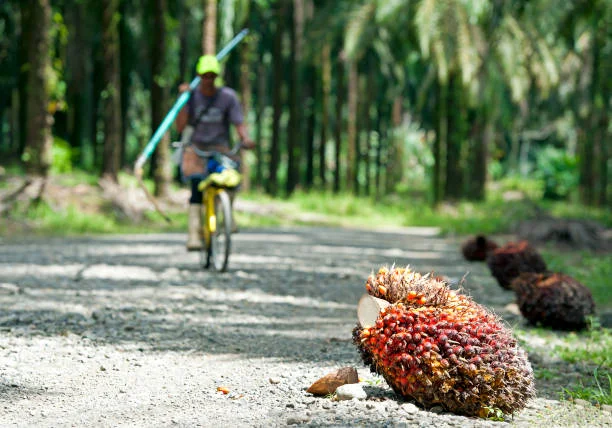
The palm oil connection doesn’t stop at coatings. There’s a second dimension to this project that’s equally important: using oil palm waste as a biomass fuel source.
Oil palm waste includes empty fruit bunches, shells, and fibres. These materials are rich in carbon and can be converted into energy through processes like gasification or specialised microbial fuel cells. This process is carbon-neutral because the CO₂ released during energy production is the same amount the tree absorbed while growing.
That’s a genuinely circular system. Palm oil production generates enormous agricultural residue — including empty fruit bunches, palm kernel shells, mesocarp fibres, and palm oil mill effluent — most of which currently rots, gets burned, or sits in landfill. Channelling that waste into street light energy turns an environmental headache into a public asset.
Industry observers note that the system works particularly well in tropical regions where palm cultivation and high dust environments overlap. According to recent infrastructure sustainability reports, hybrid solar-biomass lighting systems can reduce operational costs by up to 40% over a 10-year period compared to grid-dependent conventional lighting.
Real-World Benefits: What Cities Actually Gain
Let’s break down the practical wins:
- Lower maintenance costs — Maintenance visits are significantly less frequent than with conventional lights, though periodic checks on battery health, mechanical cleaning components, and biomass energy connections are still recommended.
- Longer lifespan — High quality solar streetlights built with self-cleaning mechanisms are generally designed to last 15 to 25 years, depending on component quality and operating conditions. The self-cleaning mechanism reduces panel degradation and helps maintain consistent energy output over that entire period.
- Safer roads — When street lights stay clean and functional, they provide better illumination and use energy more efficiently. Cleaner lights also contribute to safer roads. Even small reductions in brightness can impact visibility at night.
- Agricultural waste reduction — Local palm plantations get a revenue stream for their residual biomass instead of burning it.
- Rural electrification potential — Rural areas gain employment, new revenue streams, and improved public services, strengthening regional resilience.
This isn’t just a green tech story. It’s a local economy story too.
Challenges Worth Acknowledging
No technology ships without friction. The self cleaning street light palm oil model has real hurdles.
Higher initial cost is a known challenge — advanced coatings and corrosion-resistant materials add to upfront investment. For cash-strapped municipalities, that’s a genuine barrier, even when the long-term savings are clear.
There’s also the palm oil sustainability debate. Palm cultivation has a complicated environmental history — deforestation, habitat loss, and biodiversity concerns are real issues that critics rightly raise. The self-cleaning street light approach addresses this partly by using waste products rather than virgin palm oil, which shifts the environmental equation. But responsible sourcing still matters.
Although challenges remain surrounding palm oil sustainability and technical implementation costs, advancements in responsible sourcing practices and automation technology continue improving the feasibility of such projects.
It’s a technology that needs policy support just as much as it needs engineering refinement.
Where Is This Heading in 2026 and Beyond?
Smart city planners in tropical urban centres are watching developments closely, as the combination of automation, renewable energy, and waste reduction aligns with broader sustainability goals that many cities are pursuing in 2026.
Emerging trends include advanced photovoltaic coatings — new hydrophobic and anti-soiling materials that will further improve solar panel efficiency, reducing cleaning frequency and energy loss.
The Smart Cities Council has flagged bio-material infrastructure as one of the fastest-growing areas of urban investment. Self cleaning street light palm oil systems sit squarely in that category.
What’s particularly notable is the design philosophy shift. Engineers are increasingly looking to nature — not labs — for solutions. The oil palm tree didn’t evolve a self-cleaning structure by accident. It did it because survival required efficiency. Cities, facing rising maintenance costs and shrinking budgets, are finally asking the same question: what would nature do?

Conclusion
The self cleaning street light palm oil project isn’t a gimmick or a research paper gathering dust. It’s an active, field-tested engineering approach that answers multiple urban problems at once — dirty lights, wasted agricultural residue, high maintenance costs, and energy dependency. As of 2026, pilot projects across Southeast Asia and parts of Africa are demonstrating real-world results.
If your city is still sending maintenance crews up ladders to wipe down street lights by hand, it might be time to ask why. Nature already solved this problem. Engineers just needed to pay attention.
FAQs
Q1: What makes palm oil effective for self-cleaning street light coatings?
Palm oil derivatives create hydrophobic surfaces that repel water and dust. When moisture contacts the treated surface, it beads up and rolls off, carrying dirt with it — similar to how a lotus leaf stays clean in muddy water.
Q2: Is this technology only useful in tropical countries?
Not at all. While it’s especially relevant in palm-growing tropical regions, the self-cleaning coating technology works in any climate where dust or pollution is a problem. The biomass energy component is more region-specific.
Q3: Can existing street lights be upgraded with palm oil coatings?
Yes — the coating can be applied to most existing lamp surfaces, making retrofitting a viable option without full fixture replacement.
Q4: How does this project address palm oil’s environmental reputation?
The project primarily uses palm waste — shells, fibres, and empty fruit bunches — rather than fresh palm oil. This avoids driving new plantation demand and instead redirects material that would otherwise be burned or landfilled.
Q5: How long do these coatings last before they need reapplication?
Depending on the formulation, coatings can last several years before reapplication is needed, making them a low-intervention solution compared to manual cleaning schedules.