Introduction
The landscape of work has rapidly evolved. The prevalence of remote and hybrid setups has created the need for dynamic security solutions that safeguard sensitive data as employees operate from various locations and devices. Traditional network security models are not equipped to address the agility and flexibility required in today’s environment. With companies facing an uptick in cyber threats targeting remote users, robust frameworks have become critical to maintaining business continuity and compliance.
Adopting an agile and comprehensive security model is essential for organizations that want to empower their teams while protecting intellectual property and client information. As a result, decision-makers are increasingly turning to SASE Solutions to protect their distributed workforces efficiently.
Remote work is not a passing trend, and organizations that do not adapt risk being outpaced by competitors who provide seamless, secure access to cloud applications and collaboration tools. However, shifting from a traditional perimeter-based security structure introduces new complexities, demanding more innovative, integrated approaches to minimize exposure and maximize resilience.
As digital transformation continues, businesses must also consider regulatory requirements, privacy expectations, and a growing device portfolio. With this in mind, navigating the future of remote security requires a strategy that merges convenience with airtight defense, allowing organizations to thrive in a cloud-first world. For additional insights on how global businesses are adapting their technology strategies, you can visit CSO Online.
Challenges of Securing a Remote Workforce
The massive shift to remote work has amplified the risks that organizations face. Employees access sensitive applications and data from home networks, public Wi-Fi hotspots, and a diverse set of devices. Each point of connection increases the potential for cyberattacks, making it more complicated for IT teams to maintain oversight and enforce security policies.
According to a report by Hughes Network Systems, employees are now the number one risk to network security in hybrid environments. Common pitfalls include weak password protocols, a lack of device patching, and difficulties in monitoring off-site endpoints. While legacy VPNs once provided basic remote access, they have become too rigid and slow to protect modern cloud-based workflows. Cybercriminals are exploiting these vulnerabilities with ransomware, phishing attacks, and advanced persistent threats, targeting remote entry points as a strategic attack vector.
Maintaining consistent and efficient security for a diverse workforce is further complicated by the rapid adoption of cloud services and SaaS applications. Employees need immediate, uninterrupted access to collaborate and serve clients, but this should not come at the expense of data security or compliance.
What Is SASE?
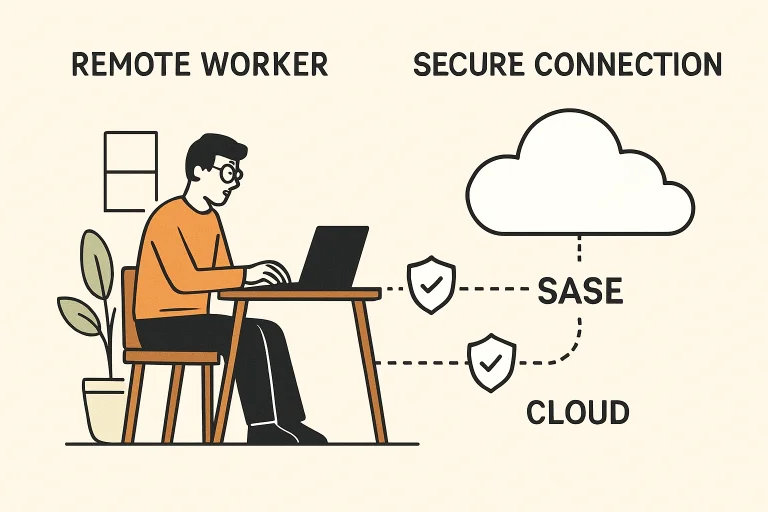
Secure Access Service Edge, or SASE, is a transformative security architecture that converges networking and security functions into a unified, cloud-native service. SASE centralizes access controls and security enforcement at the network edge rather than in a corporate data center, enabling organizations to deliver secure access anywhere, at any time.
SASE brings together a suite of security services, including Zero Trust Network Access (ZTNA), Secure Web Gateway (SWG), Cloud Access Security Broker (CASB), and Firewall-as-a-Service (FWaaS). These are combined with software-defined WAN (SD-WAN) technologies, enabling connectivity and threat protection that adapt to a user’s location and device.
In an age where workforces are globally dispersed and information must be shared quickly, adopting SASE enables enterprises to enforce policies uniformly while ensuring that latency-sensitive applications perform optimally. As Gartner notes, SASE is an essential foundation for organizations embracing digital transformation, bringing agility and consistent security across users and locations.
Benefits of SASE for Remote Workforces
- Enhanced Security: SASE enables organizations to apply identity-driven policies that validate users, devices, and connections before granting access. Universal policy enforcement mitigates risks related to unauthorized data sharing and external threats.
- Improved Performance: With a network of globally distributed points of presence, SASE platforms minimize latency and optimize the path between users and cloud resources. Employees experience consistent speeds, even during peak demand or across geographic boundaries.
- Simplified Management: SASE solutions consolidate networking and security administration onto a single, cohesive platform. Having a unified dashboard streamlines policy updates, audit controls, and threat monitoring, freeing up IT resources for business innovation.
These benefits position SASE as a cornerstone of remote work strategies, helping organizations remain resilient amid the ongoing evolution of cyber threats. For an in-depth look at zero-trust security frameworks and their impact on remote work, ZDNet offers valuable context.
Implementing SASE in Your Organization
Assess Current Infrastructure
The first step in the SASE journey begins with a thorough evaluation of current networking, security, and access controls. Organizations should identify inefficiencies, outdated solutions, and gaps in protection that threat actors could exploit.
Define Security Policies
Next, it is critical to establish clear, well-defined access and usage policies that align with business goals, regulatory requirements, and industry standards. Policies should be granular enough to address specific remote work scenarios while remaining adaptable for future needs.
Select a SASE Provider
Carefully select a SASE vendor that offers a suite of integrated services tailored to the organization’s size, complexity, and operational objectives. Look for providers with a strong record of reliability, support, and innovation.
Plan for Integration
A well-crafted implementation roadmap will ensure that new SASE components do not disrupt day-to-day activities. IT leaders should coordinate with end users and application owners to facilitate seamless adoption.
Monitor and Optimize
Ongoing monitoring is essential to gauge network performance and security postures. Continual optimization allows the security footprint to evolve in parallel with business requirements, reducing risks while enabling productivity.
Conclusion
As remote and hybrid work models continue to gain traction, organizations must elevate their security posture without hindering workforce agility. SASE bridges the gap between performance and protection, providing a single framework to address new challenges of the distributed enterprise. Embracing SASE not only enhances resilience but also enables businesses to confidently support remote teams and deliver seamless digital experiences to clients worldwide.