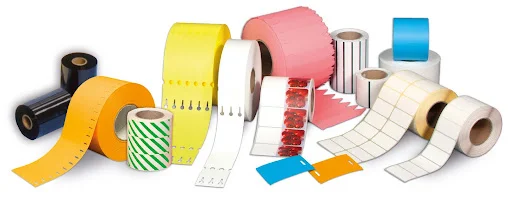
Starting in 2026, Industrial Thermal Transfer Labels are predicted to transform some elements of modern manufacturing and logistics. As supply chains become more advanced and automated, many industries are going to need highly functional Industrial Thermal Transfer Labels.
Industrial Thermal Transfer Labels offer more than identification. They offer the ability to record real-time compliance and product authentication alongside automation. From retail to healthcare, all sectors of manufacturing and logistics, will have their operations advanced with Industrial Thermal Transfer Labels.
Below are the trends that will most likely impact Industrial Thermal Transfer Labels in 2026 and after.
1. Smart Supply Chains and Industrial Thermal Transfer Labels
Incorporation of Industrial Thermal Transfer Labels into smart supply chains is now a reality. Industrial Thermal Transfer Labels are a major component in modern, structured, digital systems of real-time, continuous tracking.
Thermal Transfer Labels are part of a bar code, RFID, and cloud-based inventory system that can trace all products throughout the entire supply chain, whether it be for manufacturing, storing, or shipping goods.
When it comes to automation-centric logistics solutions, Industrial Thermal Transfer Labels design a more efficient method for managing and tracking inventory by enhancing the accuracy of the sort. Each Industrial Thermal Transfer Label connects a physical item to the enterprise resource planning systems in real time.
2. The Rising Need for High-Durability Industrial Thermal Transfer Labels
By 2026, one of the most prominent trends is expected to be the demand for high-durability Industrial Thermal Transfer Labels.
Some sectors such as automotive, chemical processing, logistics, and heavy manufacturing need labels that don’t lose their printed information.
Thermal Transfer Labels manufactured recently provide:
– Resistance to extremes of heat and cold
– Protection from chemicals and solvents
– Strong adhesion to metal, plastic, and rough surfaces
– Readability for the printed information in outdoor conditions
This ensures that the important printed information such as serial numbers, safety messages and tracking codes remain readable.
3. Sustainability and Industrial Thermal Transfer Labels
By 2026, sustainability is expected to dominate Industrial Thermal Transfer Labels.
Companies will be forced to adopt sustainable manufacturing practices and either eliminate or substantially reduce waste. Otherwise, they will face penalties.
To achieve that, manufacturers have been making labels with:
– Synthetic and paper substrates that are recyclable
– Film layers that contain less plastic
– Adhesives that are eco-friendly
– Coatings that are low-impact
Industrial consumers are increasingly choosing labels that contain no or low sustainable certificates and that address environmental concerns.
This is a very noticeable trend among various sectors such as logistics, retail packaging, and food distribution as sustainability reporting is going to be compulsory.
4. Improved Printing Quality and Information Capacity
Modern Industrial Thermal Transfer Labels have the ability to contain much more information than in the past, and that information can be printed much more clearly and in a much smaller area.
Improved technology in thermal transfer printing enables:
– Barcodes and QR Codes at an ultra-high resolution
– Extensive data for product identification
– Information for Regulatory Compliance
– Labeling needs in Multiple Languages
– Tracking codes for Serialized Items
Complex, global distribution networks pose challenges to numerous industries. However, most can now ensure accuracy and compliance.
For both the pharmaceutical and electronics industries, having high-resolution Industrial Thermal Transfer Labels is extremely important.
5. Automation in Industrial Thermal Transfer Label Production
Automation is changing the production and application of Industrial Thermal Transfer Labels. Labeling systems are being incorporated into Automated Production Lines by Modern Manufacturing Facilities.
The focus is on:
– Labels are applied Automatically
– Print Real-time Error Detection
– Print Optimization using AI
– Integration of ERP and Warehouse Systems
– Printing Systems are Maintenance Predicted
Automation is decreasing the amount of down time and is improving consistency and the speed of production.
The production of Industrial Thermal Transfer Labels has, therefore, been Automated to an extent that has not been experienced before.
6. Expansion of Industrial Use Cases Across Industries
The rapid adoption of Industrial Thermal Transfer Label is evident across many industries.
Logistics relies on Labels for Tracking Shipments and managing Warehouse Inventory. In Manufacturing, Labels are used to identify Materials, Components, and Finished Goods. Accurate labeling of Medications and Laboratory Samples is accomplished using Industrial Thermal Transfer Labels in Healthcare.
Further examples of Industrial Thermally Transferred Labels in use include:
– Identification of Automotive Parts
– Labeling of Chemical Drums
– Monitoring of Cold Chains
– Tracking of Aerospace Components
Each Industry has Specific Industrial Thermal Transfer Labels that incorporate compliance and environmental considerations.
7. Smart Label Integration and Digital Connectivity
Digital Technology and Industrial Thermal Transfer Labels are developing in tandem.
The inclusion of QR Codes and RFID integrated labels allow direct connections with cloud databases. Businesses can readily obtain an item’s historical records and certifications as well as tracking data.
Supply chain transparency and tracking technology minimizes counterfeiting, mislabeling, and other supply chain disruptions.
Currently, Industrial Thermal Transfer Label link physical items to the digital supply chain.
8. Shrinkability and Space Friendly Labeling
Products and their packaging are shrinking, and Industrial Thermal Transfer Labels are following suit.
Manufacturers want labels that fit on small surfaces, and still convey a lot of information.
New options include:
– Barcodes that are high density and compact
– Micro QR Codes
– QR Codes with Fine Print
– Text with Fine Print
This is a growing trend in the electronics, medical devices and precision engineering industries.
9. On-Demand Production of Industrial Thermal Transfer Labels
Industrial Thermal Transfer Label are changing how businesses operate.
Large stocks of preprinted labels are becoming a thing of the past. Labels are being printed as required, per the operational demand.
Benefits include:
– No need for large stocks
– Less wasted labels
– Greater speed for design changes
– Compliance is much easier
– Custom labels for varying markets are made on demand
On-demand printing is the new standard in industrial operations.
Final Thoughts
Industrial Thermal Transfer Labels will be the embodiment of the development lines of growing automation, sustainability, and process digitization from the year 2026. As the basic mechanism for tagging and identification, they will be a part of smart Industrial systems.
Industrial Thermal Transfer Labels will be at the center of new supply chains and manufacturing systems, thanks to increased durability, precision of printing, higher intelligent integration, and new sustainable materials.
In a fully automated and interlinked Industrial ecosystem, the relevance of Industrial Thermal Transfer Label will not only remain, but will increase with respect to growing needs for efficiency, accuracy, and connectedness across the globe.
See how much he means to me. Visit our love 2A Magazine.