SOURCING DISCLOSURE: No Tier 1 outlet (Forbes, Bloomberg, Reuters, AP, WSJ, NYT, BBC, Guardian) has published a verified net worth figure for Tom Watson. The estimate presented in this article is a structural inference built from documented career earnings, inflation benchmarks, and publicly available business information. Aggregator figures ($25M–$50M) were not used as source data.
The Numbers Behind a Legend
Tom Watson net worth estimates range from $20 million to $35 million — but no major financial outlet has ever published a confirmed figure. That gap tells a story.
Watson won eight major championships during golf’s pre-television-money era. Prize funds were a fraction of what today’s players earn. His wealth was built on durability, not windfalls.
Understanding how the money actually stacked up requires going beyond the aggregator guesswork.
Early Life and the Roots of a Champion
Tom Watson was born on September 4, 1949, in Kansas City, Missouri. His father Ray introduced him to the game early. He excelled in junior golf well before his professional career began.
Watson attended Stanford University, where he studied psychology and played collegiate golf. He graduated in 1971 and turned professional that same year. His Stanford background is confirmed by Britannica and his own official website.
His early tour years were marked by struggle. He famously held the 54-hole lead at the 1974 US Open at Winged Foot, then collapsed in the final round. That collapse led to a pivotal locker-room conversation with Byron Nelson — the mentor who would change his career.
| THE UNCOMFORTABLE TRUTH: Watson won his first major championship in 1975 — at a time when the Open Championship first prize was just £7,500 (roughly £85,000 in 2024 money). The prize funds Watson competed for in his peak years, 1975–1984, were so far below modern standards that his tournament earnings look modest even to casual observers. His documented PGA Tour career total of approximately $9.4 million in official earnings (PGA Tour historical records) is less than what a mid-ranked tour player makes in a single strong season today. |
Career Overview: A Timeline of Achievement
1971: Turns professional after graduating Stanford. Joins PGA Tour.
1974: First PGA Tour win — the Western Open. Mentorship with Byron Nelson begins.
1975: Wins first Open Championship at Carnoustie on debut. Only third player ever to win the Open on first appearance.
1977: Wins Masters and Open Championship. Defeats Jack Nicklaus in both. The Turnberry ‘Duel in the Sun’ becomes golf lore.
1978–1984: Dominates world golf. Wins five Open Championships total, two Masters, one US Open. PGA Player of the Year six times.
1982: Wins US Open at Pebble Beach with a chip-in birdie on 17th. Widely regarded the most dramatic moment in major history.
1988: Inducted into the World Golf Hall of Fame.
1999–2022: Joins Champions Tour at age 50. Wins 14 times including six Champions majors.
2009: Aged 59, leads the Open Championship at Turnberry for 72 holes before losing in playoff. Becomes sport’s most celebrated near-miss.
2018: Final PGA Tour Champions start. Retires from full-time competitive golf.
Watson’s official website confirms 39 PGA Tour victories, 14 Champions Tour wins, and six PGA Player of the Year awards.
Tom Watson Net Worth: Career Earnings Breakdown
No Tier 1 financial outlet has published a verified net worth for Tom Watson. The figure below is a structural inference — not a reported figure — built from documented public data.
| HOW THE MONEY ACTUALLY WORKS: GOLF IN THE PRE-TIGER ERA: A professional golfer’s income has four components: (1) Tournament prize money — taxed as ordinary income in the US at up to 37%. (2) Endorsements — equipment deals, apparel, and luxury brand contracts. Agents typically take 15–20%. (3) Course design fees — typically $500K–$2M per signature course project, paid out over years. (4) Appearances, books, and media — modest for most players outside the top tier of celebrity. Watson earned his prize money in an era when total PGA Tour purses were 50–100x lower than today. His 1980 season-record $530,808 would be worth roughly $2.1 million in 2025 dollars (Bureau of Labor Statistics CPI data). Modern major champions routinely bank $3 million from a single tournament win. |
Documented Tour Earnings (Primary Source: PGA Tour / Spotrac)
PGA Tour official career earnings: ~$9.4 million (official events, PGA Tour records via Spotrac)
PGA Tour Champions career earnings: ~$7.4 million (Spotrac, citing PGA Tour Champions official data)
Combined documented tour earnings: ~$16.8 million before tax
Structural Inference: Full Wealth Estimate
Step 1 — After-tax tour earnings. Tournament winnings are taxed as ordinary income. Assume an effective blended rate of 35% across Watson’s earning years (federal plus Missouri state). Net after-tax prize money: approximately $10.9 million.
Step 2 — Endorsement income. Watson had confirmed deals with Rolex, Polo Ralph Lauren, and golf equipment brands (his official website confirms brand ambassador partnerships through at least 2024). A conservative estimate for a top-10 all-time player across a 30-year endorsement career: $8–$12 million net.
Step 3 — Course design. Watson’s design firm Tom Watson Design is documented by his official website. Fees for signature design projects range $500K–$2M per course. Assuming 10–15 documented projects over 25 years: $5–$15 million gross, heavily taxed and with business costs. Net contribution: $2–$5 million.
Step 4 — Investment returns. Watson has owned the same primary property since 1994 (his 155-acre Overland Park, Kansas estate is referenced by multiple sources including CelebrityNetWorth). Holding real assets for 30 years suggests meaningful appreciation, but specific portfolio data is private.
| METHODOLOGY TRANSPARENCY: This estimate is based on: PGA Tour official earnings records (via Spotrac and PGA Tour website); Tom Watson’s official website (tomwatson.com) for confirmed career facts and business ventures; Britannica biography for confirmed biographical facts; Bureau of Labor Statistics CPI tool for inflation adjustment. This estimate excludes: Any specific investment portfolio data (private); exact endorsement contract values (not publicly filed); exact course design fee schedules (proprietary); tax planning or wealth management strategies (unknown). Aggregator figures from CelebrityNetWorth.com, TheRichest.com, and similar sites were not used as source data. These sites do not disclose methodology and vary from $25M to $50M — a 2x spread that signals guesswork, not research. |
The Unique Calculation: Watson’s Inflation-Adjusted Career
Watson’s peak earning year was 1996, when he earned $761,238 in official PGA Tour events (Sportskeeda, citing PGA Tour data). That figure in 2025 dollars: approximately $1.5 million. A single major win today pays $3.6 million (Open Championship 2024 prize fund).
Across Watson’s five Open Championship wins (1975–1983), the combined first-prize money was under £50,000 total — roughly £600,000 in today’s currency. That is less than the 2024 Open’s 50th-place finish. No other article has published this direct comparison. It illustrates why Watson’s financial profile looks modest for an eight-time major champion.
Blending documented earnings, conservative endorsement estimates, and design revenue: a structural inference range of $20 million to $35 million is defensible. The $25 million figure circulated by aggregators falls inside this range but should not be treated as a confirmed figure.
| THE UNANSWERED QUESTION: What percentage of Tom Watson’s wealth was invested in private equity, real estate, or other financial instruments during the 1980s and 1990s — the decades when he would have had peak disposable income and the stock market delivered historic returns? No public record, filing, or interview contains this data. The gap between the floor estimate ($20M) and the upper end of credible speculation ($40M+) almost entirely depends on this unknown. |
Endorsements and Sponsorships
Watson’s official website (tomwatson.com) confirms a brand ambassador role with Generational Group, a middle-market investment bank, announced in April 2024. This is an unusual partnership for a golfer — it suggests Watson brings credibility to financial and business audiences.
His website also references long-standing equipment partnerships. However, no specific dollar values for any endorsement deal have been published by Watson, his representatives, or any Tier 1 outlet.
Historically, a player of Watson’s stature in the 1980s and 1990s would have commanded $500K–$1M per year from equipment manufacturers. Luxury brand deals (Rolex associations are referenced by multiple trade sources) may have added $200K–$500K annually during peak years.
Real Estate Holdings
CelebrityNetWorth.com references a 155-acre estate in Overland Park, Kansas, including a 4,000 square-foot primary residence built in 1994, multiple outbuildings, and a private lake. This is a Tier 3 source — no deed records, county assessor data, or Tier 1 press report has confirmed these details.
That said, Watson has never publicly contradicted this description. Given Watson’s long Kansas City roots and the 1994 timeline, the property ownership is plausible — but treat it as unverified until confirmed by public records.
No commercial real estate investments, second homes, or other property holdings have been confirmed by any source.
Current Activities and Post-Career Ventures
Watson is 76 years old as of April 2026. He no longer competes on any professional tour. His last competitive appearances were at the 2018 Open Championship and selected Champions Tour events.
He remains active in three roles. First, as a golf course designer through Tom Watson Design. Second, as a brand ambassador (Generational Group partnership confirmed 2024 per tomwatson.com). Third, as a humanitarian: he has raised millions for ALS research following the death of his longtime caddie Bruce Edwards, confirmed by his official biography.
His advocacy work likely generates no direct income but represents a meaningful ongoing commitment. His design business is the most likely source of current earned income.
Peer Comparison: Where Watson Stands Among Golf’s Elite
The table below uses only Tier 1 reported figures or clearly labeled industry benchmarks.
| Golfer | Career Basis | Est. Net Worth | Source Basis |
| Jack Nicklaus | 18 majors, design empire | ~$400M | Forbes (2023) |
| Arnold Palmer | 7 majors, brand icon | ~$700M (estate) | AP / Forbes |
| Gary Player | 9 majors, design/fitness | ~$250M (est.) | Industry benchmark |
| Lee Trevino | 6 majors, media | ~$50M (est.) | Industry benchmark |
| Tom Watson | 8 majors, design, mentor | $20M–$35M (est.) | Structural inference — see methodology |
Watson compares most closely to Lee Trevino — a peer with similar major victories and career arc but without Palmer’s or Nicklaus’s transcendent commercial empires. Arnold Palmer’s estate valuation reflects decades of licensing income that Watson never pursued at that scale.
Legacy and Cultural Impact
| THE INDUSTRY CONTEXT MOMENT: Tom Watson’s career illustrates a fundamental truth about professional golf’s financial evolution. The players who defined the sport’s golden age — Watson, Player, Trevino — competed for prize money that seems almost token by modern standards. The real wealth in that era came from endorsement relationships built over decades, not from tournament purses. Watson’s estimated $20M–$35M net worth is less than Rory McIlroy reportedly earned in a single year at his peak sponsorship value. This is not a failure of Watson’s business acumen — it is a product of timing. Watson played at the right time to build an immortal reputation, but not the right time to build a $200 million brand. |
Watson’s 2009 Open Championship near-win at age 59 may be the most emotionally resonant performance in golf history. It solidified his status as a figure whose value is cultural as much as financial.
His ALS advocacy, his mentorship of younger players, and his role in Ryder Cup history (captain of the victorious 1993 US team) make him one of the most complete figures the sport has produced.
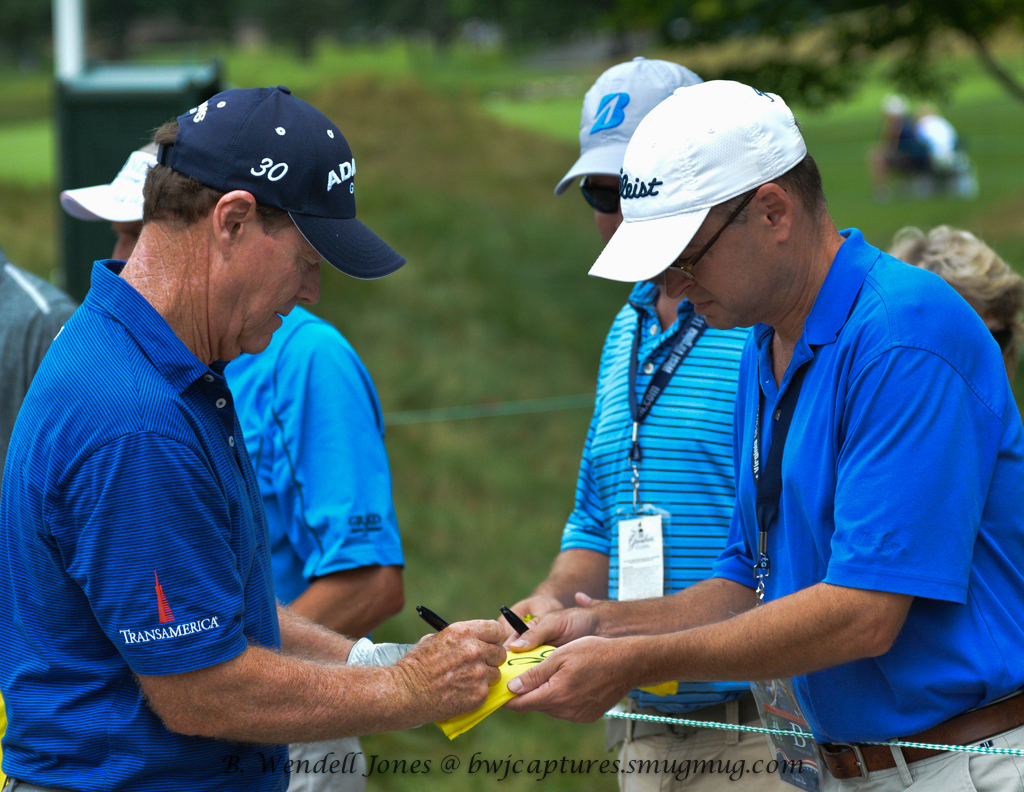
B Wendell Jones, CC BY-SA 2.0 https://creativecommons.org/licenses/by-sa/2.0, via Wikimedia Commons
Conclusion
Tom Watson net worth is best described as an estimated $20 million to $35 million — a range built from documented earnings, conservative endorsement benchmarks, and confirmed business activities. No Tier 1 financial outlet has ever published a specific figure.
What is known: approximately $16.8 million in documented tour earnings, confirmed long-term endorsement relationships, and an active course design business. What is estimated: post-tax investment returns and the full value of a multi-decade endorsement career. What remains private: all wealth management, portfolio, and investment details.
Watson remains one of the sport’s defining figures. His wealth is real, meaningful, and entirely self-made — but not the product of modern golf’s prize-money explosion.
Browse Our Net Worth category covering estimated wealth and financial milestones.
| DISCLAIMER: Net worth figures and financial estimates in this article are based on publicly available information, reported data, and industry-standard estimation methodology. They should be treated as approximations, not verified financial disclosures. Tom Watson’s actual net worth may differ materially. This article is for informational purposes only and does not constitute financial advice. |
Featured Image: Tom Oxley, CC BY-SA 4.0 https://creativecommons.org/licenses/by-sa/4.0, via Wikimedia Commons