Electrical systems power homes, factories, and businesses every day. They need strong safeguards to prevent damage from faults. Molded case circuit breakers stand out as a reliable choice for this task. These devices stop current flow during problems like overloads or short circuits. Their role grows more vital as power demands rise in various sectors. Readers who work with electrical setups or plan new installations will find value in understanding these breakers. This article covers their basics, advantages, hurdles, and future directions to help make informed decisions.
What Are Molded Case Circuit Breakers?
Molded case circuit breakers, often called MCCBs, serve as automatic switches in electrical circuits. They protect wiring, equipment, and people from harm caused by excessive current. The name comes from their design: a sturdy plastic case molds around the internal parts. This case provides insulation and strength, allowing use in tough conditions.
Unlike smaller miniature circuit breakers, MCCBs handle higher currents, typically from 10 amps up to 2000 amps or more. They suit medium to large systems. Manufacturers like Oohmage produce these with features for specific needs, such as waterproof ratings for outdoor use.
Standards guide their build. Certifications like CE, IEC, and TUV ensure they meet safety rules. MCCBs come in different poles: single, double, triple, or four-pole versions. This lets them fit AC or DC circuits. In solar setups, DC-rated molded case circuit breakers manage power from panels safely.
Their frame sizes vary too. Smaller frames work for light industrial loads, while larger ones tackle heavy-duty tasks. Adjustable settings on some models allow users to set trip points for current levels. This flexibility makes molded case circuit breakers adaptable across applications.
How Do Molded Case Circuit Breakers Work?
Molded case circuit breakers use two main mechanisms to detect and respond to faults: thermal and magnetic.
The thermal part relies on a bimetallic strip. This strip bends when heat from overload current builds up. As it bends, it triggers the breaker to open contacts and cut power. This protects against slow, sustained overloads that could melt wires.
The magnetic part acts faster for short circuits. An electromagnet activates when high current surges through. It pulls a lever to separate contacts almost instantly. This quick action stops arcs and fires from forming.
Some advanced molded case circuit breakers add electronic trips. These use sensors and processors for precise control. They monitor current patterns and trip only when needed, reducing false alarms.
When a fault occurs, the breaker trips to an off position. Users reset it manually after fixing the issue. This design prevents automatic restarts that could cause more damage.
In operation, current flows through the breaker’s contacts under normal conditions. The case insulates everything, keeping operators safe. Accessories like shunt trips or auxiliary contacts add functions, such as remote control.
Understanding this process shows why molded case circuit breakers provide effective protection. Their dual mechanisms cover a range of faults reliably.
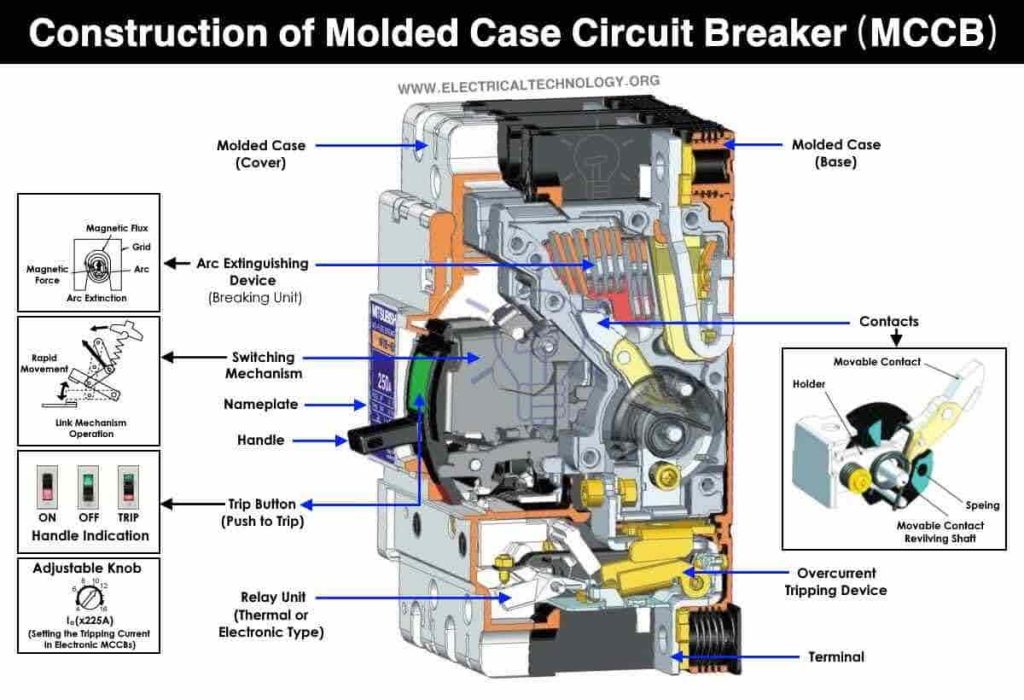
MCCB (Molded Case Circuit Breaker) – Types and Working
This diagram illustrates the internal structure, highlighting key components like the trip unit and contacts.
Benefits of Molded Case Circuit Breakers
Molded case circuit breakers offer several advantages that make them a top pick for electrical protection.
- They provide high breaking capacity, often up to 100kA. This means they can interrupt large fault currents without failing.
- Adjustable trip settings allow customization. Users set protection levels to match specific loads, improving system efficiency.
- Their compact size saves space in panels. Despite handling high currents, they fit into tight setups.
- Durability stands out. The molded case resists impacts, dust, and moisture, especially with IP65 ratings.
- Cost savings come from long service life. With thousands of operations possible, they reduce replacement needs.
- Safety features protect users. Insulated handles and arc chutes minimize risks during maintenance.
- Versatility applies to many voltages, from 230V to 690V AC, and DC options for solar.
These benefits explain why industries rely on molded case circuit breakers for consistent performance.
Challenges with Molded Case Circuit Breakers
While useful, molded case circuit breakers present some challenges that users should consider.
- Higher initial costs compared to simpler breakers. Their advanced features add to the price, though long-term savings often balance this.
- Size can be an issue in very small spaces. Larger frames for high currents take up more room than miniature options.
- Maintenance requires skilled workers. Regular checks for wear ensure reliability, but this adds to operational tasks.
- Heat generation during operation needs management. In hot environments, extra cooling might be necessary.
- Compatibility with older systems can pose problems. Upgrading may require panel modifications.
- False trips occur if settings are not precise. This interrupts power unnecessarily, affecting productivity.
- Weight makes installation harder in some cases. Heavy-duty models need strong mounting.
Addressing these challenges through proper selection and setup maximizes the value of molded case circuit breakers.
Trends in Molded Case Circuit Breakers
The field of molded case circuit breakers evolves with technology and industry needs.
One trend involves smart features. Integration with monitoring systems allows remote tracking of breaker status. This helps predict failures before they happen.
Another focuses on energy efficiency. New designs reduce power loss during normal operation, supporting green initiatives.
DC applications grow with renewable energy. Molded case circuit breakers rated for higher DC voltages suit solar and battery systems better.
Electronic trip units gain popularity. They offer more accurate protection than traditional thermal-magnetic ones, with data logging for analysis.
Miniaturization continues. Smaller, lighter breakers maintain high performance, easing installation in modern setups.
Global standards drive improvements. Manufacturers align with stricter safety rules, enhancing product quality.
Sustainability matters too. Use of recyclable materials in cases appeals to eco-conscious users.
These trends show how molded case circuit breakers adapt to future demands, especially in clean energy sectors.
Applications of Molded Case Circuit Breakers
Molded case circuit breakers find use in diverse settings due to their robust protection.
In industrial plants, they guard motors and machinery. They prevent downtime from electrical faults in production lines.
Commercial buildings use them for power distribution. They protect lighting, HVAC, and elevators from overloads.
Renewable energy systems rely on them heavily. In solar farms, DC molded case circuit breakers handle power from panels to inverters.
EV charging stations benefit from their high current handling. They ensure safe operation under varying loads.
Data centers employ them for reliable uptime. They protect servers and cooling systems from short circuits.
Residential complexes with large loads use them in main panels. They offer better protection than standard breakers.
Marine and offshore platforms choose waterproof models. They withstand harsh, wet conditions.
Each application highlights the adaptability of molded case circuit breakers in safeguarding electrical infrastructure.
Final Thoughts
Molded case circuit breakers play a key role in electrical safety and reliability. They protect against overloads and short circuits with proven mechanisms. Benefits like adjustability and durability outweigh challenges when selected carefully. Trends point to smarter, more efficient designs, especially for renewable energy.