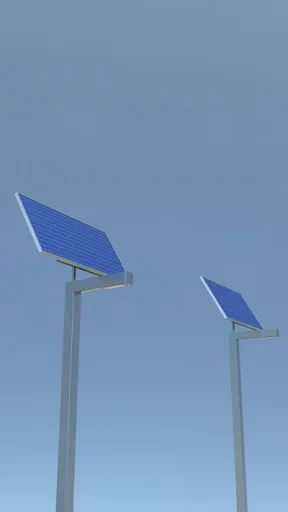
Smart cities and sustainable growth in the industry has made energy independence one of the most important goals for businesses, developers Industrial Solar Devices, and governments, The industrial solar street lights are one of the most impactful innovations of this industrial solar street lights combine solar energy and cutting edge technology to provide industrial zones, highways, logistics centers, and smart cities maintenance free, powerful lights.
For most B2B businesses like infrastructure contractors, utility companies, and energy project developers, the industrial solar street lights aren’t simply updates to the lighting systems. It’s the first step to creating intelligent and energy resilient systems that improve safety and performance while lowering the carbon footprint.
The Rise of Energy-Independent Lighting Systems
Energy independence has become one of the most recognizable traits of modern infrastructure projects. As energy costs rise and environmental pressures become greater, businesses are no longer able to rely heavily on the grid and renewable powered systems have become the norm. Lighting, and street lighting in particular, has become one of the most impactful areas of change in the built environment.
Industrial solar street lights are essential. They are specially designed to collect solar energy using state-of-the-art solar panels, store it in high-tech lithium batteries, and power the lights for an entire night. They are designed to operate Industrial Solar Devices without the need for an interconnected power line and are well-suited for instances in which a facility needs to operate independently of the power grid and in locations where the use of a power grid would be infeasible. They can be set to operate in any remote location and will provide continuous illumination for the entire night.
As an example, an enhanced solar street light can be equipped with smart controls, features such as motion sensors, wireless communication, power-saving changes in brightness, and so on. For industries with the goal of long-term organizational independence and sustainability, these solar street lights will be the first step in developing a foundation for an energy autonomous facility.
Advantages of Industrial Solar Street Lights for B2B Projects
Industrial and large scale infrastructure projects need to consider several factors when it comes to the street lights. They don’t just need to provide illumination, they need to be cost-effective, project durable, and cause no negative impact on the environment. Working with the suppliers and system integrators of industrial solar street lights has several business related benefits, making them a great partnership option for B2B clients.
1. Dependable and durable power source
Industrial operations run on tight schedules and often run at all hours, leaving no room for the light to turn off, and a reliable, uninterrupted light or Industrial Solar Devices source is necessary. Solar powered street lights offer consistent performance, even during the day due to power outages. This is critical for maintaining safety and high productivity in high risk areas, such as ports, warehouses, and logistics centers.
2. Saving Money and More Efficient with Less Work Required
Because solar street lights are not connected to the power grid, they do not incur the costs of monthly electric bills. Also, they last for many years and are less costly to take care of, which, if looked at in the long run, saves a lot of money.
3. Adaptable and Easy to Expand
Industrial solar systems can be set up in both built up and rural places easily without the trouble of having to do a lot of digging or complex wiring systems. Because of this, they are great for projects that need to be up and running in a short amount of time or need to be built in stages.
4. Environmental Responsibility
Companies can generate less greenhouse gases because they are not using the traditional electrical power sources. Because solar lighting is an effective and easy solution, companies are able to integrate solar lighting to sustainable ESG (Environmental, Social, and Governance) practices to meet their carbon reduction goals.
For example, many projects that include led street lights for sale and other energy-efficient lighting systems also integrate solar-powered units to enhance resilience and sustainability. The combination of LED and solar technologies illustrates the efficient and eco-innovative practices that B2B companies are working towards.
How Industrial Solar Lighting Supports Smart Infrastructure
The main tenets of smart infrastructure are connected, efficient, and sustainable systems. Because of their unique control and renewable energy collection, industrial solar street lights or Industrial Solar Devices showcase all of these tenets seamlessly and support the plan of smart infrastructure.
Intelligent Capabilities Supporting Digital Transformation
- Wireless connectivity and IoT: Operators can monitor and adjust settings, monitor energy consumption and schedule maintenance from a distance via a centralized dashboard.
- automated energy control: Motion and daylight sensing dimming helps optimize energy consumption and prolong battery life.
- Predictive maintenance and data analytics: Sensor data collection on overall system performance and environmental state helps to facilitate data-based maintenance and optimization.
- Hybrid power system compatibility: Several systems can utilize solar power hybrids with wind or grid backups and perform continuously under severely adverse weather conditions.
Such systems make solar street lighting highly vital for smart infrastructure ecosystems. self-sustaining and intelligent systems for industrial parks, logistics corridors, and urban road networks are of great environmental value. Such systems also allow B2B enterprises to gain operational visibility and added value from infrastructure.
Economic and Environmental Benefits for Global Projects
Empirical evidence shows solar street lighting provides measurable economic and environmental benefits for large scale projects. With more aggressive sustainability targets, governments and corporations gain added value from industrial solar street lights which help bridge the energy and sustainability responsibility gap.
1. Reduced Operational Costs
Organizations eliminate the dependence on the grid while enjoying savings of up to 70-80% on lighting ELP. See scaling savings with project size. Developments in solar lighting of services in industrial zones and urban planning activities.
2. Accelerated ROI and long term Value
Solar systems have shorter payback periods with cost savings generated from energy savings and maintenance free. Even though the installation of solar lighting systems is costlier than traditional lighting, solar lighting systems offer long term savings.
3. Compliance with International Standards
Renewable lighting assists B2B enterprises in satisfying worldwide environmental certifications and sustainability standards, such as ISO 14001 and LEED.
4. Positive Environmental Footprint
Every solar light installed supports the world’s carbon neutrality activities by significantly reducing the co2 emitted and ensuring climate resilience.
By investing in solar powered industrial street lights, companies enhance the optimization of their operations and reinforce corporate positioning as sustainability frontrunners in their verticals.
The Future of Industrial Lighting and Renewable Integration
Digitalization and automation with energy diversification characterize the global industrial lighting market’s new phase. Within this context, solar street lighting will continue to support the organization of energy-independent smart infrastructure systems.
Expected upcoming changes include,
- Artificial intelligence (AI)-powered lighting management systems that learn and predict patterns, proactively managing and limiting energy consumption.
- Next-generation photovoltaic materials that are more efficient, last longer, and perform better in challenging environments.
- Partnerships with renewable microgrid technologies to establish autonomous industrial and urban environments.
- Circular economy practices aim to close material loops with lighting components designed to reduce disposal and lifecycle emissions by recycling and reusing.
The synergistic combination of solar and energy storage digital technologies is a game changer for industrial sustainability for B2B enterprises. Infrastructure designed by their leading suppliers and integrators can exceed today’s performance thresholds designed for future carbon-neutral, fully energy-independent systems.
Conclusion
There is a growing global embrace for sustainability and smart urbanization. The industrial solar street lights offer unique energy-independent smart infrastructure that is cost-effective, resilient, and environmentally friendly. For B2B enterprises, the industrial solar street lights or Industrial Solar Devices provide the building blocks for intelligent infrastructure, helping to meet the energy independence goals of new industrial and municipal projects.
Virtually and literally, the lights will pave the way for a sustainable future.