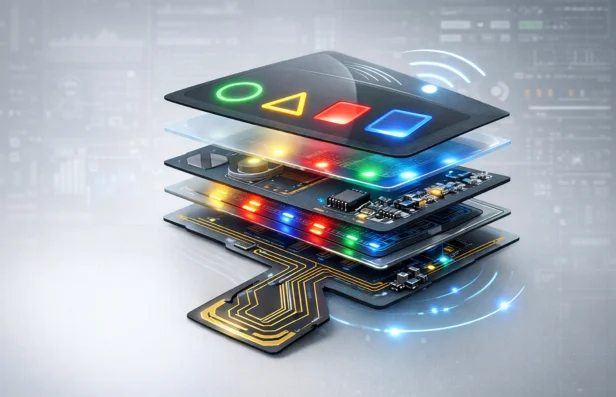
Membrane switches have long been trusted for their durability, thin construction, and sealed surfaces that withstand harsh environments. They are widely used in medical devices, diagnostic instruments, industrial controls, transportation systems, and consumer appliances. Their reliability stems from a simple operating principle: a flexible top layer deflects onto a printed circuit to make electrical contact.
As products become smarter and more connected through the Internet of Things, simplicity is giving way to a more sophisticated role. Membrane switches are evolving from single-purpose input mechanisms into intelligent, sensor-enabled, communication-aware interface modules. They are now part of the broader IoT architecture, contributing data and responding dynamically to system conditions, while supporting advanced functionality that was not possible a decade ago.
This transformation is reshaping the way engineers design membrane switch assemblies, from the materials used to the circuitry, electronics, and data pathways embedded within them.
Moving From Passive Inputs to Intelligent IoT Interfaces
For decades, membrane switches acted as passive components. Their job was to register a button press and transmit a binary signal. IoT integration changes this relationship entirely. Devices require interfaces that are not only responsive but also aware of their context, capable of generating telemetry, and able to interact with embedded software and cloud systems.
Modern membrane switch assemblies may include:
- Printed sensors that monitor force, temperature, humidity, or proximity
- Microcontrollers that preprocess signals or handle communication logic
- Visual indicators that change dynamically based on system inputs
- Flexible antennas for wireless connectivity
- Diagnostic features that report usage data or environmental status
The membrane switch becomes part of the product’s intelligence layer rather than a simple contact point.
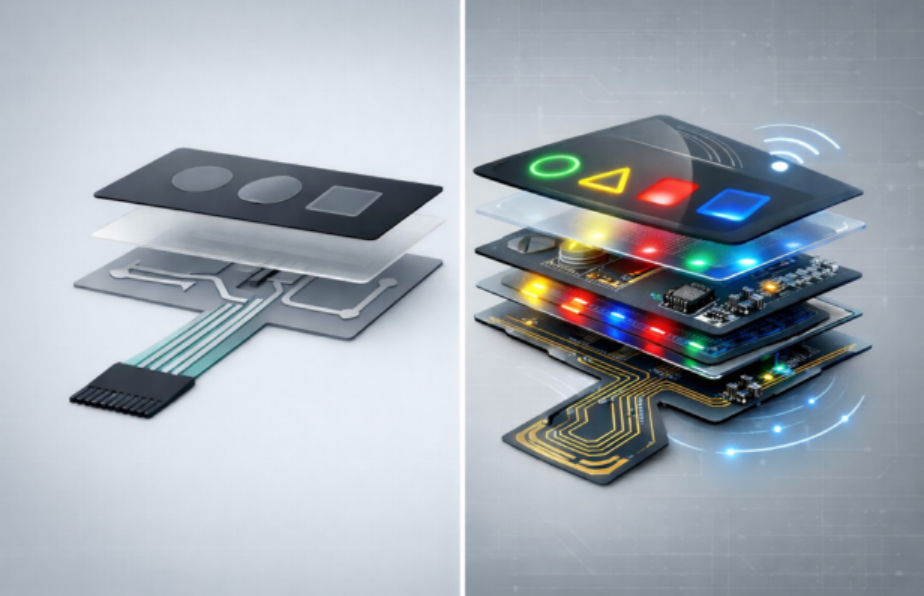
Embedded Sensors Inside the Membrane Stack
Printed electronics solutions have opened the door for a wide range of sensors to be integrated directly within the membrane switch layers. This is possible without significantly altering the profile, weight, or flexibility of the assembly.
Common integrations include:
- Capacitive touch sensing for zero-travel, sealed interfaces
- Printed force sensing for pressure measurement and verification
- Temperature and humidity sensing for environmental awareness
- Contactless input areas for sterile or gloved environments
- Proximity detection for non-contact actuation patterns
Embedding sensors within the switch reduces the number of components, improves reliability, and allows the interface to become a localized IoT data node rather than just a user control.
For medical devices, this may mean detecting improper user input. In industrial controls, it could translate to monitoring environmental drift inside an enclosure. The switch becomes a valuable feedback point for the device’s operational health.
IoT-Driven Data Tracking and Intelligent Actuation
IoT systems depend heavily on real-time insights. Membrane switches now play an active role in gathering and transmitting valuable usage data.
Examples of data captured include:
- Number of actuations over time
- Force applied during each press
- Variations in actuation behavior
- Contact resistance trends
- Local temperature or humidity
- Error states triggered by abnormal inputs
This information supports predictive maintenance and operational analytics. Engineers gain the ability to identify worn-out switches long before they fail, monitor user behavior trends, or detect contamination or moisture under the surface.
In regulated environments such as healthcare, aerospace, and industrial manufacturing, these capabilities directly support traceability and compliance.

Adaptive Lighting and Connected Feedback Systems
As connected systems become more complex, users expect interfaces that respond intelligently. Membrane switches now integrate advanced lighting technologies that react dynamically to events within the device or the cloud.
Enhancements include:
- Light-guide films for uniform backlighting
- RGB LEDs that shift color based on system states
- Brightness levels that automatically adjust to ambient conditions
- Indicator windows that illuminate based on IoT-triggered alerts
- Multi-zone lighting for workflow or safety guidance
These lighting systems create interactive feedback loops. In a medical device, a critical button may pulse to signal an urgent step. In industrial automation, keys can change color based on system mode, operating temperature, or lockout conditions. The membrane switch becomes an active communication channel.
Flexible Antennas and Wireless Communication Paths
IoT systems rely on wireless connectivity. Traditionally, antennas required rigid modules or dedicated real estate on a PCB. Flexible printed antennas are now being implemented directly into membrane switch assemblies.
These printed RF structures support protocols such as:
- Bluetooth Low Energy
- Wi-Fi
- NFC
- RFID
- Proprietary sub-GHz industrial networks
Rather than adding a discrete antenna component, the membrane switch itself can incorporate the conductive pattern. This approach reduces total part count, decreases enclosure complexity, and supports ultra-thin industrial design.
For wearables, smart appliances, and portable medical equipment, this integration can significantly reduce size and manufacturing cost.

Enhanced Environmental Monitoring and Sealing Intelligence
Membrane switches are inherently suited for extreme environments because they naturally resist dust, fluids, and chemicals. IoT integration expands this advantage by embedding environmental intelligence inside the sealed structure.
Modern membrane switches may incorporate:
- Humidity or condensation tracking
- Thermal sensing behind the overlay
- Alerts for liquid intrusion or chemical exposure
- Condition monitoring for internal switch performance
These capabilities allow devices to respond proactively to environmental issues. If moisture builds inside an enclosure, the system can notify operators or shut down safely. If the temperature rises beyond acceptable limits, the membrane panel can trigger an alert through the IoT platform.
The membrane switch becomes both a barrier against harsh conditions and a sentinel that monitors them.
Integration With Microcontrollers and Edge Logic
IoT devices increasingly rely on edge computing, where local microcontrollers handle low-level logic before data is sent to the cloud. Membrane switches now incorporate embedded microcontrollers or flexible printed logic circuits that execute tasks traditionally handled by the main board.
These localized tasks include:
- Debouncing and input filtering
- Preprocessing sensor data
- Detecting invalid actuation patterns
- Power state awareness for battery devices
- Secure communication between the switch and the main processor
This architecture improves responsiveness, reduces noise, and enhances security by preventing direct tampering with input lines.
Tail Design for High-Speed Data Paths
As membrane switches incorporate sensors, lighting control, antennas, and microelectronics, the connector tail becomes more complex. It is now a data conduit rather than a simple open-close signal strip.
Tail considerations for IoT-enabled designs include:
- Higher conductor counts
- EMI-controlled trace layouts
- Grounding strategies for shielding layers
- Rigidizers for stable ZIF insertion
- Signal integrity preservation across long flexible runs
The tail must accommodate both digital communication signals and traditional switch contacts, often on the same flexible substrate.
Implications for Designers and Manufacturers
IoT-driven membrane switches require closer collaboration between electrical, mechanical, and software teams. Designers must consider system architecture, communication protocols, sensor placement, power consumption, environmental sealing, and durability.
Key design adjustments include:
- Viewing membrane switches as intelligent subsystems
- Selecting materials that support embedded electronics
- Integrating printed antennas, sensors, and lighting elements
- Coordinating with firmware teams for data handling
- Ensuring compliance with EMI, ESD, and IoT security standards
- Designing tails to handle mixed signal types
This evolution is reshaping the role of membrane switches across industries, pushing them into new categories of device intelligence and system-level functionality.