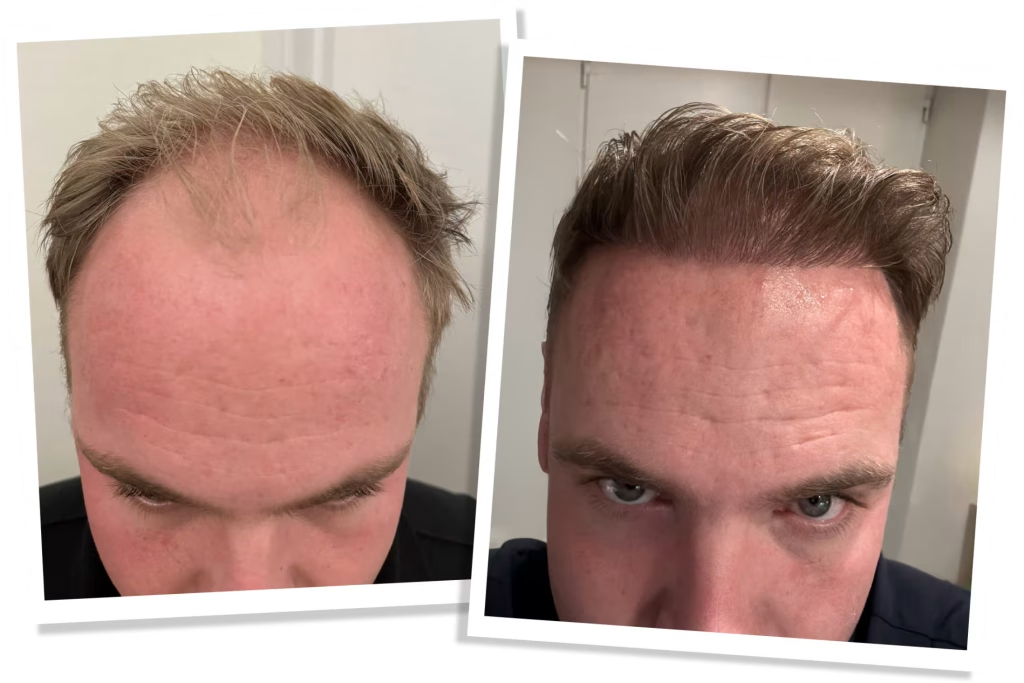
It can be a very challenging process for people to experience hair loss.
The development and progress of hair loss can be due to age, genetics, health, or lifestyle.
That could be seen as one of the main reasons there is no single treatment that would be beneficial to everyone.
That is also the reason why each person’s treatment has to be customized for long-lasting yet natural-looking hair.
This is exactly where experienced hair transplant specialists play a valuable role.
To meet the needs of individuals, each person requires a specialist-designed personalized treatment plan.
By tailoring each step of the process, from consultation to recovery, specialists can ensure that patients receive results that look natural and align with their expectations.
1. Why Customization Matters in Hair Transplants?
Every person has a different pattern of hair loss.
Some have a receding hairline and bald spots, while others have gradually thinning hair.
Other factors to consider are hair growth direction, density, color, and texture.
This makes customization an essential part of hair transplantation.
Working with experienced hair transplant specialists ensures that these variables are carefully considered.
The process helps the specialist to address the cause of hair loss and how to plan for the future and preserve existing hair.
This approach improves the final results in not only maintaining the best results but also doing it most quickly and healthily.
2. Initial Consultation: Understanding the Patient’s Hair Loss
Initially, there is a comprehensive consultation to start the customized restorative process.
First, a detailed scalp analysis is done by a specialist to assess the density of the hair, the condition of the scalp, and the strength of the follicles.
The donor area, where hair is harvested, receives special attention, which typically refers to the areas with healthy hair follicles that are on the sides or back of the head.
To identify conditions or medications that may affect hair growth, the medical history of the patient is reviewed.
Each individual is assessed regarding their hair care routine, diet, and their level of stress.
Realistic expectations are important, which leads to specialists discussing not only the process but also the final results that can be expected.
3. Designing a Personalized Hair Transplant Plan
After the hair, health, and habits have been evaluated, a customized transplant plan is designed by the specialist.
This discussion would include hairline shape, which other areas need to be covered, and the number of grafts that would be required to complete the process.
The hairline design needs to complement the natural appearance and facial features, as well as the age of the patient.
And do not forget that gender differences also have to be considered.
Hair loss is different for men and women; therefore, a specialist has to adjust their treatment according to individual needs.
For example, women often require density restoration rather than a reconstructed hairline, while men may focus on the frontal hairline or crown coverage.
4. Selecting the Right Technique for Each Patient
Another critical part of customization is choosing the correct technique suitable for each person.
Follicular Unit Transplantation (FUT) and Follicular Unit Extraction (FUE) are the most common methods used.
FUE involves extracting individual follicles, while FUT removes a small strip of scalp to harvest grafts.
It all depends on the patient’s hair type, goals, donor area density, scalp flexibility, etc., when making final decisions about FUT or FUE.
Sometimes patients make use of both techniques in combination for the best results.
The specialists also do their best to ensure that any future hair loss does not compromise the final results and how the hair will be preserved long-term.
5. Location-Based Expertise and Patient Needs
Demographics and environmental factors are also considered by the specialists when deciding on treatment with transplants.
Patients’ needs differ according to location, as well as aesthetic preferences and hair characteristics.
For example, specialists offering hair restoration Sarasota services often address sun exposure and lifestyle factors, common in warmer climates.
Patients seeking Virginia hair transplant services may look for advanced techniques that suit professional lifestyles and varying seasonal conditions.
Similarly, clinics providing hair transplants in North Carolina often focus on personalized treatment plans that balance natural results with long-term hair preservation.
Specialists are able to deliver more relevant and precise solutions for each patient based on their location.
6. Custom Post-Procedure Care and Recovery Plans
After the procedure is done, there is more to keep in mind, for example, customization.
In order to support healing and promote optimal hair growth, postoperative care is tailor-made for each patient.
Aftercare instructions, like washing routines, activity restrictions, and medication guidance, are provided by specialists.
Depending on the chosen technique that was used, as well as the hairline design, needs to complementimes vary from patient to patient.
To monit, or the progress and address any concerns, follow-up appointments are scheduled for each patient.
This ongoing support plays a crucial role in achieving natural, long-lasting results.
7. How Technology Helps Hair Transplant Specialists Personalize Results?
Technology has been modernized, which means treatment can be personalized for each patient by the specialist.
By making use of digital scalp mapping and imaging, results can be visualized and planned more precisely.
This results in optimal graft placement and hair direction through digital tools used by specialists.
More accurate graft extraction and placement through these advanced instruments minimizes trauma.
Continuous improvements in hair transplant technology ensure better survival rates for transplanted follicles and more natural-looking outcomes.
8. Conclusion: The Value of Choosing the Right Hair Transplant Specialist
For successful hair restoration, customized treatment is the answer.
Transplant specialists can deliver results that look natural, stand the test of time, and suit the patient’s lifestyle by tailoring every step of the transplant process.
A better outcome and higher satisfaction can be expected when patient- focused care is combined with experience and advanced technology,
Anyone considering hair restoration should consult a qualified specialist who prioritizes personalized solutions and long-term results.
Let your happy hair days return!