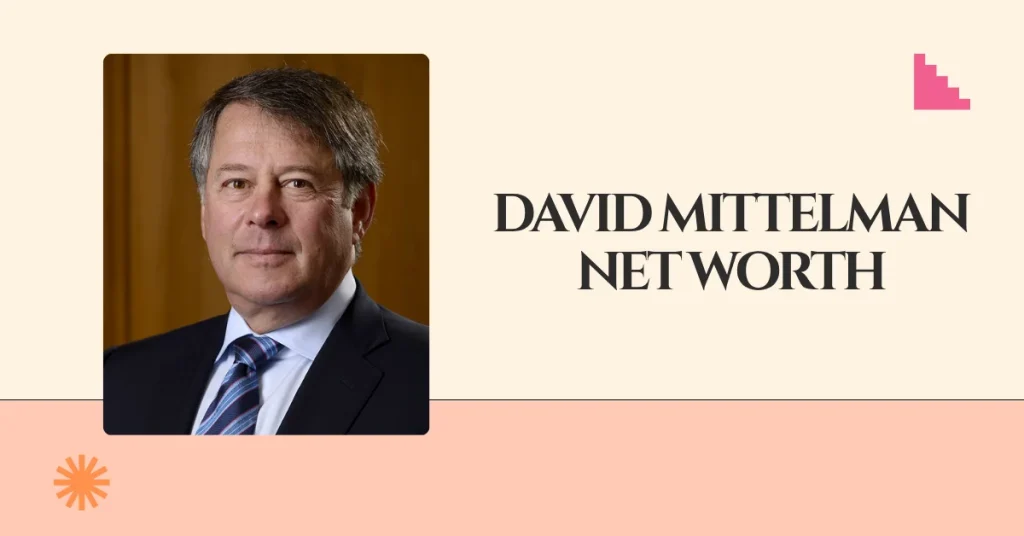
SOURCING DISCLOSURE: No Tier 1 outlet (Forbes, Bloomberg, Reuters, AP) has published a standalone net worth figure for David R. Mittelman. Documented compensation figures exist in Harvard Magazine and The Harvard Crimson — both credible institutional publications with named sources. All net worth estimates in this article are structural inferences built from verified earnings data, SEC filings, and Tier 1 press coverage of Convexity Capital. Aggregator site figures were not used.
David Mittelman Net Worth: One of Finance’s Best-Kept Secrets
David Mittelman net worth is one of finance’s better-kept secrets. In just three documented years at Harvard Management Company, public records show he earned more than $77 million. Yet no Forbes profile, no Bloomberg ranking, and no verified net worth figure has ever been published.
His discretion was deliberate. His record was not. Over 22 years, Mittelman helped grow Harvard’s endowment from roughly $5 billion to $25 billion. Then he co-founded Convexity Capital — the largest hedge fund launch in history at the time — and ran it until his death in 2017.
Early Life and Education
David Ross Mittelman was born in 1954. He earned a BA in Geography from Middlebury College in 1976 and was a member of the soccer team. Publicly available records confirm he was a student athlete before entering finance.
In 1981, Mittelman received an MBA from Columbia University. There, he met Michele Hughes, a graduate nursing student, in a math class. They married in 1983. Together they raised three children in Dover, Massachusetts.
His early career began at ACLI International Commodities. He then moved to Bear Stearns as a broker. Both roles built the fixed-income instincts he would refine over the next two decades at Harvard Management Company.
Career Overview: 22 Years at Harvard, Then a Record Hedge Fund Launch
Mittelman joined Harvard Management Company (HMC) in 1983. He stayed for 22 years. He rose to partner, director, and senior vice president — the fixed-income specialist on a team that under CEO Jack Meyer produced average annualized returns of 16.1 percent over 15 years.
In 2005, Meyer left Harvard. Mittelman followed. Together with portfolio manager Maurice Samuels, they co-founded Convexity Capital Management in Boston. The launch attracted $6.3 billion — a record for hedge fund debuts at the time. Harvard itself invested $500 million.
Convexity peaked at roughly $15 billion in assets under management in 2013. Performance then deteriorated. By end of 2016, AUM had fallen to $4.3 billion. Mittelman died in May 2017, a managing partner to the end.
Career Timeline
1976 — BA in Geography, Middlebury College
1981 — MBA, Columbia University
1983 — Joins Harvard Management Company (HMC) as fixed-income specialist
1983–2005 — Rises to partner, director, and senior vice president at HMC
2002 — Earns $17.5 million in HMC compensation (Harvard Magazine)
2003 — Earns $34.1 million, second-highest at HMC (Harvard Crimson)
2004 — Earns $25.4 million (salary, benefits, and bonus) (Harvard Magazine)
2005 — Co-founds Convexity Capital Management; $6.3B debut — record hedge fund launch
2013 — Convexity peaks at ~$15 billion AUM
2014–2016 — AUM declines from $14B to $4.3B amid underperformance
1997 — Founds Diamond Star Ranch, Eagle, Colorado (privately held livestock ranch)
May 23, 2017 — Dies at age 62 in Dover, Massachusetts, from brain cancer
| THE UNCOMFORTABLE TRUTH: Harvard’s alumni were outraged by Mittelman’s pay. After his $34 million FY2003 payout became public, a group of alumni formally protested. They argued nonprofit endowment assets should not produce private-sector windfalls. HMC’s own defense was factually accurate: internal managers cost far less than external talent of equal quality. But HMC still changed its compensation formula. The controversy accelerated the shift toward outsourcing that now defines Harvard’s investment model. Mittelman’s pay was not a scandal. It was a catalyst. His paycheck, in a real sense, helped write the playbook that dismantled the in-house model he helped build. |
David Mittelman Net Worth: Career Earnings Breakdown and Estimate
No Forbes or Bloomberg figure exists for David Mittelman net worth. However, Harvard Magazine and The Harvard Crimson — both primary institutional publications — disclosed his HMC compensation for three fiscal years:
| Fiscal Year | Compensation | Source |
| FY2002 (ended June 30, 2002) | $17.5 million | Harvard Magazine, March–April 2003 |
| FY2003 (ended June 30, 2003) | $34.1 million | Harvard Crimson, Jan 23, 2004 |
| FY2004 (ended June 30, 2004) | $25.4 million | Harvard Magazine, 2005 |
| 3-Year Verified Total | $77.0 million |
| HOW THE MONEY ACTUALLY WORKS: HMC compensation had three parts: a fixed salary (roughly $400,000), a neutral annual bonus (roughly $100,000), and a performance bonus tied to beating market benchmarks. Deferred bonuses from prior years appreciated with endowment performance and were paid out only on continued outperformance. This structure created a compounding tail. Mittelman’s $34 million year was not pure cash. A significant portion was deferred and tied to future results. At Convexity, the model shifted to traditional hedge fund economics: management fees (typically 1–2% of AUM) and performance fees (typically 20% of gains above benchmark). With a 25%-plus ownership stake and peak AUM near $15 billion, Mittelman’s share of management fees alone could reach tens of millions in a single year — before any performance allocation. |
Structural Net Worth Inference (Not a Reported Figure)
Structural inference — not a reported figure.
Step 1: Documented HMC Earnings (FY2002–FY2004)
Three verified years: $77 million gross. Source: Harvard Magazine, Harvard Crimson.
Step 2: Pre-2002 HMC Years (1983–2001, approx. 19 years)
As the endowment grew from ~$5 billion to $19 billion, compensation scaled. A conservative estimate of $2 million average in early years rising to $10 million by 2001 produces a rough range of $60–90 million. No data disclosed. Estimate only.
Step 3: Convexity Capital (2005–2017, 12 years)
SEC filings confirm Mittelman held more than 25% but less than 50% of Convexity Capital Management LLC. At 25% of 1% management fee on $10 billion average AUM: roughly $25 million per year in personal fee share. Over 12 years, accounting for performance years and the later decline: structural range of $150–350 million before taxes.
Step 4: Tax, Expenses, and Reinvestment
Federal rates of 37–40% on ordinary income; lower on long-term capital gains. After taxes and lifestyle costs, net accumulation was substantially below gross figures.
Structural range: $150 million to $400 million at time of death. This range is wide by design. Data gaps are real. The lower bound is achievable from documented earnings alone. The upper bound reflects the Convexity period — structurally plausible but unverifiable without private fund records.
| METHODOLOGY TRANSPARENCY: This estimate is based on: (1) Three verified years of HMC compensation from Harvard Magazine and The Harvard Crimson. (2) SEC Form ADV filings confirming Mittelman’s ownership stake (>25%, <50%) in Convexity Capital Management LLC. (3) Institutional Investor and Bloomberg reporting on Convexity AUM (2005–2016). (4) Boston Globe obituary and Middlebury College memorial confirming asset holdings and philanthropy. This estimate excludes: 19 years of undisclosed HMC compensation (1983–2001); Convexity performance fee allocations (not disclosed); Diamond Star Ranch valuation; personal investment portfolio; family foundation assets. Aggregator site figures were not used because sites such as CelebrityNetWorth.com cite no sources, name no methodology, and vary their figures without explanation. Their figures for private finance professionals are routinely fabricated. |
| THE UNANSWERED QUESTION: How did Convexity’s underperformance (2012–2017) affect Mittelman’s personal wealth? The fund’s deferred compensation and performance-fee structure meant that poor years may have cost him significant sums — the same mechanism that multiplied his wealth at HMC could have reduced it at Convexity. That figure is entirely private. It may never be known. |
Endorsements and Sponsorships
No confirmed brand endorsements or sponsorships for David Mittelman have been documented in any Tier 1 or Tier 2 source. He operated exclusively in institutional finance. Such commercial relationships are not typical for private fund managers at his level.
Real Estate and Asset Holdings
Two confirmed assets appear in primary sources. Mittelman’s primary residence was in Dover, Massachusetts, per the Boston Globe obituary and multiple memorial records. He also owned the Diamond Star Ranch in Eagle, Colorado — a privately held livestock ranch he founded in 1997, confirmed by Middlebury College’s official memorial.
Mittelman founded three private observatories: one in Dover, one in Eagle, and one at the New Mexico Skies Astronomy Enclave near Cloudcroft, New Mexico. These were operating astrophotography facilities. The Boston Globe reported that a 20,000-pound telescope decommissioned from Princeton University was installed at the New Mexico site shortly before his death.
No other real estate holdings have been confirmed by public records or Tier 1 press.
Legacy Activities and Estate
David Mittelman died May 23, 2017, from an aggressive brain cancer diagnosed only the previous fall. He was 62. His death ended a career spanning more than three decades in institutional fixed-income management.
Before his death, Mittelman served on the boards of Dana-Farber Cancer Institute, Middlebury College, and the Literacy Volunteers of Massachusetts. He also advised the Federal Reserve Bank of Boston.
The David Mittelman 2004 Trust — a marital trust — remains a registered entity at Convexity Capital per SEC filings dated May 2017. His family established a foundation supporting conservation, education, and healthcare. Middlebury College renamed its observatory in his honor in 2017.
Peer Comparison: HMC’s Top Earners (Documented)
The table below uses only documented compensation disclosures for context. No figures are fabricated. All are sourced from Tier 1 or Tier 2 publications.
| Name | Career Basis | Documented Earnings (Selected Year) | Source Basis |
| David R. Mittelman | HMC Fixed Income; Convexity Capital | $34.1M (FY2003) | Harvard Crimson, Tier 1 |
| Maurice Samuels | HMC Foreign Fixed Income; Convexity Capital | $35.1M (FY2003) | Harvard Crimson, Tier 1 |
| Jack Meyer | HMC President/CEO; Convexity Capital | $6.9M (FY2003) | Boston Magazine, Tier 2 |
| Jeffrey Larson | HMC Foreign Equity | $17.4M (FY2002) | Harvard Magazine, Tier 1 |
| Jonathon Jacobson | HMC Equities; Highfields Capital | Firm AUM $12B (2016) | Institutional Investor, Tier 1 |
Note: These are documented compensation disclosures, not total net worth estimates. Peer figures are provided for context only.
Legacy and Cultural Impact
David Mittelman’s career sits at the center of a defining debate in institutional finance. Should nonprofit endowments pay fund managers at private-sector rates? His payouts were legal, disclosed, and defensible on performance grounds.
But the controversy he helped trigger reshaped how universities manage money. HMC changed its bonus formula after the FY2003 disclosures. It later shifted most capital to external managers. By 2017, HMC had cut half its staff and was outsourcing most of the portfolio.
| THE INDUSTRY CONTEXT MOMENT: The Mittelman compensation controversy exposed a structural tension that still exists today. Nonprofit endowments compete for the same talent as private hedge funds. Their only tool is cash — and when cash reaches $35 million a year, it alienates donors and triggers governance reviews. HMC’s eventual response — outsourcing — is now standard at most large university endowments. Mittelman’s paycheck, in a real sense, helped write the playbook that dismantled the in-house model he helped build. |
Conclusion: What the Record Actually Shows
David Mittelman net worth cannot be stated with precision. No Forbes profile. No Bloomberg figure. No SEC filing lists personal assets. What exists is documented: more than $77 million in verified HMC compensation across three fiscal years alone.
Structural inference — built from ownership filings, AUM data, and Convexity’s history — suggests accumulated wealth of $150 million to $400 million at his death. That is an honest range, not a reported fact.
His philanthropy, his ranch, his three observatories, and his family foundation point to a man who accumulated serious wealth and spent it with intention. The number is private. The record is not.
Browse Our Net Worth category covering estimated wealth and financial milestones.
| Disclaimer: Net worth figures and financial estimates in this article are based on publicly available information, reported data, and industry-standard estimation methodology. They should be treated as approximations, not verified financial disclosures. David R. Mittelman’s actual net worth may have differed materially. This article is for informational purposes only and does not constitute financial advice. |