
Introduction
Ecommerce is growing fast. More people buy products online every year. Because of this, many businesses want their own ecommerce website instead of relying only on large marketplaces.
Having your own online store gives you more control. You can design the brand, manage your products, and communicate directly with customers. For many small businesses and creators, this is an important step in building a long-term brand.
However, building a website the traditional way is not easy. It often requires developers, design work, and time. The process can be slow and expensive, especially for new businesses that want to launch quickly.
Today, things are starting to change. AI and no code tools make it possible to create an ecommerce website much faster. With these tools, people can build and manage an online store without writing complex code. This new approach is helping more businesses launch online and test their ideas quickly.
Why More Businesses Are Choosing Independent Ecommerce Websites
Many companies now prefer to run their own ecommerce website instead of selling only on large marketplaces.
One reason is brand control. With an independent digital storefront, businesses can design their website and present products in their own style.
Another reason is customer data. Running an online business on a self-owned site allows companies to understand their customers and communicate with them directly.
Cost is also important. Marketplaces often charge listing or transaction fees. An independent ecommerce website helps businesses avoid many of these costs.
Finally, a personal digital storefront offers more customization. Businesses can adjust features, product pages, and the shopping experience to match their needs.
The Challenges of Building an Ecommerce Website
Building an ecommerce website involves many steps. It is not only about designing a page and adding products.
First, the frontend design needs to be clear and easy to use. Customers should be able to browse products and place orders without confusion.
Next comes product management. Businesses need a system to upload products, manage prices, track inventory, and update product information.
Another important part is payment integration. The website must support secure payment methods so customers can complete purchases smoothly.
There is also the backend setup, which handles orders, user accounts, and store operations behind the scenes. In addition, the website needs hosting to stay online and a database to store product and customer information.
All these tasks can make traditional website development slow and complex. This is where AI-powered no-code builders come in. They simplify the process and help businesses launch an ecommerce website much faster.
What Is MeDo?
MeDo is an AI website builder designed for no code development. It allows users to create apps and websites without writing code. The platform supports full-stack app generation, meaning it can build both the frontend and backend automatically. Users can simply describe what they want to build using prompts. MeDo also creates the database structure during the setup process, so users do not need to configure it manually.
With this approach, people can build full stack apps faster. The platform also supports API integration, making it easier to connect additional services when needed.
Why MeDo Works Well for Ecommerce Websites
As AI development grows, many coding tools have appeared. However, most only generate small code snippets or simple demos. MeDo focuses on a more practical goal — helping users turn ideas into real products such as websites, apps, and games. With a natural language workflow, users can describe what they want to build, and the system helps generate the structure and logic.
1. AI-generated full-stack apps
MeDo can generate an ecommerce website from simple prompts. Users describe their store idea, and the platform can create the frontend, backend, and database needed for the project.
2. No coding required
The platform focuses on no code development, so users do not need programming skills. Creators, entrepreneurs, and small businesses can build an online store more easily.
3. Built-in backend and database
MeDo includes built-in backend functions and database support. Core systems such as data storage and APIs can be created automatically, reducing technical setup.
4. API integration for payments and services
The platform supports API integration, allowing users to connect useful services such as payment gateways, shipping tools, or other online services for ecommerce operations.
5. Cost-effective for early stage projects
MeDo offers a freemium model. New users receive 300 Credits at signup and 100 Credits daily for logging in, allowing them to start building without cost. Premium plans start at $20 per month for larger projects.
Step-by-step Guide: Building an Ecommerce Website with MeDo
Once the main idea of the store is clear, the next step is turning that idea into a working website. With AI tools like MeDo, this process can be much faster because many technical steps are handled automatically. The workflow below shows how a typical ecommerce website can be created.
1. Describe core features
Start by describing your store idea using a prompt. For example:
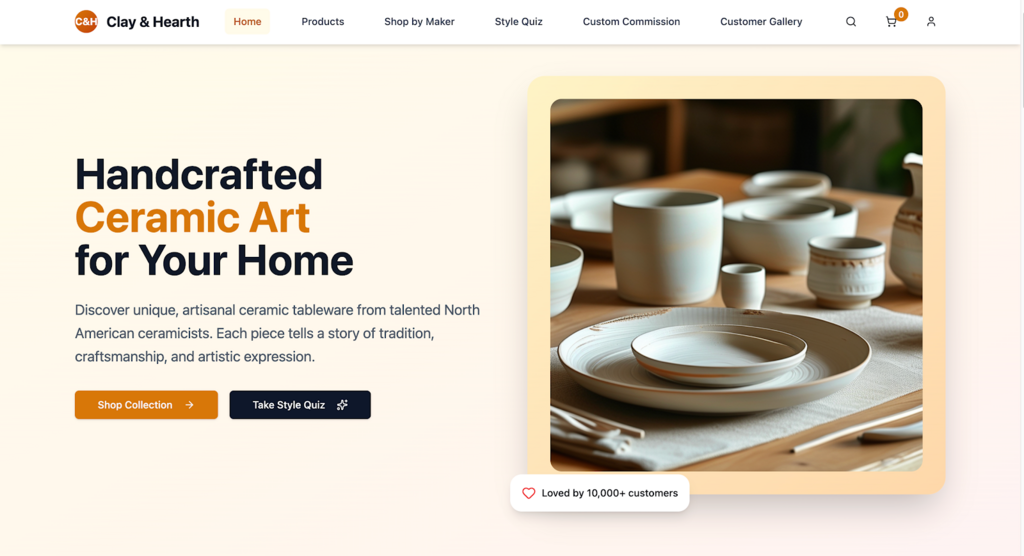
Create an e-commerce website for the North American market specializing in artisanal handcrafted ceramic tableware, named “Clay & Hearth”.
The site will feature unique, small-batch pieces from independent North American ceramicists, including dinner sets, mugs, serving bowls, and decorative vases.
Key features:
- a “Shop by Maker” section highlighting artist stories and studio locations;
- a “Style Quiz” (e.g., “rustic vs. minimalist”, “everyday use vs. special occasions”) to recommend pieces; AR functionality allowing users to visualize products on their own dining tables;
- and a “Custom Commission” tab for personalized orders. Include detailed care instructions, material sourcing info (e.g., locally mined clay), and carbon-neutral shipping options.
Design with warm, earthy tones to reflect the handcrafted aesthetic, and integrate customer photos of products in use.
2. Add products and connect payment
Next, upload product information such as images, prices, and descriptions. You can then connect payment services so customers can place orders through your online store. Additional tools like shipping or inventory services can also be integrated.
3. Test and publish
Finally, review the website and test key features such as product pages and checkout. Once everything works properly, the ecommerce website can be published and made available to customers.
Conclusion
The demand for ecommerce websites continues to grow as more businesses move online. At the same time, traditional development can still be slow and costly, especially for small teams or new entrepreneurs who want to launch quickly.
AI-powered tools are starting to change this workflow. By reducing technical complexity, they allow more people to build and manage their own online store without relying on large development teams.
Platforms like MeDo show how this shift is happening. By combining AI website builder technology with no code tools, users can experiment with ideas, build functional websites, and launch projects more efficiently. In this way, MeDo offers a flexible path for turning ecommerce ideas into real products without major technical barriers.
Spotlight stories that inspire, inform, and ignite your curiosity fast at 2A Magazine.