Music creation is undergoing a fundamental change. Where creating a professional-quality track used to take a recording studio, session musicians and hours of mixing and mastering, AI music generation has folded that entire process into seconds. At the heart of this transition is Suno – a text-to-music generator turned fully equipped creative production environment. Suno v5 and Suno Studio with it brought the technology from “interesting experiment” territory into professional-scale creative tool.
For developers and companies who want to plug this functionality directly into their own products, the Suno API is the connection between Suno’s generation engine and the world. And for teams who want that access to be affordable, globally available and easy to integrate, APIPASS is the platform that makes it possible.
What is Suno API and what it can do?
Suno is a platform that generates full, high-quality music tracks from text prompts using AI. Where earlier AI music tools delivered simple loops or MIDI sequences, Suno renders fully mixed audio — vocals, instrumentation, rhythm, dynamics and arrangement — in a single generation pass. Maximum noise, minimum starting point for editing. They are a completed musical work.
The Suno API provides programmatic access to this capability, making it possible for developers to create applications that generate and customize AI music at scale. This layer forms the core generation of whatever use case—music streaming platform, content creator tool, gaming soundtrack engine, automatic media production pipeline.
The latest model, Suno v5, is the platform’s biggest technological jump yet. Public in September 2025, it was a radical re-architecture that raised the ceiling on audio fidelity, vocal authenticity and compositional intelligence. It was complemented by the release of Suno Studio, which offered a complete Digital Audio Workstation (DAW) environment with multi-track editing, stem separation, MIDI export and even generative stem capabilities — turning Suno from a generator into an integrated creative platform.
Suno API Features: What Developers Can Expect
Create unprecedented music from text prompts.
Suno API is fundamentally a text-to-music generator. The developer sends a prompt detailing genre, mood, instrumentation, vocal style and structural direction to the model which returns a finished audio track. Suno v5 is also much better at responding to prompts, so specific, nuanced descriptions yield a more faithful output — “smoky jazz vocal with legato phrasing over sparse upright bass,” for example, yields an output that’s basically different from requesting generic jazz. The model (generates sequences) of up to eight minutes long, with an Intelligent Composition Architecture preserving a structural coherence throughout the full track — verses, choruses, bridges and outros that flow organically and evolve with professional dynamics.
Vocal remover and stem separation.
Stem splitting is the API’s ability to break a track you generate into its underlying elements — vocal, drums, bass, guitars, synths and others up to twelve different stem. The separate files are import-friendly for external DAWs like Logic Pro, Ableton Live, or FL Studio, so the Suno API can become a viable piece in professional hybrid production workflows. Remix Beatz could be built right into remixing tools, mastering applications or sampling platforms that developers build.
MIDI export.
While its audio output, is all we’re working with right now the platform also exports MIDI data, allowing you to extract and use the underlying musical information from an AI-generated track in any virtual instrument or synthesizer. This suggests a whole track of creative applications — from devs creating music education tools, to those who integrate AI-composed melodic ideas into more complex production environments.
Extend music seamlessly.
Clip extension is also supported, where developers could generate extra clips that continue and blend into a previously provided track. This is critical for use cases that demand dynamic, adaptive music — game soundtracks that should stretch to match gameplay or content platforms looking to integrate longer audio assets without a repeated loop.
Generate song lyrics.
Developers can even integrate the API into their projects, allowing for text input in order to generate track or theme-specific lyrics, helping address both the compositional dimension of a song and its lyrical side. Developers can set keywords, mood, narrative arc, and stylistic direction and receive original lyrics that match the project’s tone — a content creation pipeline for any number of music apps or creative tools.
Multi Audio Format Support.
MP3, MP4 and WAV output — the trio of formats covers everything from delivery optimized for streaming to professional, lossless audio fit for commercial release and broadcast use.
Suno v5: The Latest Model Behind the Suno API
To know what the Suno API can offer, one needs to understand exactly what Suno v5 does differently than past iterations.
The most obvious improvement is audio fidelity. In complex arrangements, individual instruments are now clearly distinguishable instead of getting lost in a homogenous texture — particularly noticeable for orchestral and multi-instrument productions. The underlying architecture, which is thought to mix transformer and diffusion processes in larger scale, generates a warmer and fuller sound with a more uniform frequency response including steadfast low-end presence, expanded high-end detail and a polished out-of-the-box mix quality requiring less work through post-production correction.
The vocal metamorphosis is equally impressive. Where earlier versions sounded competent and emotionally detached, v5 offers voice that people are noting across the board as feeling natural, authentic and human. The model can weave together finely wrought performance instructions — leaping from a “wistful verse” to a “confident chorus” to a “cathartic bridge” — using sophisticated control of breath support, micro-dynamics and vibrato. Vocal phrasing, moreover, is rhythmically locked to the instrumentation, rather than sitting loosely on top of it; this solves one of the most obstinate complaints about an AI-generated music.
Suno v5 also adds reliable negative prompting, meaning that developers can specify things they don’t want — “no guitars,” “instrumental only,” “clean mix, no harsh distortion” — to produce cleaner, more tailored output. And its Genus Stick Voice and Genus Stick Instrument Memory preserves the personality of voices and instruments continuously at multiple generations within a project so that layered arrangements feel more coherent as one creative work.
Why Choose APIPASS for Suno API Integration?
Far: affordable pricing + flexible credit system
APIPASS offers the Suno API at competitive rates without any subscription requirements. The credit-based, pay-as-you-go model ensures spend directly correlates with usage — teams only pay for what they generate. Suno API provides the crucial advantage of economic feasibility among developers, startups and even with enterprise teams without subscription tiers that lock you in at pricing levels irrespective of your volume.
Access all over the world, without regional limitations.
APIPASS does not limit geographical access to the Suno API. Any developer from any country can sign up, obtain an API key immediately, and develop against it — no approval processes, no regional waitlists, no hacks. This level of openness is not incidental for international teams and distributed organizations — it’s what allows global deployment to happen.
Output with high concurrency and without a watermark.
The concurrency and load on the Suno API is elastically handled with stable performance even at peak traffic levels, thanks to the highly scalable infrastructure of APIPASS. For applications that require variable or high-frequency generation — content automation platforms, social media tools, enterprise creative workflows — the system serviceably fulfills parallel requests without deterioration in speed or output quality. APIPASS may be used to deliver watermark-free audio that are fit for commercial purposes and direct delivery to end users.
Easy documentation for the developer and integration.
APIPASS offers comprehensive API documentation, including authentication setup, endpoint references, prompt structure guidance, response handling instructions and callback configuration information. Integration is easy thanks to working code examples in Python, cURL, and REST depending on how the developer stacks up. This documentation is written for teams that need to move quickly from evaluation to working production integration.
Responsive technical support.
When questions arise about integration, APIPASS also ensures ease of access to technical support in the form of direct contact channels and documentation guidance. Whether a team is assessing the Suno API for the first time or tuning an existing workflow for throughput, there’s support to help troubleshoot issues as well as pinpoint enhancements — and not only during the free trial but at every phase of integrating it into your application.
Step 1: Learn More About the Suno API
Step 1: Sign up and generate your API Key
Go to APIPASS, register for an account and your API key is instantly available in the dashboard — no improving queue, no approval waiting period. This key is used to authenticate all requests in the Bearer Token format.
Step 2: Create your first music track.
Now you can request a generation using your API key (make sure you guard it well to prevent abuse of your service by other people) and allow as parameters the prompt, model version, and duration. When the track is ready — download links and audio metadata timestamps and so on — the system returns a task ID and delivers results to your configured callback URL. Alternatively, if desired, you can poll the status endpoint manually.
Step 3: Read through the documentation and experiment in Playground.
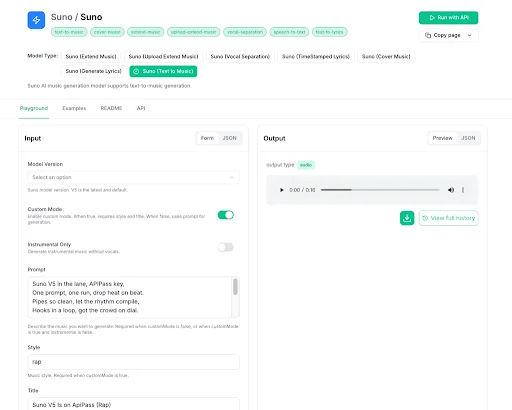
The new users, come with free trial credits to the actual Playground environment inside APIPASS itself — allowing easy experimentation of the Suno API. Experiment with various prompts, compare outputs at different generation settings and compare how well the model will be able to do what you need before spending any budget. Playground provides real outputs, real latency and real results — not a mocked up demo.
Step 4: Monitor usage, and optimize.
Once the authentication process is complete, you can access the APIPASS dashboard which provides real-time visibility of api call volume and credits consumed as well as tasks created and usage over time. Maintain cost tracking, spot patterns, and scale Suno API generation capacity up or down as per project needs — all from a single, well organized interface.
Use Cases for the Suno API: What Are Developers Building?
Music streaming and creative platforms
Music streaming platforms and tools for creative artists are integrating the API to offer music generation on-demand, driven by users. Users can describe the kind of music they want — genre, mood, instrumentation, vocal character — and receive a unique song produced in seconds. The generation layer is handled by the API, and delivery, storage, and user experience are managed at the platform level.
Gaming and interactive entertainment.
Game developers are implementing it to create dynamic, adaptive soundtracks that respond to gameplay state. Dynamic music that changes in mood, tempo, and intensity in response to what’s happening in the game — all dynamically generated rather than recorded or produced beforehand — offers richer experiences while circumventing the licensing expenses associated with pre-recorded tracks. The clip extension feature is particularly useful in this context, as it allows audio to be extended seamlessly in a way that responds to gameplay without repetition.
Creative tools for video and social media.
Content creators making video for YouTube, TikTok, and other platforms require custom soundtracks that reflect the mood and pacing of their content without copyright headaches. Developers are constructing tools on top of the API that allow creators to produce royalty-free, stylistically aligned music inside their editing workflow — removing the friction of stock music licensing and the threat of copyright claims.
Enterprise media automation.
At the infrastructure level, media companies and content agencies are developing server-side pipelines that dynamically trigger generation jobs based on content events, publication schedules, or user actions. The high-concurrency infrastructure of APIPASS runs the parallel job queues these systems need, ensuring that the generation throughput matches production demand.
EdTech and music education.
Educational technology companies are using it to build interactive music learning experiences. By mixing text-to-music generation, MIDI export and stem separation, a whole set of tools can be developed to aid students exploring composition, understand arrangement or have a go at production — all without needing access to costly instruments or recording facilities.
Leveraging the Suno API to Build Smarter Music Applications
AI music generation has evolved from curiosity to professional use case, and Suno v5 is the clearest showcase of how far that use case has developed. And for developers and businesses that want to build on this technology, the API provides the programmatic hooks to make Suno’s generation engine a central part of an actual product.
With pricing not locked-in to a subscription plan, globally accessible, suitable high-concurrency infrastructure for production workloads, consumption of watermark-free (for commercial use) output and developer-friendly documentation that significantly reduces time-to-integration. the APIPASS makes making that access practical.
Whether this is a music creation app, an automated content pipeline, an adaptive gaming soundtrack engine or something totally new the API through APIPASS is your product foundation to ship.
Head to APIPASS for a free account, get your API key, and start generating.