
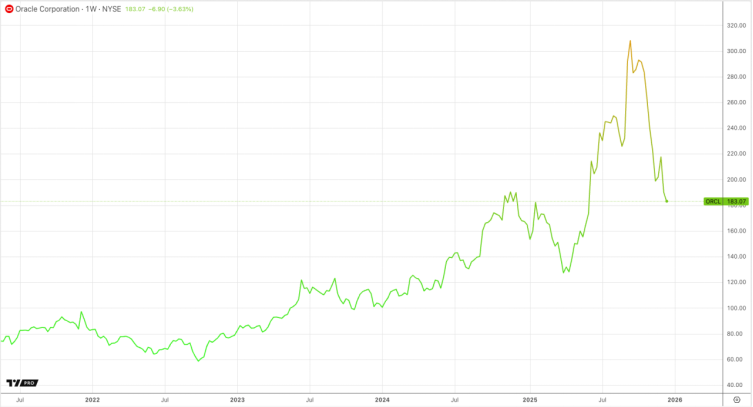
The rapid capitalization growth of the most prominent AI market players has long been driven more by investors’ faith in long-term financial returns than by calculations and analysis. However, as the scale of infrastructure projects becomes more tangible, the reserve of optimism has begun to run out. The first alarming signal was the situation around Oracle AI Market Splits. A growing negative information environment, combined with institutional investors’ reluctance to participate in individual projects, led to a decline in the company’s stock price and negatively impacted the entire technology sector.
Asian stock markets quickly picked up the negative momentum coming from the United States. The Japanese Topix index, the South Korean Kospi, and the Chinese CSI 300 have significantly declined. At the same time, the American market looked less unambiguous. The S&P 500 index was supported by the actions of US authorities towards Venezuela, which led to an increase in oil prices and, consequently, a rise in the stock prices of energy sector companies. As a result, the S&P 500 managed to strengthen, partially offsetting the pressure from technology stocks.
The reason for the revision of sentiment was the refusal of the Blue Owl Capital investment fund to participate in financing the construction of an Oracle data center in Michigan worth $ 10 billion. The fund was alarmed by Oracle’s growing debt burden and rapidly increasing costs for AI infrastructure. It was about a data center with a capacity of 1 GW, planned for use by OpenAI. Although Oracle representatives claim that the project will be implemented with the involvement of alternative sources of financing, the breakdown of negotiations highlights how vulnerable AI Market Splits even the largest players are becoming amid the rising cost of capital and the complexity of financial schemes.
Oracle’s balance sheet dynamics compound the picture. By the end of November, the company’s debt obligations reached $105 billion, and this amount is expected to rise to almost $290 billion by 2028. In a matter of months, the volume of leasing contracts has more than doubled from $100 billion to $248 billion. In this context, the 45% drop in Oracle stocks from their September highs no longer appears to be an emotional market reaction, but rather a reflection of systemic concerns. The pressure has spread to other participants in the AI boom. Alphabet, Broadcom, and Nvidia stock price fell, confirming the beginning of a broader reassessment of risks.
Under these circumstances, Micron Technology’s reporting looks contrasting and even paradoxical. While some investors doubt the payback of giant AI projects, the memory market is showing signs of structural overheating. Micron management is confident that by 2028, the memory market, in monetary terms, will grow at an average annual rate of 40% and reach a volume of $100 billion, compared to $35 billion by the end of this year. Moreover, according to CEO Sanjay Mehrotra, the HBM segment is expected to overcome this barrier two years earlier than initially expected, and the deficit is anticipated to persist well beyond 2026.
The company’s financial results only confirm these estimates. Year-over-year, Micron’s revenue increased by 57% to $13.64 billion, and net profit almost tripled, reaching $5.24 billion. The forecast for the current quarter proved to be significantly higher than market expectations, with $18.7 billion in revenue compared to the consensus of $14.2 billion. At the same time, the company acknowledges that it meets only half to two-thirds of the memory demand in the server segment, and the supply growth in physical terms does not exceed 20% annually. In response, Micron is increasing capital expenditures to $20 billion, focusing on new DRAM processes and accelerated HBM development, including preparations for the mass release of HBM4.
As a result, the AI market is increasingly splitting into two layers. On the one hand, capital-intensive infrastructure projects, where investors are increasingly demanding greater financial discipline and transparency, leaving no room for error, even for giants facing a sharp rise in debt. On the other hand, narrow technological bottlenecks, such as memory, where scarcity and technological leadership allow individual companies to feel confident and dictate market conditions AI Market Splits.
It is noticeable that the era of unconditional AI euphoria is gradually being replaced by a phase of selection. Capital is becoming less willing to scale for the sake of scaling and is looking more closely at segments where real supply constraints and sustained demand support growth. For the market as a whole, this means increased volatility, and for investors, the need to distinguish more clearly where AI remains a story about future promises, and where it is already turning into a source of tangible profits.
This linked story reveals hidden angles that will change how you see the topic today.