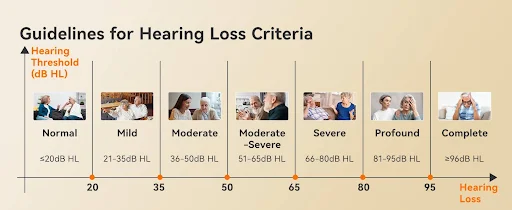
When selecting your first hearing aids, many newcomers focus solely on the “audiogram” as the key standard, often overlooking the real factors that affect daily experience—your lifestyle.
01 Understanding Hearing Loss and Hearing Aid Types
The degree and type of hearing loss are the primary factors when choosing a hearing aid. Hearing loss is typically classified into mild, moderate, severe, and profound.
Modern hearing aids come in five main types:Modern hearing aids come in five main types:
- BTE (Behind-the-Ear) – Worn behind the ear with a sound tube connecting to a custom ear mold.
- RIC/RITE (Receiver-in-Canal) – Worn behind the ear with a thin wire delivering sound directly into the ear canal.
- ITE/ITC (In-the-Ear/In-the-Canal) – Fits inside the ear, with a moderate size.
- CIC (Completely-in-Canal) – Completely hidden in the ear canal, with a small removal line visible.
- IIC (Invisible-in-Canal) – Fits deeply into the ear canal, nearly invisible to the naked eye.
BTE, RIC, ITE, ITC, and CIC are the main options, each offering different features. Shape differences = Functional differences: the larger the device, the more features it can offer; the smaller it is, the more discreet it becomes. Prioritize your “appearance” and “performance” requirements to avoid confusion later.
02 Why Your Lifestyle Matters in Choosing Hearing Aids
Choosing the right hearing aid isn’t just about the numbers on your audiogram—it’s about your daily life and personal habits.
A professional who regularly attends meetings and works in noisy environments has different hearing aid needs compared to a retiree. The retiree, who spends most of their time reading at home and occasionally chatting with family, requires less specialized hearing assistance.
Key questions to consider:
- Do you mostly find yourself in quiet or noisy environments?
- Do you often use the phone, watch TV, or participate in online meetings?
- Are you active in sports or outdoor activities, requiring a sweat-proof and dust-proof hearing aid?
- How agile are your hands? Can you easily operate small buttons or replace tiny batteries?
Considering your lifestyle first is crucial to finding hearing aids you’ll be happy with.
03 How to Match Lifestyle Needs to Technology Features
To help understand how to choose hearing aids based on lifestyle, the following table summarizes core needs and fitting types:
| Lifestyle & Audience | Core Needs & Pain Points | Suitable Hearing Aid Types | Key Technical Considerations |
| Business Professionals / Social Active | Clear speech in noisy environments, seamless communication in meetings | High-end RIC/RITE, Mini BTE | Multi-microphone system, smart noise reduction, Bluetooth connectivity |
| Sports Enthusiasts / Outdoor Workers | Sweat and water resistance, secure fit, strong environmental adaptability | Rugged BTE | High protection rating, secure fit design, wind noise reduction |
| Severe/Profound Hearing Loss | Sufficient amplification power, clear sound quality | Standard BTE, High-power models | High power output, feedback suppression, custom ear molds |
| Seniors / Those with Limited Dexterity | Easy operation, simple maintenance, comfortable wear | Standard BTE, ITE with large buttons | Large capacity batteries, simplified controls, automatic programs |
| Appearance-Conscious Individuals | Discreet, aesthetically pleasing, hard to notice | CIC, IIC, Mini RIC | Custom deep ear molds, skin-tone matching, miniaturized design |
04 The Advantages of BTE Hearing Aids: Perfect for Diverse Lifestyles
Among all types, BTE hearing aids stand out for their versatility and powerful features, making them an excellent choice for those with complex lifestyles.
| Type | Hearing Loss | Discreetness | Wind/Sweat Resistance | Notes |
| BTE | Mild to profound | ★★☆ | ★★★ | Most feature-rich, suitable for all ages |
| RIC | Mild to severe | ★★★ | ★★☆ | Lightweight, ear-friendly |
| CIC | Mild to moderate | ★★★★ | ★☆☆ | Most discreet, simple functions |
| ITE | Moderate to severe | ★★☆ | ★☆☆ | Custom shell, easy to use |
- Strong Power: Suitable for mild to profound hearing loss.
- Expandable Features: Larger devices can accommodate more complex chips, larger batteries, and additional functions.
- Durability and Ease of Maintenance: Ear molds and sound tubes are detachable and washable. With the device worn behind the ear, earwax buildup is less of an issue compared to other styles.
- User-Friendly: Large buttons, easy to handle, less prone to slipping off.
- Long Battery Life: Rechargeable versions last 24-30 hours. For instance, RETEKESS’s upcoming BTE202 hearing aid offers 45 hours of battery life in hearing mode and a total of 162 hours with the charging case.
05 Choosing and Fitting: Seek Professional Help
There’s no “best” hearing aid—only the one that fits your needs.
Avoid focusing solely on the “smallest” or “most advanced” options. Instead, find the solution that aligns with your lifestyle. For first-time users, durability and ease of use are often more important than high-end features.
Regular follow-ups and adjustments are key—your hearing and lifestyle will change, and your hearing aids should evolve accordingly. Many brands, like RETEKESS, offer personalized services with one-on-one support to help you adjust and optimize your device.
Remember: the most expensive option isn’t always the best one. You are the best judge of your hearing health. Choose a partner who listens to you, respects you, and is committed to helping you adjust over time.

Conclusion: Make Hearing Aids Truly Part of Your Life
As a beginner, the first step is to integrate your hearing aids seamlessly into your 24/7 life. When you find that you can once again engage in family conversations, enjoy every note of a concert, or clearly hear the sounds of nature, you’ll realize that choosing the right hearing aid not only improves your hearing but also enhances your overall quality of life.
Wishing you the best as you choose the perfect hearing aid to enjoy the sounds of the world once again!
Smart reads connected to this topic at 2A Magazine.