
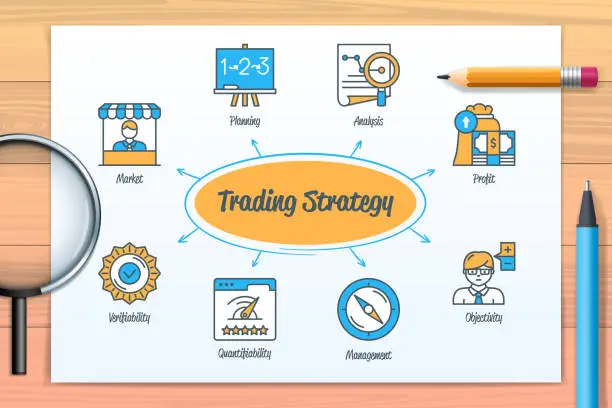
Trading without a plan is a recipe for emotional decisions and losses. A plan provides the structure to identify opportunities, plan your entries and exits and manage your risk. You need to start by defining your own objectives and your own tolerance for loss. In this blog, we will see step by step on how you can build your own strategy.
1. Define your trading goals and understand your risk appetite
Work out what you’re trying to achieve and how much risk you’re prepared to take. Think about your capital, your responsibilities, the amount of time you have available and your ability to absorb losses. You also need to decide on your expected holding period.
Someone who can monitor the markets during the trading day might be inclined to go in for intraday trading; someone with very limited time may be better off with swing or positional trading. Set your expectations realistically and don’t risk any money that you need to live on. Your strategy should be in line with your own circumstances rather than your hoped-for returns.
2. Choose a trading style that suits your goals
Different trading styles require different levels of time and involvement:
- Intraday trading: These orders are opened and closed in the same session. It’s all about close monitoring and making quick decisions.
- Swing trading: Positions are held for days or weeks in the hope of picking up a price move.
- Positional trading: Positions are held for weeks or months (often based on the broader market).
Choose a style that fits with your availability and your risk appetite. Master one before you go and try any others.
3. Build your strategy using market research and analysis
How you identify opportunities is up to you. Technical analysis is the use of price charts, trends, volume and various indicators to spot potential entry and exit points. Moving averages and support/resistance can be used to interpret price action.
Fundamental analysis looks at the company’s financial statements, its earnings and the state of the industry. Stock market courses can be very useful for the novice in order to get a handle on these things. Start with a couple of the analytical tools, get a good understanding of what they can and can’t do and don’t just go on one indicator. Always bear the wider market context in mind before you act on a signal.
4. Set entry, exit and risk management rules
A strategy needs clear rules to prevent impulsive decisions. Define when you will enter and exit. Include these elements:
- Entry point: The price or condition which triggers the trade.
- Exit point: The condition under which you book your profits or close a losing position.
- Stop-loss: A predetermined level designed to cap potential losses.
- Position sizing: The amount of capital committed to a trade.
- Risk/reward ratio: Potential profit versus potential loss.
For instance, a risk of Rs.100 for a potential reward of Rs.200 is a 1:2 risk/reward. That doesn’t mean you’ll make a profit. Remember to include brokerage, taxes and all other transaction costs when you’re looking at your actual returns.
5. Backtest your strategy
Test your rules against historical data to see how they would have performed. Paper trading allows you to practice without risking any of your own capital.
Keep a trading journal which records the reasons for your entries, the reasons for your exits, the results and the mistakes. Go through that journal regularly to see what you can learn. Remember that past performance is not an indicator of future performance.
Conclusion
An approach to trading is developed through learning, testing and evaluation. Begin with a very simple trading strategy for beginners, protect your capital and review your decisions constantly. As you gain experience, you will refine your rules. Remember that profits are not guaranteed.