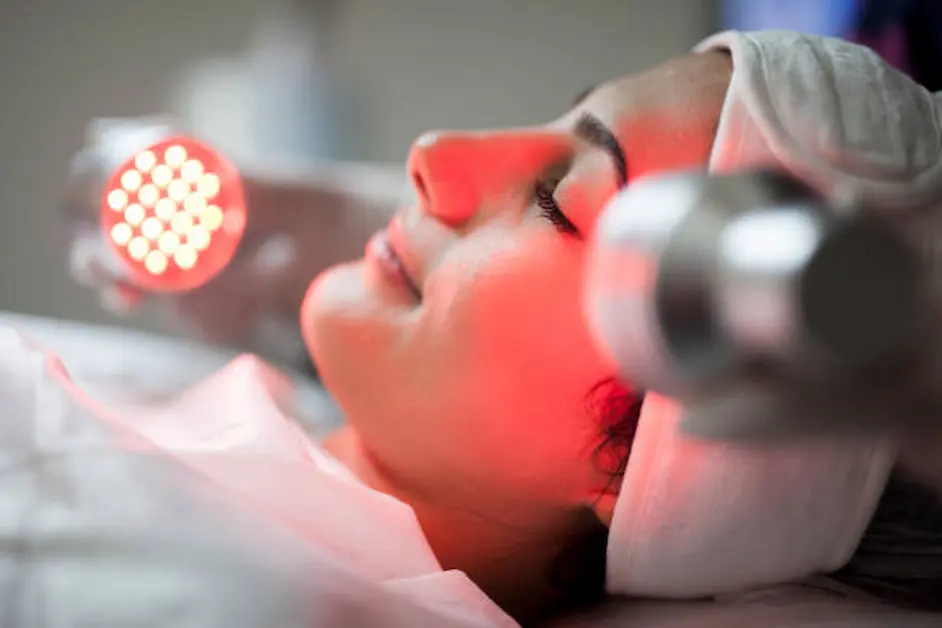
Walk down the skincare aisle and you’ll see creams promising to boost collagen, serums claiming to smooth texture, and devices of every shape and size. Among all of it, red light therapy has quietly become one of the most researched options in the anti-aging conversation. Once limited to dermatology offices and high-end spas, it’s now available in at-home panels, masks, and handheld devices. But with that popularity comes a wave of overblown marketing, which makes it hard to know what’s real. This article looks honestly at the science behind red light therapy benefits for skin, what the research actually supports, and what it can’t do.
What Red Light Therapy Is
Red light therapy, also called photobiomodulation or low-level light therapy, involves exposing the skin to specific wavelengths of red and near-infrared light. The wavelengths used most often in skincare fall between roughly 630 and 660 nanometers for red light, and around 850 nanometers for near-infrared.
This is not a laser resurfacing treatment, and it’s not a tanning bed. The light is low intensity, produces no heat worth mentioning, and doesn’t damage the skin the way ablative treatments do. That distinction matters. Treatments like laser resurfacing and chemical peels work by intentionally injuring the skin to trigger a healing response. Red light works differently, by stimulating cellular processes directly without causing damage.
The proposed mechanism comes down to how the light interacts with the mitochondria, the energy-producing structures inside your cells. Certain wavelengths are absorbed by an enzyme called cytochrome c oxidase, and that absorption appears to increase the production of adenosine triphosphate, or ATP, which is the energy currency cells use to do their work. In skin cells, particularly fibroblasts, the cells that produce collagen and elastin, more available energy means more capacity to do their jobs.
What the Research Says About Wrinkles and Collagen
The collagen connection is where most of the serious research lives, and the findings are more encouraging than most people expect.
Fibroblast activity declines with age. Starting in our mid-twenties, we lose collagen at a gradual rate every year, and the remaining fibroblasts become less productive. This is the biological process behind fine lines, thinning skin, and the gradual loss of firmness.
Several controlled studies have looked at whether red light can nudge this process in the other direction. In research settings, participants who received regular red light treatments over the course of 10 to 30 weeks showed measurable improvements in skin smoothness and a reduction in fine lines, with skin density measurements improving as well. Studies using ultrasound to measure skin thickness have documented increases in collagen density in treated areas. Biopsies taken in some of the research showed increased numbers of collagen-producing fibroblasts in skin exposed to red light.
The wrinkle findings are real but modest, and that’s the honest framing. Red light therapy won’t give anyone the results of a surgical procedure or even a deep ablative treatment. What the research supports is a gradual improvement in fine lines and skin quality over weeks to months of consistent use. Deep wrinkles, significant sagging, and volume loss are structural problems that light therapy doesn’t address.
Texture, Tone, and Wound Healing
Beyond wrinkles, texture is where many users report noticing changes first.
The reasoning is plausible from a research standpoint. Collagen and elastin provide the skin’s underlying structure, and improvements in that structure tend to show up as smoother, more even skin. Some studies have documented improvements in skin roughness measurements after red light treatment, and the effect on pore appearance and overall smoothness is one of the more consistently reported outcomes in user surveys and clinical observations alike.
Red light also has a decent research track record in wound healing, which is relevant to skin appearance in indirect ways. Studies going back decades have shown that red and near-infrared light can accelerate healing of wounds and burns, likely through the same cellular energy mechanism. Faster and more efficient repair matters for post-procedure recovery, and some dermatology practices use light therapy alongside other treatments for exactly that reason. There’s also a body of research on red light for scar appearance, with some studies showing improvement in the look and texture of surgical scars, though the evidence there is thinner than for general skin rejuvenation.
Circulation may play a role too. Near-infrared light has been shown to increase local blood flow in treated tissue, and better circulation supports the delivery of nutrients and oxygen that skin repair requires. It’s one more plausible pathway behind the texture and glow improvements people report.
What the Research Doesn’t Support
Being honest about limitations is what separates useful information from marketing copy, so here’s the other side.
Red light therapy is not a treatment for significant sagging or volume loss. Those involve fat pads, ligaments, and structural changes that light doesn’t reach or affect. It won’t remove dark spots or hyperpigmentation, since those involve melanin, and red light doesn’t target pigment the way IPL and laser treatments designed for pigmentation do. It’s not a substitute for sun protection, and it does nothing to prevent the UV damage that causes most visible aging in the first place.
The research also has gaps worth knowing about. Many studies are small. Treatment protocols vary widely between studies, with different wavelengths, intensities, session lengths, and schedules, which makes it hard to compare results directly. And the at-home device market specifically has far less research behind it than professional-grade equipment, since consumer devices vary enormously in power output and design. A weak device used inconsistently is unlikely to reproduce the results of a clinical protocol.
What a Realistic Approach Looks Like
For anyone considering it, a few practical points come out of the research.
Consistency matters more than intensity. The studies that showed results used regular sessions, typically several times per week, sustained over months. This is a slow, cumulative process, not an event. People who see benefits are the ones who stick with a schedule.
Results take time. Most research showing improvements ran 10 to 30 weeks. Anyone expecting visible change in a week will be disappointed and will likely quit before anything happens. A reasonable expectation is subtle improvement in skin quality over a few months of consistent use.
Device quality varies enormously. If going the at-home route, look for devices that publish their wavelengths and power output, and be skeptical of anything with vague claims or suspiciously low prices. Professional treatments offer stronger, more controlled dosing, and for people who want the best-supported protocols, that’s where the clinical research actually applies.
And keep the basics in place. No light therapy compensates for unprotected sun exposure, smoking, poor sleep, or a skincare routine that ignores sunscreen. Red light is best understood as one tool among several, layered on top of the fundamentals that matter more.
The Bottom Line
The science on red light therapy for skin is more solid than most trends that reach this level of popularity. There’s a plausible mechanism, decades of related research in wound healing, and controlled studies showing measurable improvements in collagen density, fine lines, and skin texture. The honest summary is that it works modestly and gradually, for the right expectations. It won’t replace procedures, and it won’t turn back time, but as a non-invasive, low-risk option for supporting skin quality over the long term, it has earned its place in the conversation. For people willing to be consistent and patient, it’s one of the few popular anti-aging approaches where the research and the reasonable expectations actually line up.