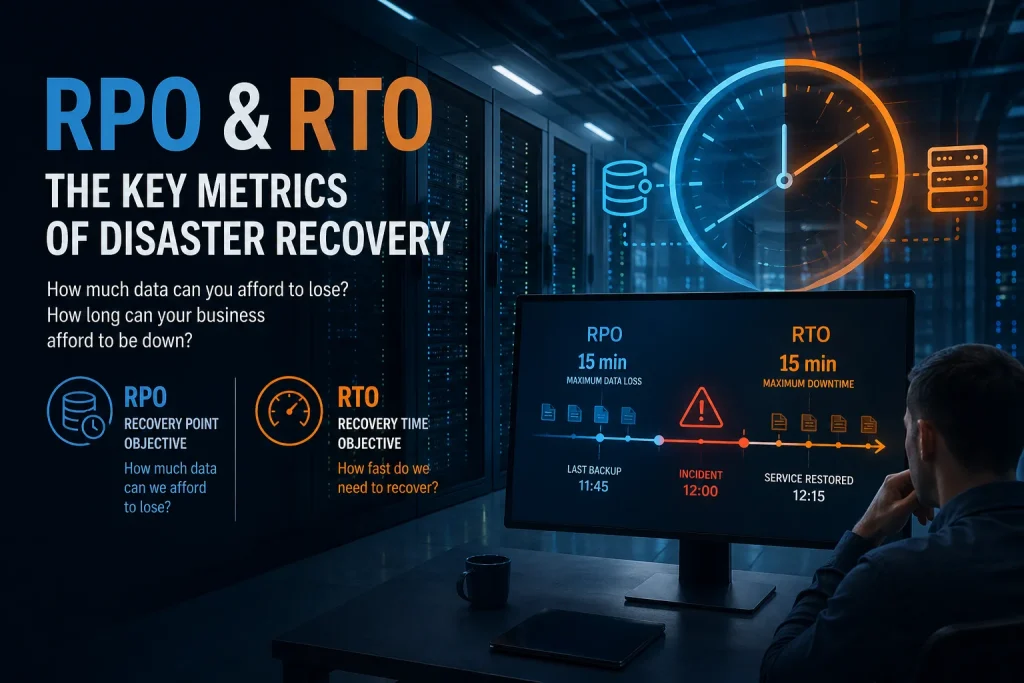
What is the maximum amount of data your company is comfortable losing?
And how long can it operate without its systems before customers start leaving? These two questions are answered by the Recovery Point Objective (RPO) and the Recovery Time Objective (RTO), metrics that form the backbone of every disaster recovery plan. We will explain their differences, how to set them based on your operations, and the risks of ignoring them.
Both metrics are based on a simple principle: every system has a different value to the business and, therefore, a different tolerance for downtime or data loss. Properly defined RPO (Recovery Point Objective) and RTO (Recovery Time Objective) are not just technical parameters, but strategic decisions that influence infrastructure choices, budgeting, and the overall resilience of the company.
What Are Recovery Point Objective and Recovery Time Objective Metrics
Recovery Point Objective (RPO)
Defines the maximum acceptable amount of data loss a company can tolerate in the event of an unexpected incident. This metric is measured backward from the moment of failure to the last valid backup point. If your Recovery Point Objective is 15 minutes, your backup system must capture data at least at this interval; otherwise, you risk losses that no IT team can recover.
Recovery Time Objective (RTO)
Defines the maximum amount of time systems and applications can remain unavailable without causing unacceptable damage to the business. It is measured forward from the moment of failure, like a stopwatch that starts ticking at the moment of an incident and must be stopped before the business begins to suffer.
Both metrics are closely related and form the foundation of every disaster recovery strategy. Without them, a company bases its recovery on assumptions, and those work about as well as a fire extinguisher without contents when a data center outage occurs. This is why infrastructure choice plays a critical role. Companies running systems in a data center colocation environment need more from their provider than just rack space and connectivity; they also require guaranteed security standards, from physical protection to a disaster recovery plan, all of which directly impact the ability to meet defined Recovery Point Objective and Recovery Time Objective targets.
How Recovery Point Objective and Recovery Time Objective Differ
At first glance, both terms may seem similar, but both of them deal with time and both relate to recovery. The differences begin exactly where the definitions end.
| Recovery Point Objective (RPO) | Recovery Time Objective (RTO) | |
| Focus | amount of data loss | speed of service recovery |
| Measurement direction | backward from the incident | forward from the incident |
| Impacts | backup frequency, replication, storage | redundancy, failover, recovery processes |
| Automation | easily automatable | significantly more complex, involves the entire IT stack |
| Cost | grows linearly with backup frequency | typically higher, requires full infrastructure recovery |
Recovery Point Objective addresses how much data a company can afford to lose. A shorter RPO means more frequent backups and higher demands on storage capacity and network resources. Recovery Time Objective focuses on how quickly operations can be restored and determines investments in redundant infrastructure, hot standby systems, and automated failover.
In general, achieving an aggressive RTO is more expensive because it requires restoring the entire infrastructure in real time. For RPO, costs increase more directly with backup frequency and the volume of protected data.
How to Set Recovery Point Objective and RTO Based on Business Type
There are no universal values for Recovery Point Objective and Recovery Time Objective. Each system requires its own configuration based on its impact on the business. A proven approach is to divide applications and systems into tiers according to their criticality.
- Tier 1 – mission-critical systems (payment gateway, e-commerce platform, ERP)Recovery Point Objective in seconds to minutes, Recovery Time Objective up to 15 minutes. These systems require continuous data replication and immediate failover.
- Tier 2 – important internal systems (CRM, email, project management tools) Recovery Point Objective: 1 – 4 hours. Recovery Time Objective: up to 4 hours. The company can operate without immediate financial losses. Incremental backups at regular intervals represent a reasonable balance between cost and protection.
- Tier 3 – supporting systems (internal wiki, archive databases, testing environments) Recovery Point Objectives: 12 – 24 hours. Recovery Time Objective: up to 24 hours. Daily backups are sufficient.
Correctly assigning systems to tiers requires collaboration between the IT department and company leadership. The technical team understands the infrastructure, but the business impact of outages can only be quantified by those who understand revenue, contractual obligations, and regulatory requirements.
What Happens When You Underestimate The Recovery Point Objective
Underestimating the Recovery Point Objectives and Recovery Time Objective is not a theoretical risk; it is a bill that arrives at the worst possible moment. According to Splunk data from 2024, the average cost of downtime for large enterprises reaches approximately $5,600 per minute. And that does not include reputational damage, loss of customers, or potential regulatory penalties.
Most common mistakes:
- setting a Recovery Point Objectives and Recovery Time Objective without linking them to real business impact,
- lack of regular recovery testing,
- ignoring the 3-2-1-10 rule.
An effective disaster recovery strategy is therefore based on regularly reassessing both metrics, at least quarterly or whenever there is a significant change in the IT environment, whether it is new applications, data growth, or a change in the infrastructure provider.
More Depends on the Recovery Point Objective Than It Seems
Recovery Point Objectives and Recovery Time Objective are not checklist items you set once and forget. They are dynamic parameters that evolve with the business, and companies that take them seriously do not wait for a disaster to find out whether their recovery actually works.
Connect the dots: How this topic evolves in our next guide at 2A Magazine.