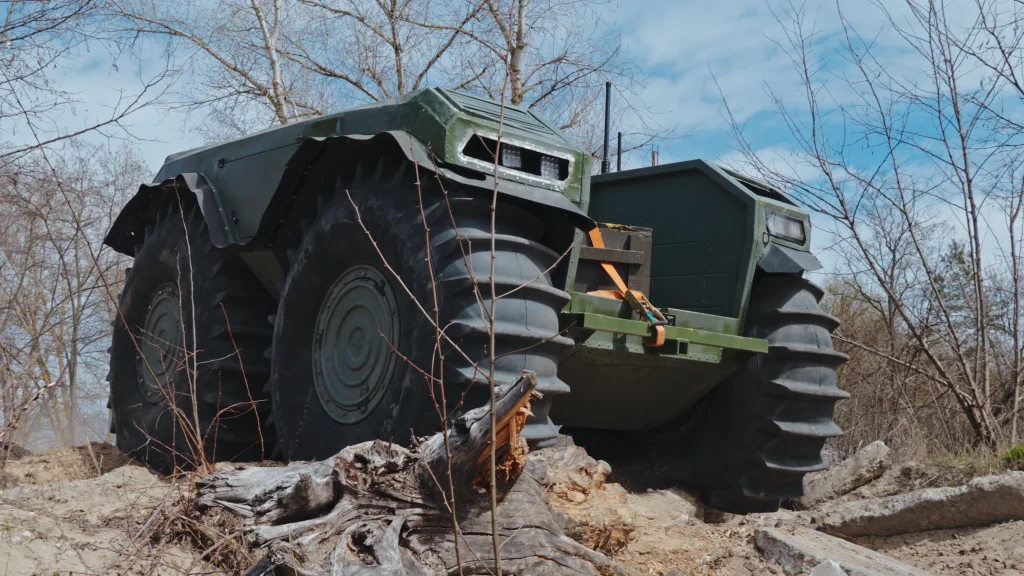
A UGV unmanned ground vehicle is an autonomous robotic platform that operates without a pilot on board and is usually controlled remotely. These systems are built to perform tasks in environments where safety, efficiency, and access are critical factors.
A ground drone can navigate complex terrain, carry payloads, and execute missions ranging from logistics to reconnaissance. As technology continues to evolve, the UGV robot is becoming a key asset in high-risk missions, preserving personnel while increasing operational effectiveness.
How UGVs Work: Technology and Architecture
Modern UGV systems rely on a combination of hardware and software solutions – a UGV drone typically includes:
- Chassis system – wheels or tracks built for different terrain
- Power supply – fuel or electric, depending on mission requirements
- Cameras and sensors – thermal or night vision for improved situational awareness
- Navigation systems – GPS, onboard cameras and inertial sensors
- Control interface – allowing remote control or autonomous mission execution
Maintaining performance in degraded and GPS-denied environments is equally important. Advanced UGVs, such as the UNEX UGV, can operate in conditions where communication and navigation signals are limited.
Types of Unmanned Ground Vehicles
UGVs vary significantly based on their intended use. Each UGV vehicle type is optimised for specific operational needs. Main categories include:
- Logistics UGVs for transporting ammunition, equipment, and supplies
- Reconnaissance UGVs for surveillance and intelligence collection
- Engineering and demining UGVs for route clearance, mine action, and obstacle removal
- Combat and military UGVs for air defence, border patrol and fire support
Applications of UGVs
The use of ground drone technology continues to expand across multiple sectors. In defence, UGV vehicles are commonly deployed for CASEVAC, logistics, combat support, and reconnaissance. Unmanned ground platforms are highly effective for accessing hazardous areas during disaster response operations and for perimeter monitoring and threat detection during security and border patrol missions.
In civil sectors, UGVs are used in agriculture and land management for monitoring and automated tasks. They are also useful for infrastructure and facility inspections, crop irrigation, and snow removal.
Choosing the Right UGV for Your Task
Selecting the right UGV drone usually depends on a few key factors – all-terrain capability, payload capacity, control range, performance in degraded environments and resilience to external factors. A well-matched UGV unmanned ground vehicle should align with mission demands while offering reliability in real-world operations.
UGV Solutions by ABRIS DG
ABRIS DG delivers advanced military UGV solutions designed for modern operational environments. Its flagship platform, the UNEX UGV, represents a new generation of unmanned ground systems.
The UNEX platform is an amphibious UGV capable of operating on land, water, ice, and complex terrain, and can overcome obstacles up to 1 m high. With a payload capacity of up to 1,700 kg and a fully electric drive, it supports a wide range of military and civil operations thanks to its modularity and scalability. This versatile UGV robot easily integrates with services, sensors, and cameras within an ecosystem for additional mission flexibility. UNEX UGV also operates in degraded environments with minimal dependence on signal availability.
By combining mobility, resilience, and modularity, UNEX UGV appears as a cutting-edge ground drone solution for the evolving operational requirements across various mission domains.
For more helpful tips, check out the rest of our site today.