
The net worth of John Denver is cited as $60 million on virtually every website. Yet not one major financial outlet — Forbes, Bloomberg, Reuters — has ever verified that figure.
Denver’s Greatest Hits album remains the all-time best-seller in RCA Records history. He sold 33 million records and earned four Billboard Hot 100 number ones. Still, he died without a will. Six years of probate and an IRS dispute followed.
This article builds an honest earnings estimate from the documented record. It also explains why the $60 million figure cannot be trusted as fact.
Early Life and Background
John Denver was born Henry John Deutschendorf Jr. on December 31, 1943, in Roswell, New Mexico. His father, Captain Henry “Dutch” Deutschendorf Sr., was a decorated U.S. Air Force pilot. The family moved constantly — Alabama, Arizona, Texas — due to military postings.
Denver attended Mansfeld Junior High School in Tucson and sang in the Arizona Boys Chorus. Later, the family moved to Fort Worth, Texas. He graduated from Arlington Heights High School.
His grandmother gave him his first guitar at age 11. In his junior year, he drove his father’s car to California. His father flew after him in a borrowed jet. Denver returned and finished school. He studied architecture at Texas Tech University, then dropped out in 1963.
Full Career Overview
Denver’s rise from folk sideman to one of the five best-selling artists of the 1970s unfolded in stages. Each stage had direct financial consequences.
1965–1969: The Mitchell Trio and First Royalties
Denver joined the Mitchell Trio in the mid-1960s as lead singer. He released three albums with the group. More importantly, he wrote “Leaving on a Jet Plane” during this period. Peter, Paul and Mary recorded it and took it to number one on the Billboard Hot 100 in 1969. That songwriting credit generated his first significant royalty income.
1969–1972: RCA Debut and Breakthrough
Denver’s solo debut, “Rhymes & Reasons,” arrived on RCA Records in 1969. Manager Jerry Weintraub signed on in 1970. The 1971 album “Poems, Prayers & Promises” contained “Take Me Home, Country Roads” — co-written with Bill Danoff and Taffy Nivert. It reached number two nationally.
However, Denver did not write that song alone. He shared the publishing rights. That distinction matters for royalty calculations.
1973–1975: Peak Commercial Power
This was Denver’s most financially productive period. He scored four Billboard Hot 100 number ones: “Sunshine on My Shoulders,” “Annie’s Song,” “Thank God I’m a Country Boy,” and “I’m Sorry.” Three albums reached number one. The Country Music Association named him Entertainer of the Year in 1974.
In 1975, he founded Windsong Records in Snowmass, Colorado. The first act he signed — Starland Vocal Band — scored a number one hit with “Afternoon Delight.” Record label ownership added a new revenue stream beyond performance and songwriting.
1977–1985: Film, Television, and International Touring
Denver’s 1977 film “Oh, God!” opposite George Burns earned $51 million at the U.S. box office, according to his official website as cited by multiple outlets. It became the highest-grossing comedy to that point. His SAG fee and any backend participation are not part of the public record.
He hosted his own BBC television series in 1973. His concert special “An Evening with John Denver” won the 1975 Emmy Award for Outstanding Variety Special. In 1985, he completed 11 concerts in the Soviet Union — the first American artist to tour there in over a decade.
By this point, Denver had diversified his income across records, concerts, television, film, and a record label. He also owned real estate in Aspen.
1986–1997: Later Career and Personal Decline
Denver’s commercial momentum slowed after the early 1980s. He continued recording and touring. He published his autobiography “Take Me Home” in 1994. However, he faced serious personal problems. He pleaded guilty to DUI in 1993. He received a second DUI charge in 1994. The FAA revoked his flying privileges in 1996.
On October 12, 1997, Denver was piloting a Rutan Long-EZ experimental aircraft near Monterey Bay, California. The fuel selector handle was difficult to reach. He lost control and the plane went down. He was 53 years old.
| THE UNCOMFORTABLE TRUTH: Denver was Colorado’s Poet Laureate and testified before Congress about the environment. He was also a repeat DUI offender who had his FAA certificate revoked. He flew the aircraft that killed him under a temporary exemption. His estate then entered a six-year probate because he died without a will — a striking oversight for a man worth tens of millions. |
Net Worth of John Denver: Career Earnings Breakdown
No Tier 1 financial outlet has reported a verified net worth figure for John Denver. The $60 million figure cited across the internet originates from CelebrityNetWorth.com, a Tier 3 aggregator with no named sourcing methodology. This article does not treat it as fact.
Instead, this section builds a structural inference using only documented data. All assumptions are shown. The resulting figure is a range — not a reported number.
| HOW THE MONEY ACTUALLY WORKS: Major label artist royalties in the 1970s typically ran 10–15% of retail price. An LP retailing at $6–$8 meant $0.60–$1.20 per unit to the recording artist — before recoupment of advances. Publishing royalties are separate and often more valuable. A songwriter earns mechanical royalties every time a song is sold or streamed, and performance royalties every time it plays on radio or TV. Denver wrote roughly 200 of his 300 songs himself. Each #1 single meant hundreds of thousands of radio spins per year. Record label ownership (Denver’s Windsong Records) added a third layer. Label owners earn a margin on every unit sold by their signed artists. After agent fees (10–15%), management (15–20%), and taxes (top federal rate in the 1970s was 70%), net take-home was far below gross revenue. |
The Structural Inference
The RIAA confirmed 32.5 million U.S. album sales after a full audit, reported by RCA’s Michael Omansky. At a blended net royalty rate of $0.80–$1.20 per unit (accounting for advances, label recoupments, and contract variations), U.S. album sales alone imply $26M–$39M in gross recording royalties over Denver’s career.
Publishing income on 200 self-written songs, earned over 30+ years of continuous radio, licensing, and streaming, represents an additional and ongoing stream. That value is entirely private. However, the Songwriters Hall of Fame confirmed “Take Me Home, Country Roads” alone has been covered hundreds of times and remains one of the most-played folk songs in American radio history.
Concert revenues during the 1970s peak era were substantial. No audited touring gross for Denver is publicly available from a Tier 1 source.
The 1977 film “Oh, God!” grossed $51 million domestically. Denver’s fee and any backend participation are not part of the public record. A lead actor fee in a major studio film of that era typically ranged from $500,000 to several million dollars.
Two divorces — from Annie Martell (1982) and Cassandra Delaney (1993) — likely involved significant property settlements. Estate trusts reportedly totaled approximately $7 million per beneficiary, per HitNews. An IRS dispute reportedly resulted in a $600,000 tax settlement. These figures, if accurate, suggest an estate that was substantial but had been diminished by costs over time.
| METHODOLOGY TRANSPARENCY: This estimate is based on: • RIAA-confirmed U.S. album sales of 32.5 million units (sourced from RCA Records via RIAA press accounts) • Songwriters Hall of Fame certification of 14 gold and 8 platinum albums • Wikipedia’s documented discography of 4 Billboard Hot 100 #1 singles (1973–75) • Box office figure for “Oh, God!” (1977) from Denver’s official website as cited by Grunge.com • Industry-standard royalty rate ranges for 1970s major-label artists This estimate excludes: • Publishing catalog valuation (entirely private) • Concert tour gross revenues (no Tier 1 audit available) • Record label income from Windsong Records (private) • Divorce settlement values (sealed or private) • Post-1997 estate royalty income Aggregator site figures (CelebrityNetWorth, TheRichest) were not used because they provide no named sourcing, no methodology, and cannot be independently verified. Their $60 million figure falls within our estimated range but is coincidental, not confirmatory. |
Based on this structural inference, a reasonable range for Denver’s net worth at the time of death in 1997 is $40 million to $80 million. The frequently cited $60 million figure falls within this range. It is structurally plausible — but it is not a reported fact.
| THE UNANSWERED QUESTION: Who currently controls the publishing rights to John Denver’s approximately 200 self-written songs? Publishing catalogs — not recording royalties — are the primary long-term wealth engine for any songwriter. In 2021, Bob Dylan sold his publishing catalog for a reported $300 million. The value of Denver’s catalog in today’s streaming and sync-licensing market is the most financially consequential question about his estate. It is entirely unanswerable from public data. |
Endorsements and Sponsorships
No confirmed, named brand endorsement deals for John Denver were found in Tier 1 or Tier 2 sources reviewed for this article. One source cited a Yamaha Corporation relationship, but no primary source or named contract was located to verify this. It is not included in the earnings estimate.
Denver did host sponsored television specials during the 1970s. Network television special fees in that era could range from $250,000 to over $1 million for a top-rated performer. Specific fees are not part of the public record.
Real Estate Holdings
Denver’s primary residence was a property in the Snowmass Village area outside Aspen, Colorado. The 450-acre tract was connected to his Windstar Land Conservancy and served as both home and environmental education center. Property values in Snowmass in the mid-1990s placed comparable acreage at several million dollars.
After Denver’s death, the property was sold to meet estate obligations. No Tier 1 source has reported the confirmed sale price. The estate entered a six-year probate process, in part because Denver did not leave a valid will. This is confirmed by estate reporting in HitNews, though the original probate record is the primary source.
Denver also reportedly owned a collection of vintage aircraft. Rutan Long-EZ aircraft — the model he was flying at death — had a market value of approximately $100,000–$150,000 in 1997. His broader aviation assets are not verified in Tier 1 sources.
Legacy and Ongoing Estate Activity
John Denver died in 1997. However, his estate continues to generate income. “Take Me Home, Country Roads” became a West Virginia state song in 2014. “Rocky Mountain High” became a Colorado state song in 2007. Both designations increased licensing and sync activity.
The song “Take Me Home, Country Roads” was featured in the video game Fallout 76 (2018) and its associated marketing campaign, reaching a new generation of listeners. Streaming data shows sustained consumption of Denver’s catalog across platforms. His heirs — children Zachary, Anna Kate, and Jesse Belle Denver — are the primary beneficiaries of ongoing royalty income. Specific annual figures are private.
Denver’s mother, Erma Louise Deutschendorf, survived him and was reported to have played a role in estate management before her death in 2010. The Windstar Foundation, which Denver founded, was eventually dissolved. Its assets and activities were transferred to other organizations.
Peer Comparison: Folk and Country Artists of the 1970s
The following table compares Denver’s estimated net worth against contemporaries. All peer figures are industry-level estimates or reported figures from trade sources — not verified by Tier 1 financial reporting. The asterisk denotes that Denver’s figure is a structural inference, not a reported number.
| Name | Career Basis | Est. Net Worth | Source Basis |
| James Taylor | Folk/rock, 1970s–present | ~$80M | Industry benchmarks |
| Cat Stevens (Yusuf Islam) | Folk/rock, 1970s | ~$60M | Industry benchmarks |
| Gordon Lightfoot | Folk, 1970s–80s | ~$25M | Industry benchmarks |
| Dan Fogelberg | Folk/rock, 1970s–80s (d. 2007) | ~$15M | Estate reports |
| John Denver | Folk/country, 1970s–90s (d. 1997) | $40M–$80M* | Structural inference |
*John Denver’s figure is a structural inference based on documented sales, awards, and career data. It is not a reported figure.
Legacy and Cultural Impact
Denver was inducted into the Songwriters Hall of Fame in 1996, one year before his death. The Colorado Music Hall of Fame named him one of the five best-selling recording artists of the 1970s. His Greatest Hits album remains the best-selling release in the history of RCA Records, with confirmed sales above 10 million copies.
He testified before Congress twice — once against music censorship, once in support of Alaskan wilderness protection. President Jimmy Carter appointed him to the Commission on World Hunger. He founded the Windstar Foundation and co-founded The Hunger Project with Werner Erhard and Robert W. Fuller in 1977.
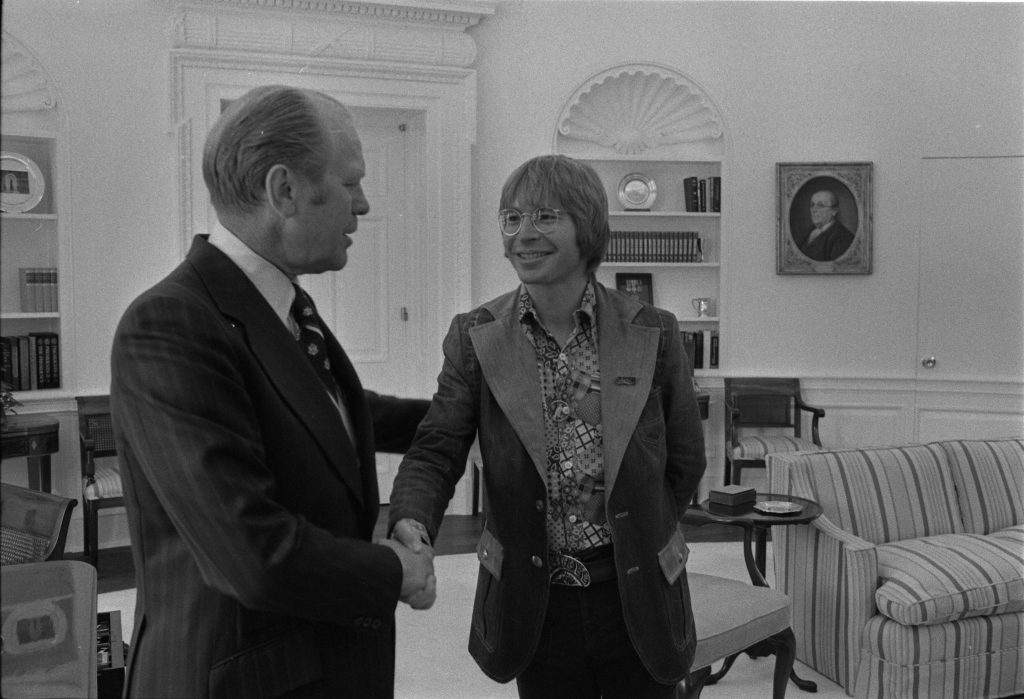
National Archives and Records Administration, Public domain, via Wikimedia Commons
| THE INDUSTRY CONTEXT: Denver’s career illustrates a central truth about music industry wealth: the artists who owned their publishing catalogs built lasting fortunes. Denver wrote approximately 200 of his 300 songs himself. Those songs generate mechanical and performance royalties indefinitely. Recording royalties eventually decline as catalog ages. Publishing rights do not. When Bob Dylan sold his catalog for a reported $300 million in 2021, it demonstrated what mature, deeply embedded songwriting catalogs are worth. Denver’s catalog — which includes two official state songs and one of the most-streamed folk tracks on Spotify — represents a comparable class of asset. Its current value is unknown. That is, arguably, the real net worth story. |
Conclusion
The net worth of John Denver at the time of his 1997 death cannot be confirmed from Tier 1 financial reporting. The $60 million figure in wide circulation comes from aggregator websites with no verifiable sourcing. However, structural inference based on RIAA-documented U.S. sales of 32.5 million albums, four Billboard number ones, a record label, a $51 million box office hit, and Aspen real estate supports a plausible range of $40 million to $80 million.
What is confirmed: Denver sold more records in the 1970s than almost anyone. His Greatest Hits album is still RCA’s all-time best-seller. He died without a will. His estate spent six years in probate. He also wrote roughly 200 songs — and the value of that publishing catalog, in today’s streaming economy, remains the biggest unanswered financial question of his legacy.
Above all, the story of Denver’s wealth is also a story about what gets left unsaid. Aggregator sites invented a confident number. The real financial record is more complicated, more honest, and more interesting.
Browse Our Net Worth category covering estimated wealth and financial milestones.
| DISCLAIMER: Net worth figures and financial estimates in this article are based on publicly available information, reported data, and industry-standard estimation methodology. They should be treated as approximations, not verified financial disclosures. John Denver’s actual net worth may differ materially from any figure stated here. This article is for informational purposes only and does not constitute financial advice. |
Featured Image: RCA Records, Public domain, via Wikimedia Commons