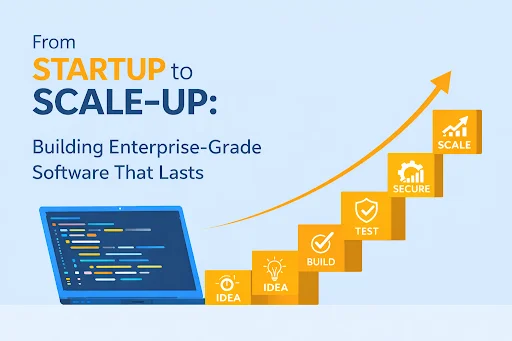
In today’s competitive digital landscape, businesses can no longer afford to build applications that simply work for today. Every forward-thinking organization needs software architectured for tomorrow systems that scale seamlessly, adapt to market shifts, and deliver a superior user experience as the company grows. Whether you are launching a startup or modernizing a legacy platform, investing in enterprise-grade applications is one of the smartest strategic moves you can make. At NewAgeSysIT, we specialize in custom mobile app development services crafting intuitive, high-performance mobile experiences that put your brand directly in the hands of your users. From native iOS and Android apps to cross-platform solutions, our mobile expertise ensures your application delivers value on every device.
Beyond mobile, our comprehensive custom software development services enable us to design and deliver end-to-end solutions built around your unique business goals not off-the-shelf compromises. From scalable cloud architectures to performance-optimized backends and intuitive frontends, we help you lay a rock-solid foundation that will serve your organization for years to come.
Building an enterprise-grade application is not just about writing good code. It is a holistic discipline that encompasses architecture decisions, technology selection, security posture, team structure, and long-term maintenance strategy. In this blog, we explore the core principles, best practices, and modern approaches that power enterprise applications designed to grow alongside your business.
1. What Makes an Application ‘Enterprise-Grade’?
The term ‘enterprise-grade’ is often misunderstood. It does not simply mean large or expensive. Enterprise-grade applications are characterized by their ability to meet the demanding requirements of modern organizations including reliability, scalability, security, and maintainability at any scale.
Key characteristics include:
- High Availability & Fault Tolerance: The system remains operational even in the face of hardware failures, traffic spikes, or third-party outages.
- Scalability: The application handles growth in users, data, and transactions without requiring a complete redesign.
- Security & Compliance: Sensitive data is protected through encryption, access controls, and adherence to regulations such as GDPR, HIPAA, or SOC 2.
- Maintainability: The codebase is clean, well-documented, and structured so that teams can confidently add features and fix bugs without fear.
- Observability: Comprehensive logging, monitoring, and alerting provide visibility into system health in real time.
2. Choosing the Right Architecture from the Start
Architecture is the single most impactful decision in application development. Getting it right from day one can save years of painful refactoring and massive engineering costs down the line. Getting it wrong, conversely, can hobble growth and frustrate engineering teams for the lifetime of the product.
Monolith vs. Microservices vs. Modular Monolith
There is no one-size-fits-all answer here. Startups and early-stage products often benefit from a well-structured monolith that allows faster iteration. As a business scale, a modular monolith where internal boundaries are clearly enforced provides a natural stepping stone toward microservices without the operational overhead of running dozens of independent services from day one. Microservices truly shine when you have independent team ownership, vastly different scaling requirements per component, or polyglot technology needs.
Event-Driven Architecture for Scalability
Event-driven architectures decouple producers and consumers of data, making systems far more resilient and scalable. By leveraging message queues and event streams (such as Apache Kafka or AWS SQS), you ensure that high-load operations like sending emails, generating reports, or processing payments do not block core user flows. This pattern is foundational in enterprise applications where peak traffic can be unpredictable.
API-First Design
An API-first approach treats your API as a first-class product. This enables web, mobile, and third-party integrations to operate on a consistent, well-documented contract. It also future-proofs your architecture: when you build a new mobile app or open your platform to partners, the backend is already ready. Adopting RESTful APIs or GraphQL with proper versioning strategies ensures that your application evolves without breaking existing consumers.
3. Scalability: Engineering for 10x, 100x Growth
Scalability is not just a technical requirement it is a business imperative. The cost of re-engineering a system that was not built to scale is enormous, both in engineering effort and lost business opportunity. Scalable systems are designed with the following principles in mind:
Horizontal Scaling Over Vertical Scaling
Vertical scaling adding more CPU or RAM to a single server has a hard ceiling. Horizontal scaling adding more instances of the same service is virtually unlimited. Building stateless services that can run as multiple instances behind a load balancer is the gold standard for enterprise scalability.
Database Strategies: Sharding, Read Replicas & Caching
Databases are often the bottleneck in growing applications. Smart database design includes indexing strategies, query optimization, and when necessary, sharding (partitioning data across multiple database instances). Read replicas offload read-heavy workloads from the primary database, while caching layers (using tools like Redis or Memcached) dramatically reduce database load for frequently accessed data. At NewAgeSysIT, we architect database layers that evolve with your data needs from thousands to hundreds of millions of records.
CDN and Edge Computing
Content Delivery Networks (CDNs) cache static assets at edge locations around the world, dramatically reducing latency for global users. Modern edge computing platforms extend this concept to run application logic at the edge, bringing computers closer to the user and enabling sub-100ms response times even for dynamic content.
4. Security as a Core Feature, Not an Afterthought
Security breaches can destroy years of hard-won customer trust in hours. In the enterprise context, security must be designed into the application from the very beginning not bolted on as a final step before launch. A DevSecOps culture integrates security practices directly into the development lifecycle.
- Authentication & Authorization: Implement OAuth 2.0 and OpenID Connect for robust identity management. Role-Based Access Control (RBAC) ensures users only access what they are permitted to.
- Data Encryption: Encrypt data both at rest and in transit. Use industry-standard encryption algorithms and manage cryptographic keys securely through services like AWS KMS or Azure Key Vault.
- Dependency Scanning: Regularly audit third-party dependencies for known vulnerabilities. Automated tools like Snyk or Dependabot can catch issues before they reach production.
- Penetration Testing: Commission regular penetration tests to proactively identify and remediate vulnerabilities before attackers can exploit them.
- Zero Trust Architecture: Never assume a request is trustworthy just because it originates inside your network perimeter. Verify every access request, regardless of source.
5. Cloud-Native Development: The Foundation of Modern Enterprise Apps
The cloud has fundamentally changed how enterprise applications are built, deployed, and operated. Cloud-native development is not simply about hosting your application on AWS, Azure, or Google Cloud it is about taking full advantage of cloud capabilities: auto-scaling, managed services, serverless computers, and global infrastructure.
Containerization with Docker & Kubernetes
Containers package application code and its dependencies into a consistent, portable unit. Docker is the industry standard for containerization, while Kubernetes provides orchestration automatically managing how containers are deployed, scaled, and healed. Kubernetes has become the de facto operating system for enterprise cloud applications, providing remarkable flexibility and resilience.
Infrastructure as Code (IaC)
Manual infrastructure management is error-prone and unscalable. Infrastructure as Code tools such as Terraform, AWS CloudFormation, or Pulumi allow teams to define, version, and deploy infrastructure using the same practices as application code. This dramatically reduces drift between environments and enables rapid, consistent provisioning of new environments.
Serverless for the Right Workloads
Serverless compute (AWS Lambda, Azure Functions, Google Cloud Run) eliminates the need to manage server infrastructure for specific workloads. It is ideal for event-driven tasks, periodic jobs, and APIs with unpredictable traffic patterns. When used judiciously alongside containerized services, serverless can dramatically reduce operational overhead and cost.
6. DevOps & CI/CD: Speed Without Sacrificing Quality
Enterprise applications must evolve rapidly to meet changing business requirements but speed without guardrails leads to instability. DevOps practices and CI/CD pipelines strike the balance between velocity and quality by automating the process of building, testing, and deploying code.
A robust CI/CD pipeline typically includes:
- Automated unit, integration, and end-to-end testing on every code commit.
- Static code analysis and security scanning as quality gates.
- Blue-green or canary deployments to roll out changes with zero downtime.
- Automated rollbacks triggered by error rate spikes or failed health checks.
- Environment parity ensures staging and production environments are as identical as possible.
When teams ship multiple times per day with confidence, innovation accelerates. Customers receive improvements faster, and engineering morale improves because deployments are no longer stressful events.
7. Observability: You Cannot Manage What You Cannot Measure
Observability is the ability to understand the internal state of your system by examining its external outputs. In enterprise applications, where a single performance degradation can cost thousands of dollars per minute, comprehensive observability is non-negotiable.
The three pillars of observability are:
- Logs: Structured, searchable records of events that occurred within the system. Centralized log management with tools like Elasticsearch, Splunk, or Datadog provides a unified view across all services.
- Metrics: Quantitative measurements of system behavior request rates, error rates, CPU usage, memory consumption, and custom business metrics. Prometheus and Grafana are popular open-source choices for metrics collection and visualization.
- Traces: Distributed tracing (using tools like Jaeger or OpenTelemetry) follows a single request as it travels through multiple services, making it possible to pinpoint exactly where latency or errors originate.
Proactive alerting based on meaningful thresholds rather than reactive firefighting is what separates mature engineering organizations from the rest.
8. Long-Term Maintainability: Building for the Team of the Future
The engineers who maintain your application five years from now may not be the ones who built it. Long-term maintainability means writing code and designing systems that future developers can understand, extend, and confidently change.
Clean Code and SOLID Principles
Applying SOLID principles Single Responsibility, Open/Closed, Liskov Substitution, Interface Segregation, and Dependency Inversion results in code that is modular, testable, and easy to extend. Code reviews, pair programming, and internal style guides ensure these standards are upheld consistently across the team.
Comprehensive Documentation
Great software teams treat documentation as a first-class deliverable. This includes API documentation (auto-generated from OpenAPI specs), architectural decision records (ADRs) that capture why key decisions were made, runbooks for common operational tasks, and onboarding guides for new engineers.
Managing Technical Debt Proactively
Technical debt is inevitable in any long-lived system, but left unmanaged it becomes a growth killer. High-performing engineering organizations budget dedicated time typically 20 to 30 percent of each sprint for refactoring, dependency upgrades, and architectural improvements. This keeps the codebase healthy and development velocity high over the long term.
9. Performance Engineering: Speed as a Competitive Advantage
Application performance is directly tied to business outcomes. Research consistently shows that a 100-millisecond increase in page load time can reduce conversion rates by up to 7 percent. Performance engineering is not a one-time optimization sprint it is a continuous discipline woven into every stage of the software lifecycle.
- Performance Budgets: Define acceptable performance thresholds (e.g., Time to First Byte under 200ms, Largest Contentful Paint under 2.5 seconds) and enforce them through automated testing in CI pipelines.
- Load Testing: Simulate peak traffic conditions using tools like k6 or Apache JMeter before major releases. Understand where bottlenecks emerge and address them proactively.
- Frontend Optimization: Code splitting, lazy loading, image optimization, and reducing render-blocking resources contribute to fast, responsive user interfaces.
- Database Query Optimization: Regularly review slow query logs and use database profilers to identify and resolve inefficient queries before they impact users.
10. Building the Right Team and Engineering Culture
Technology alone does not build great enterprise applications people do. The team and culture around the technology are equally critical to long-term success.
Cross-Functional Product Teams
Organizing teams around products or capabilities rather than technology layers dramatically improves delivery speed and accountability. Each cross-functional team owns their domain end-to-end, from database to UI, reducing hand-offs and organizational friction.
A Culture of Continuous Improvement
The best engineering teams treat every incident as a learning opportunity, not a blame exercise. Blameless post-mortems surface systemic issues and drive improvements that make the system more resilient. Regular team retrospectives, internal tech talks, and investment in learning and development keep skills sharp and teams motivated.
11. Planning for Growth: Roadmap Thinking from Day One
Enterprise applications are long-term investments. The most successful ones are built by teams who think years ahead not just about the features needed today, but the capabilities the business will need in the future. Roadmap thinking includes:
- Designing extension points and plugin architectures that allow new features to be added without modifying core systems.
- Abstracting third-party integrations behind stable internal interfaces so that vendors can be swapped without disrupting the application.
- Planning for internationalization (i18n) and localization from the start if global expansion is on the horizon.
- Anticipating compliance requirements in target markets and building the necessary data handling and audit trail capabilities early.
- Building feature flags and gradual rollout capabilities to safely test new functionality with a subset of users.
Conclusion: Build Once, Scale Forever
Building enterprise-grade applications that support long-term growth is not a single decision; it is a continuous series of deliberate choices about architecture, technology, process, and culture. Done right, these choices compound over time into a powerful competitive advantage: faster time-to-market, higher reliability, lower maintenance costs, and a platform that enables rather than constrains your business strategy.
At NewAgeSysIT, we partner with businesses at every stage of their journey from greenfield development to complex system modernization. Our team of experienced architects, engineers, and product strategists brings the expertise, processes, and technology depth needed to build software that lasts. Whether your next step is a mobile experience or a comprehensive digital platform, we are here to help you build it right.
The question is not whether your business will grow. The question is whether your application is ready to grow with it.