
Heat as the First Constraint
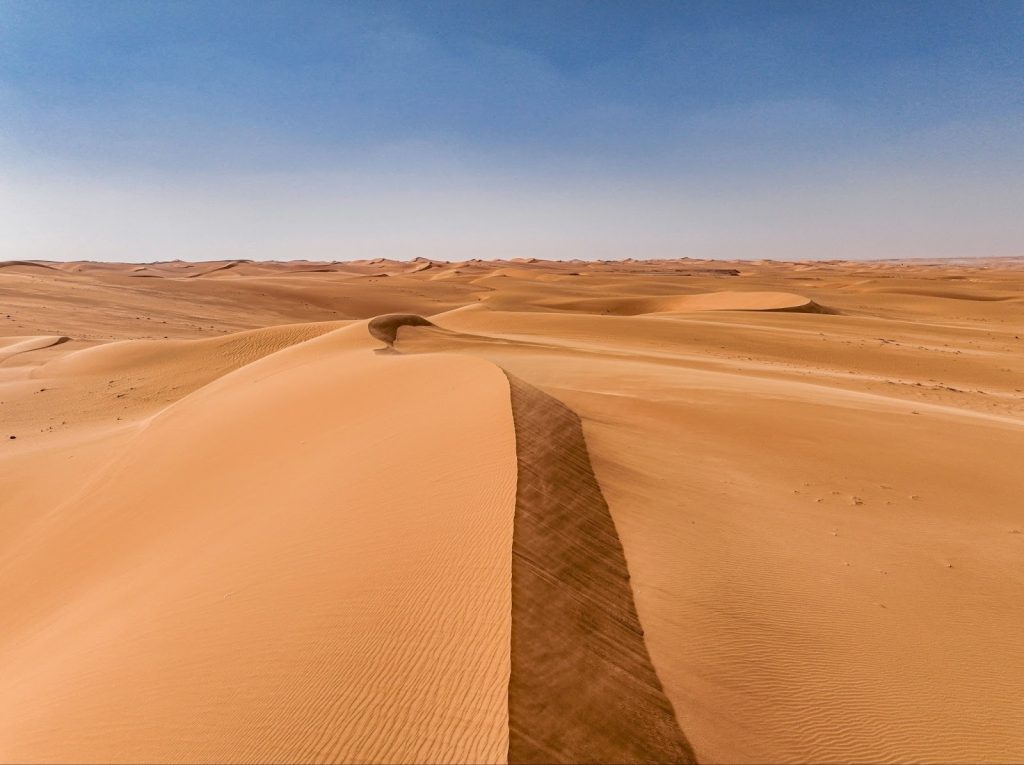
In the Hijaz, heat isn’t a condition you work around. It’s the framework everything else must accept. Light flattens distance. Air thickens by mid-morning. Surfaces behave differently here, expanding, contracting, absorbing more than they reflect. Movement in this landscape has always required negotiation — with temperature, with wind, with ground that shifts subtly even when it appears still. Any attempt to cross it quickly carries an implicit question: not whether speed is possible, but whether it can be sustained without resistance.
A Line Drawn Across Exposure
Modern rail in western Saudi Arabia doesn’t arrive quietly. It cuts across open land that offers little shelter and even less forgiveness. The Haramain train runs through this exposure with a confidence that feels almost counterintuitive at first. Not because it ignores the environment, but because it anticipates it. The route doesn’t pretend the heat isn’t there. It assumes it will be. Speed here is not an act of defiance. It’s an agreement made carefully in advance.
Engineering That Begins With Acceptance
What makes this corridor work isn’t force, but accommodation. The trains are designed with the expectation that sand will intrude, that temperature will fluctuate aggressively, that metal and mechanics will be pushed close to their limits daily. Nothing is framed as exceptional. Extreme conditions are treated as baseline. Systems adjust continuously, not dramatically. Cooling, filtration, tolerance — all operate quietly in the background, doing their work without drawing attention to themselves.
Sand as a Moving Variable
Sand here doesn’t sit still. It drifts, lifts, settles again elsewhere. It enters places you didn’t anticipate and avoids places you thought were exposed. For rail engineering, this unpredictability matters more than spectacle. Tracks must remain precise even as their surroundings refuse stability. What’s striking is how little this struggle is visible. From inside the carriage, movement feels calm, almost insulated. Outside, the landscape continues to rearrange itself, indifferent to schedules.
Speed Without the Usual Signals
High speed in this environment doesn’t announce itself through sound or sensation. There’s no dramatic sense of acceleration. No visual cue that something unusual is happening. Motion is smooth enough to disappear. Distance collapses quietly. You become aware of speed only by noticing how long something doesn’t take — how quickly the horizon shifts, how soon a stop arrives. The absence of friction becomes the defining feature.
Heat Contained, Not Eliminated
The temperature never really goes away. It’s managed, redirected, held at bay. Inside, the atmosphere remains steady, deliberately unremarkable. Outside, the sun continues its work uninterrupted. This contrast doesn’t feel artificial. It feels practical. Comfort here isn’t about indulgence. It’s about reliability. The goal isn’t to erase the environment, but to create a narrow, controlled channel through it — just wide enough to move people safely and consistently.
A Corridor Built for Repetition
What distinguishes this rail line is how ordinary it aims to become. It’s not designed for novelty. It’s designed to be used again and again under the same demanding conditions. Schedules matter. Predictability matters. The technology doesn’t frame itself as cutting-edge once you’re inside it. It fades into routine, which is perhaps the most ambitious outcome in a landscape that resists routine by default.
Movement Between Sacred Cities
The significance of the route isn’t purely technical. It connects places that already carry immense weight, both practical and symbolic. Movement between them has always existed, shaped historically by effort, endurance, and time. High-speed rail changes the duration, but not the gravity. The journey still feels purposeful. The difference is in how quietly that purpose is carried now — without exhaustion, without exposure, without the sense of being tested by the land itself.
When Infrastructure Stops Performing
Over time, the most impressive aspect becomes how little you think about the train at all. Attention shifts elsewhere — to light beyond the window, to the stillness inside, to the simple fact of arrival. Engineering succeeds here by receding. It does its work best when it stops being noticed. The mirage, if there is one, lies not in the illusion of speed, but in the disappearance of effort.
What Remains After the Crossing
Later, when the journey returns in memory, it doesn’t appear as an image of machinery or track. It surfaces as a sensation — of having moved through an unforgiving landscape without friction, of having crossed heat and sand without negotiating them personally. The experience doesn’t resolve into awe or analysis. It thins out instead, leaving behind a quiet respect for systems that understand their limits, and for speed that knows when not to announce itself.
Don’t miss our most talked-about feature at 2A Magazine.