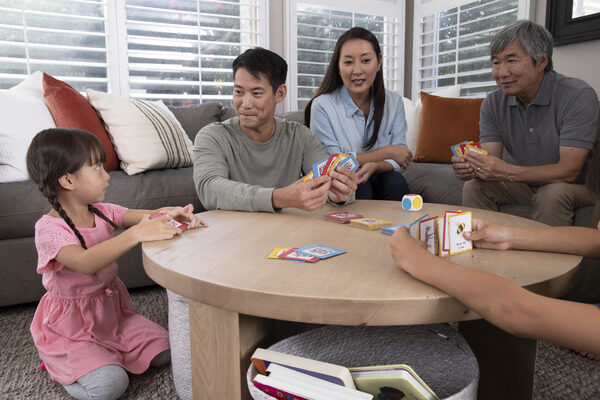
Picture this: it’s Friday evening, you’ve cleared the dinner plates, and every single person in your family is staring at a different screen. Nobody planned it that way — it just happened, the way it always does. If that scene feels familiar, you’re not imagining things. According to Common Sense Media, U.S. children ages 0–8 now average around 2.5 hours of daily screen time, and gaming time alone has surged 65% since 2020. By age 2, 40% of children already have their own tablet. By age 8, one in four has their own cellphone.
As explored in Inside Out 2 Glued to Phone: Not Just a Scene, But a Mirror of Today’s Youth, the emotional cost of passive screen time for children is becoming impossible to ignore. But the answer probably isn’t a blanket ban — it’s a better offer.
That’s what this list is about. Every pick here was chosen against three criteria: multi-generational appeal (can a 6-year-old and a grandparent both have a genuinely good time?), setup simplicity (how fast can you go from box to playing?), and replay value (will it come off the shelf again next Friday?). Price-to-value and whether the experience is active and social rather than passive and solo are secondary filters. Seven picks. All of them tested against the real question: does this actually pull people together?
How We Scored These Picks
Every game night recommendation sounds great in theory. In practice, the box sits on a shelf because setup takes 45 minutes, or a 7-year-old gets bored in round one, or adults are checking their phones between turns.
So each pick here had to clear all three bars. Multi-generational appeal means no one gets left out — not the kindergartner, not the grandparent who doesn’t own a gaming console. Setup simplicity means you can actually start playing before someone wanders off. Replay value means the experience holds up past the first session — because a game you only play once isn’t a game night tradition, it’s just a novelty.
With that framework in place, here’s what made the cut.
#1 — Board: The Tabletop Console That Redefines Game Night
What It Is
Board is a purpose-built 24-inch anti-glare tabletop touchscreen console that lies flat on your table like a giant, very smart game board. It includes dual stereo speakers, dual-band Wi-Fi 6, Bluetooth, a built-in microphone, USB-C and microSD ports, and 64GB of onboard storage. It plugs into the wall — no batteries, no controller clutter. Seven games come included out of the box, no subscription required.
The hardware was designed by Brynn Putnam — founder of Mirror, the fitness screen acquired by Lululemon for $500 million — and Seth Sivak, CCO (Chief Creative Officer) and Head of Games at Board and former VP of Development on World of Warcraft at Blizzard. That pairing isn’t accidental. Putnam told USA Today (as reported by The Shortcut): “Families want to connect, but they’re competing with incredibly powerful technologies. Board is about flipping that dynamic — using tech to support real human connection instead of replacing it.” That quote tells you everything about what this product is trying to do.
Why It Scores High on All Three Criteria
Multi-generational appeal is where Board consistently surprises people. Customer reviews on the Board reviews page document enthusiastic play from children as young as 4 alongside adults. One parent reported that their 6-year-old had “practically forgotten about his iPad and YouTube” — which, if you’ve ever tried to pry a tablet away from a first-grader, you know is not a small thing.
Setup simplicity is almost comically straightforward. Place it on a table, plug it in, connect to Wi-Fi. The seven included games are ready to go immediately — no cartridges, no downloads, no separate controller pairing.
Replay value is where the long-term case gets made. After six weeks of testing, Meeple Mountain’s reviewer wrote: “Board is already creating the kinds of memories that we’ll remember 10, 20, 30 years from now…” That same reviewer noted a 9-year-old who asked to play Strata, Space Rocks, or Chop Chop every single day for three weeks — something he had never done with any other product. (Strata is available separately at board.fun/pages/games.)
The Technology That Makes It Different
Here’s the part that sounds like science fiction until you see it work. Each physical game piece is embedded with a conductive glyph on its base. A robot trained the detection system by placing every piece in every possible position and orientation. The result: Board can recognize effectively unlimited pieces simultaneously — constrained only by available screen space — far beyond what a high-end iPad can manage, which is limited to detecting 10 touch inputs at once.
Wargamer called it “the most innovative and most accessible new interface I can remember since the original iPhone made touchscreens ubiquitous,” and separately noted that “I think it could disrupt the gaming market in ways we haven’t seen since the Nintendo Wii.” That’s a bold claim, but the underlying technology earns it.
The standout social experience in the current library is Chop Chop, a co-op cooking game that Meeple Mountain described as resulting in “yelling, sometimes screaming,” with three players hunched around the screen fulfilling orders and ending in high-fives — calling it “Chop Chop might be the game that is most emblematic of what makes the Board platform shine [for my family].” That’s the kind of moment you can’t manufacture with a solo scrolling session.
Board is priced at $399 (as of May 2026; pricing may change — verify current pricing at board.fun before purchasing, as the price has changed since launch). Additional games are priced from free up to $34.95 each (as of May 2026), and include physical components, which matters because this isn’t just software.
#2 — Codenames: Social Deduction for Smart Mouths of All Ages
Codenames is a team-based word-clue game for 4–8+ players. The publisher’s official age rating is 10 and up; some retailers and older product metadata have listed it as 14+, so verify on the box of the specific edition you’re buying. Czech Games Edition (CGE) lists the current 2025 refresh as Ages 10+.
Multi-generational appeal: No dexterity, no tech skill, no trivia library required. Adults and older kids compete on completely equal footing because the game rewards lateral thinking and vocabulary — things that don’t sort neatly by age. Setup simplicity: Lay cards in a grid, deal the key card, explain the rules in under two minutes. Replay value: The number of word combinations is effectively endless, and the Codenames Pictures variant, with its image-based gameplay, can feel more accessible to younger players.
What Codenames does that screens don’t is generate the “how did you think of that?!” moments — the clue that accidentally covers three different words, the teammate who connects dots no one else saw. That conversation outlasts the game itself.
Caveat: works best when players share a language and vocabulary baseline. Very young children may end up as spectators rather than participants.
#3 — Sushi Go Party!: Fast Drafting That Levels the Playing Field
Sushi Go Party! is a card-drafting game for 2–8 players, ages 8 and up. The mechanic is beautifully simple: pick one card from your hand, pass the rest, repeat. The adorable sushi art does real work in reducing reluctance from players who think they “don’t like games.”
Multi-generational appeal: Simple enough for younger kids to grasp in one round; strategic enough that adults stay invested and don’t feel like they’re playing down to anyone. Setup simplicity: Shuffle, deal, explain one rule — you’re playing in minutes. Gamewright officially lists 30 minutes as the playtime; in practice, many players and community sources report games finishing closer to 20 minutes with experienced groups. Replay value: The modular menu board means every session uses a different combination of card sets, creating near-infinite variety without learning new rules.
The critical advantage here is simultaneous play. Everyone acts at once — no waiting, no dead time, no opportunity for someone to quietly slide their phone out of their pocket between turns.
Caveat: the card art is charming and non-threatening, which genuinely helps with reluctant players — lean into it.
#4 — Ticket to Ride (Europe or USA): The Gateway Classic That Still Works
Ticket to Ride is a route-building strategy game for 2–5 players, ages 8 and up. You collect colored train cards, claim routes across a map, and try to complete destination tickets before your opponents block the way.
Multi-generational appeal: The rules are accessible enough that grandparents and children can play without skill gaps becoming embarrassing. There’s also a light geography lesson built in, which parents tend to appreciate. Setup simplicity: Most players find the rules straightforward enough to begin within minutes of opening the box. Replay value: Different destination tickets mean no two games play identically, and multiple map expansions extend the lifespan considerably.
Ticket to Ride earns its place because it’s long enough to feel like an event — the publisher’s official playtime is 30–60 minutes — without exhausting younger players. The physical train pieces give kids a tactile satisfaction that pure card games can’t replicate.
Caveat: can frustrate competitive adults playing against beginner children. House rules that slow down blocking strategies tend to smooth this out.
#5 — Wavelength: The Conversation Starter Disguised as a Game
Wavelength is a team-based psychic/spectrum game for 2–12 players, technically ages 14 and up — though it plays well younger with adult guidance. One player sees where a hidden target falls on a spectrum (say, “Hot ↔ Cold”), then gives a clue word. Their team debates where to aim a physical dial.
Multi-generational appeal: No trivia knowledge required, no cultural references that leave anyone behind. The game runs entirely on opinions, which puts grandparents and teenagers on identical footing. Setup simplicity: Open the box, spin the dial, start arguing — the rules take very little time to explain. Replay value: Every round sparks a different debate, and the conversation naturally bleeds into dinner long after the game ends.
The real value of Wavelength is what it reveals. Players learn things about each other — genuine opinions, surprising positions, unexpected logic — that don’t come up in normal conversation. Screens actively suppress that kind of disclosure. Wavelength actively invites it.
Caveat: best with six or more players. Smaller groups lose some of the social energy that makes it crackle.
#6 — Herd Mentality: Thinking Like Everyone Else Is Harder Than It Sounds
Herd Mentality is an opinion-matching party game for 4–20 players, ages 10 and up. The goal is to write the same answer as the majority. Sounds easy. It isn’t.
Multi-generational appeal: Questions are broad, accessible, and deliberately free of generational knowledge gaps. The “wrong” answers — the ones that miss the herd — are often funnier than the right ones. Setup simplicity: No board, minimal pieces, fits in a bag. Zero setup friction is a serious competitive advantage on a busy Friday night. Replay value: Because the “correct” answer is whatever most of your specific group writes, every session is shaped by who’s at the table.
The format rewards people who pay attention to the people around them. Which is, quietly, the entire point of game night.
Caveat: smaller families of three or fewer players lose the herd mechanic’s power. This one needs a crowd.
#7 — Jenga: The Timeless Tension Builder That Needs No Introduction
Jenga is a block-stacking and removal game for 1 or more players, ages 6 and up. Remove a block from a tower without toppling it, stack it on top, repeat. Everyone knows the rules before you’ve finished explaining them.
Multi-generational appeal: No reading, no strategy prerequisite, no language barrier whatsoever. A 5-year-old and a 70-year-old compete on entirely equal terms — and both feel the same stomach drop when the tower wobbles. Setup simplicity: Stack the blocks — no explanation needed. Replay value: The suspense resets completely with every tower. Giant outdoor Jenga elevates from a living-room game to a party centerpiece.
Jenga earns its place because it generates spontaneous collective reactions — gasps, groans, collective breath-holding, genuine cheers — that are the raw material of shared memory.
Caveat: individual games end quickly. Pair it with another pick from this list for a full game night.
The Screen-Time Reality Check — Why Game Night Matters More Now
The urgency here isn’t hypothetical. According to Common Sense Media, about 1 in 5 children use mobile devices for emotional regulation, at mealtimes, or to fall asleep. That’s not recreational use — that’s dependency. And screen time isn’t distributed equally: children from lower-income households spend nearly twice as much time on screens daily as those from higher-income households (3:48 vs. 1:52).
While tools for managing digital habits exist — and a review like FamiGuard Pro Review – Best Parental Control App in 2024? covers that territory thoroughly — the most effective long-term approach isn’t restriction, it’s replacement. Structured game nights don’t address the root engagement gap by reducing screen time through limits; they address it by offering something genuinely more compelling than a solo scroll session.
The phones aren’t the enemy. The absence of a better option is.
Caveats, Counterpoints & What This List Doesn’t Solve
No list of board games fixes family dynamics. If genuine engagement is the underlying problem, games lower the barrier — they don’t replace the effort of actual connection.
Budget concern is real. The picks here range from around ~$15–$20 for Jenga (prices vary by retailer and edition, as of May 2026) up to $399 for Board. Not every family can treat those as equally accessible, and pretending otherwise isn’t useful. Check current pricing at your preferred retailer before purchasing, as prices shift.
Older teens — 13 and up — are largely underserved by this list. Their buy-in typically requires co-design, not parental assignment. Wavelength and Codenames are the strongest bridges to that demographic, but they’re not guaranteed.
Board’s game library is still growing. Families buying primarily for variety should know that additional games are priced around $34.95 ($44.95 for some games like Strata & Daily Build), and Board will be releasing new titles and free expansions for existing games in 2026. Online and remote play isn’t available on Board yet, which means families with members who can’t be physically present won’t benefit from that pick.
Quick-Reference Comparison
- Board | Ages 6+ (customer reviews document play from age 4) | 2+ players | Minimal setup — plug in and play | Replay Value: High | $399 (as of May 2026); check board.fun for current pricing
- Codenames | Ages 10+ (some retailers list 14+ — verify on box) | 4–8+ players (2-player variant: Codenames: Duet, sold separately) | ~2 min setup | Replay Value: High | ~$20–$25
- Sushi Go Party! | Ages 8+ | 2–8 players | ~5 min setup | Replay Value: High | ~$20–$25
- Ticket to Ride | Ages 8+ | 2–5 players | <5 min setup | Replay Value: High | ~$40–$55 for the USA edition (2025 Refresh; prices vary by edition and retailer; as of May 2026); ~$39–$65 for the Europe edition at major retailers (prices vary by edition and retailer; as of May 2026)
- Wavelength | Ages 14+ (flexible) | 2–12 players | ~1 min setup | Replay Value: High | Check retailer for current pricing
- Herd Mentality | Ages 10+ | 4–20 players | ~1 min setup | Replay Value: Medium | Check retailer for current pricing
- Jenga | Ages 6+ | 1 or more players | ~2 min setup | Replay Value: Medium | ~$15–$20 (prices vary by retailer and edition, as of May 2026)
Prices approximate and subject to change; check retailers for current availability.
The Real Goal Isn’t Zero Screens
Here’s the reframe that actually matters: nobody is trying to send screens back to 1987. The goal isn’t zero screen time — it’s better screen time, used differently.
Brynn Putnam put it cleanly when she described Board’s founding philosophy as “using tech to support real human connection instead of replacing it.” That principle applies whether you’re spending $399 on a tabletop console or $20 on a card game. The delivery mechanism matters less than the decision to gather around something together.
A card game and a tabletop console can accomplish the same fundamental thing, if the family actually shows up for it. That’s the variable that no product can control.
So here’s the actual recommendation: pick one game from this list. Block 90 minutes on a Friday. Put the phones in another room — not as punishment, just as a boundary. The Common Sense Media data makes it clear that the window for building those habits is earlier than most parents expect. By age 2, 40% of children already have their own tablet. By age 8, a quarter have their own phone. The patterns are forming now, whether or not anyone is being intentional about them.
The phones will still be there after the game ends. The question is whether the conversation will be too.
Did you like this guide? Great! Please browse our website for more!